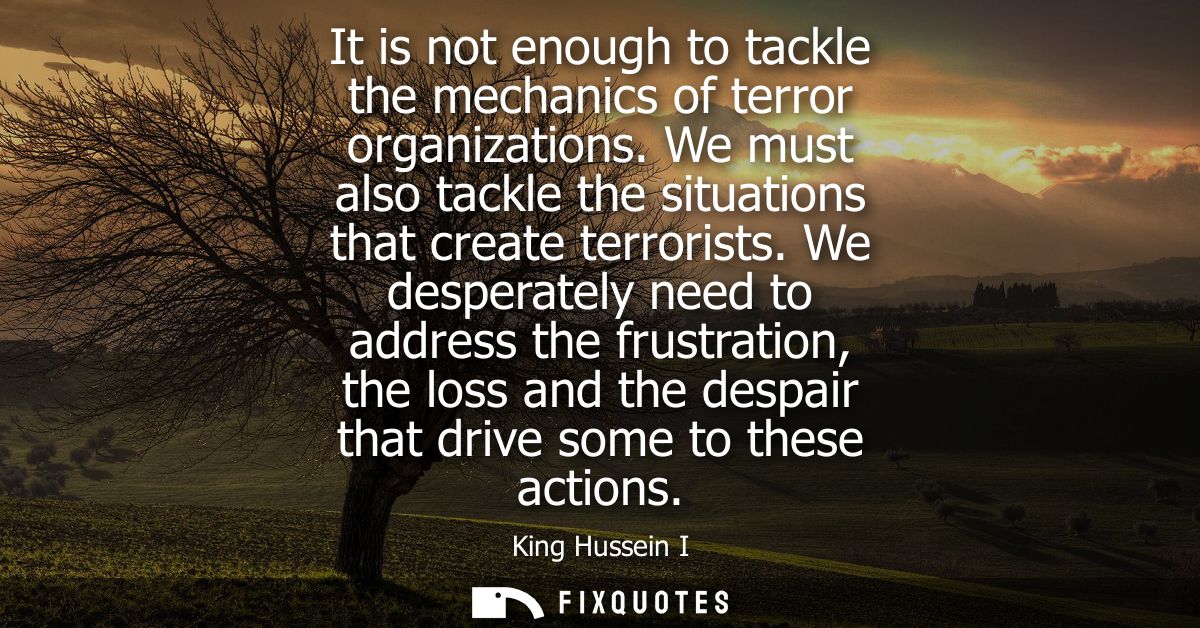
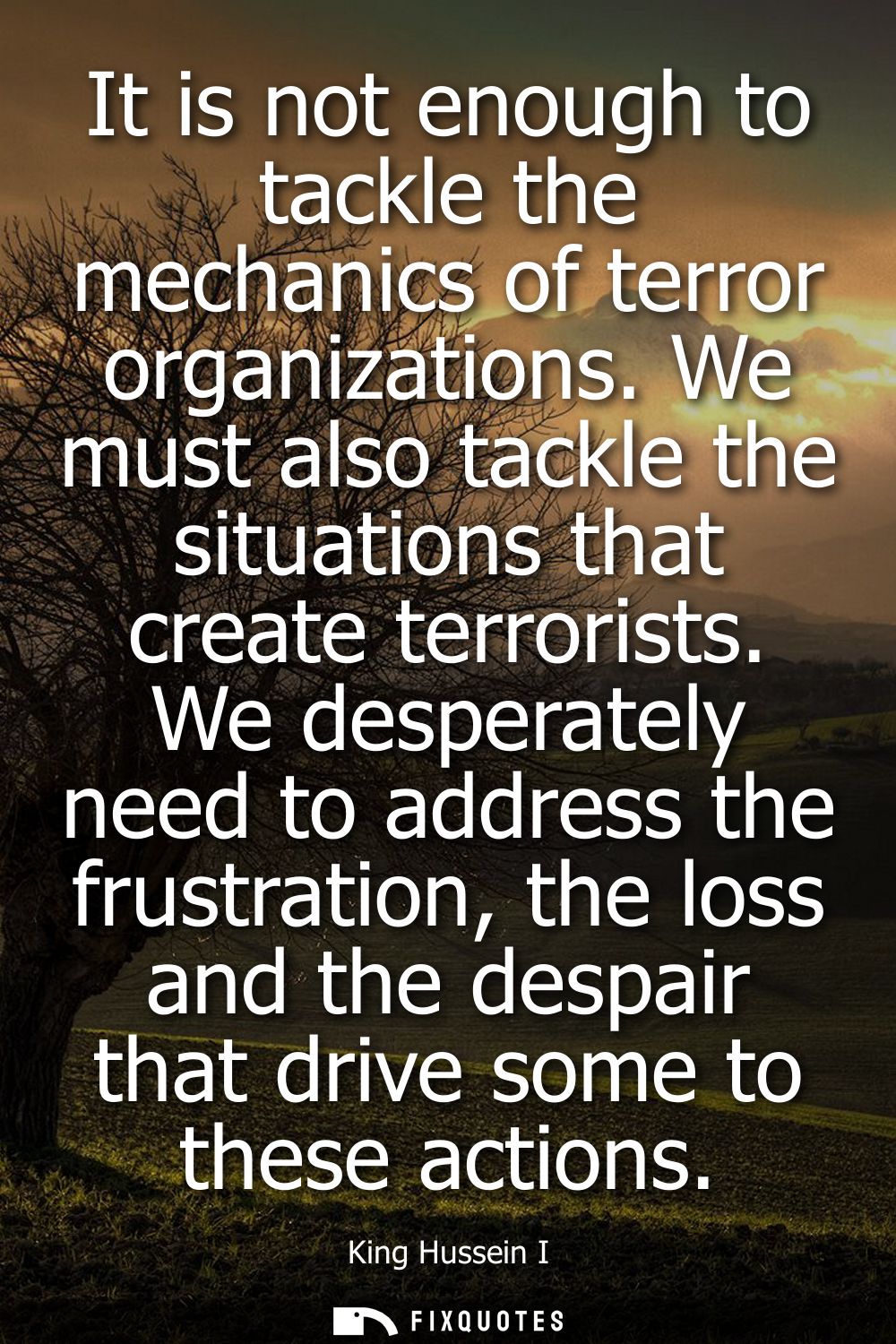
"It is not enough to tackle the mechanics of terror organizations. We must also tackle the situations that create terrorists. We desperately need to address the frustration, the loss and the despair that drive some to these actions"
About this Quote
As a regional monarch who spent decades threading alliances between the West, Israel, and Arab public opinion, Hussein is also writing between the lines. This is not soft sympathy for militants; it's a warning to policymakers who want terrorism to be an external infection rather than a predictable outcome of certain conditions. "We must also tackle" shifts responsibility from villains to systems, a subtle rebuke to the habit of treating terror as pure ideology divorced from lived experience.
The triad "frustration, the loss and the despair" is rhetorical ballast. It humanizes without absolving, framing radicalization as an emotional economy: when legitimate paths to dignity collapse, some people will buy meaning in the most destructive marketplace available. The adverb "desperately" reveals urgency and, implicitly, pessimism about cycles of retaliation. Hussein is arguing for prevention as strategy, not charity - because ignoring the upstream causes guarantees you're stuck forever chasing the downstream violence.
Quote Details
| Topic | Peace |
|---|---|
| Source | Help us find the source |
| Cite |
Citation Formats
APA Style (7th ed.)
I, King Hussein. (2026, January 15). It is not enough to tackle the mechanics of terror organizations. We must also tackle the situations that create terrorists. We desperately need to address the frustration, the loss and the despair that drive some to these actions. FixQuotes. https://fixquotes.com/quotes/it-is-not-enough-to-tackle-the-mechanics-of-156515/
Chicago Style
I, King Hussein. "It is not enough to tackle the mechanics of terror organizations. We must also tackle the situations that create terrorists. We desperately need to address the frustration, the loss and the despair that drive some to these actions." FixQuotes. January 15, 2026. https://fixquotes.com/quotes/it-is-not-enough-to-tackle-the-mechanics-of-156515/.
MLA Style (9th ed.)
"It is not enough to tackle the mechanics of terror organizations. We must also tackle the situations that create terrorists. We desperately need to address the frustration, the loss and the despair that drive some to these actions." FixQuotes, 15 Jan. 2026, https://fixquotes.com/quotes/it-is-not-enough-to-tackle-the-mechanics-of-156515/. Accessed 18 Feb. 2026.