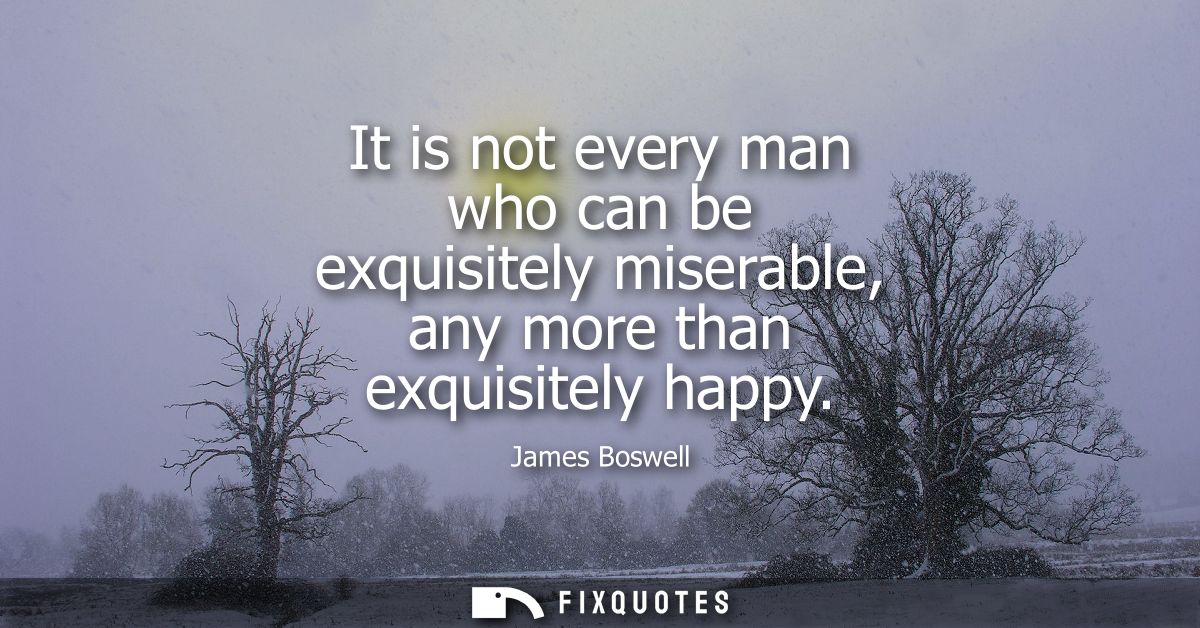
"It is not every man who can be exquisitely miserable, any more than exquisitely happy"
About this Quote
Boswell knew this terrain intimately. As Samuel Johnson's great biographer - and as a man prone to guilt, anxiety, and cycles of indulgence and remorse - he lived in a culture where "feeling deeply" was social currency. Eighteenth-century Britain was learning to prize sentiment, to treat emotional nuance as evidence of moral seriousness and intellectual depth. In that context, "exquisite" works like a sly social marker: not everyone has the emotional range (or leisure) to suffer in such a textured way.
The subtext is both confession and critique. Boswell is admitting how seductive refined unhappiness can be: misery becomes another arena for performance, for private theater, for the ego to keep busy even when life is going badly. At the same time, he implies an uncomfortable hierarchy - that some people's sadness is blunt and utilitarian, while others can turn it into something almost aesthetic. It's a chilly, self-aware reminder that sophistication doesn't just decorate our pleasures; it can also sharpen our pain.
Quote Details
| Topic | Happiness |
|---|---|
| Source | Help us find the source |
| Cite |
Citation Formats
APA Style (7th ed.)
Boswell, James. (2026, January 17). It is not every man who can be exquisitely miserable, any more than exquisitely happy. FixQuotes. https://fixquotes.com/quotes/it-is-not-every-man-who-can-be-exquisitely-56435/
Chicago Style
Boswell, James. "It is not every man who can be exquisitely miserable, any more than exquisitely happy." FixQuotes. January 17, 2026. https://fixquotes.com/quotes/it-is-not-every-man-who-can-be-exquisitely-56435/.
MLA Style (9th ed.)
"It is not every man who can be exquisitely miserable, any more than exquisitely happy." FixQuotes, 17 Jan. 2026, https://fixquotes.com/quotes/it-is-not-every-man-who-can-be-exquisitely-56435/. Accessed 3 Apr. 2026.