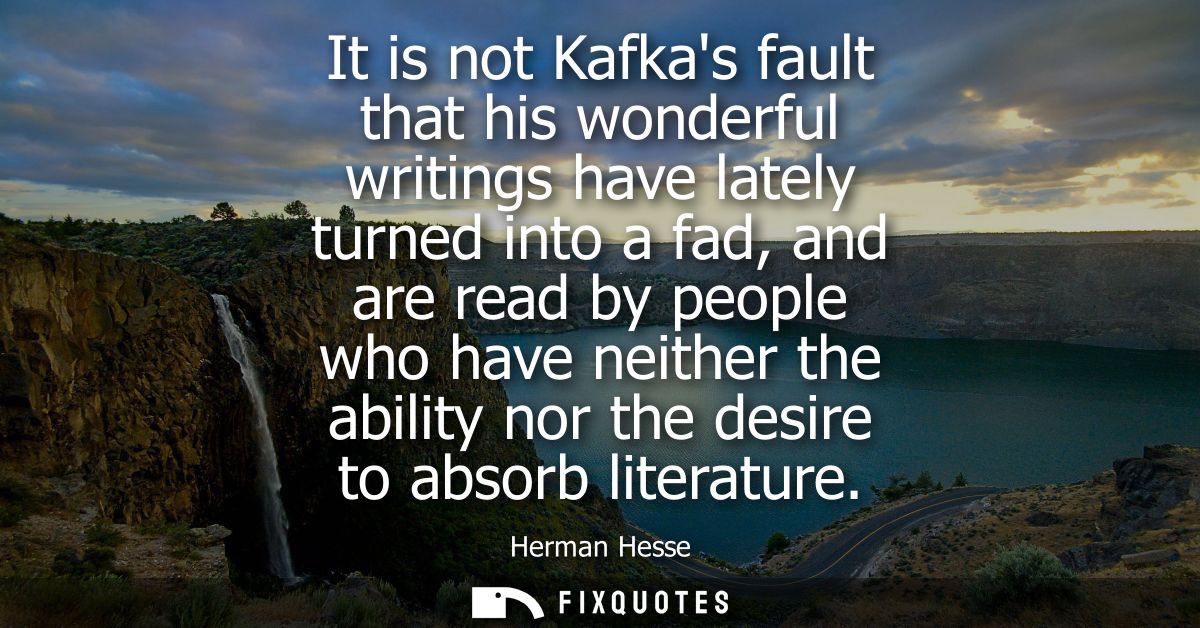
"It is not Kafka's fault that his wonderful writings have lately turned into a fad, and are read by people who have neither the ability nor the desire to absorb literature"
About this Quote
The word “fad” is the tell. Hesse isn’t only annoyed that Kafka is popular; he’s diagnosing a modern pattern where difficulty becomes a status object. Kafka’s work is famously resistant to quick consumption - it thrives on dread, ambiguity, and a kind of moral vertigo. Calling it a fad implies that the very thing worth reading Kafka for is exactly what fad-reading avoids: sustained attention, discomfort, and interpretation without the comfort of tidy answers.
Then comes the double charge: “neither the ability nor the desire.” Hesse splits the problem into competence and will, suggesting the deeper offense isn’t ignorance but indifference - a refusal to meet art halfway. That’s also self-protection. As an author who watched European culture turn anxious, mechanized, and trend-driven between wars, Hesse is defending literature as a practice, not a product. The subtext is elitist, yes, but also anxious: if even Kafka can be reduced to a craze, what chance does any serious writing have of surviving mass taste without being hollowed out?
Quote Details
| Topic | Writing |
|---|---|
| Source | Help us find the source |
| Cite |
Citation Formats
APA Style (7th ed.)
Hesse, Herman. (2026, January 17). It is not Kafka's fault that his wonderful writings have lately turned into a fad, and are read by people who have neither the ability nor the desire to absorb literature. FixQuotes. https://fixquotes.com/quotes/it-is-not-kafkas-fault-that-his-wonderful-43743/
Chicago Style
Hesse, Herman. "It is not Kafka's fault that his wonderful writings have lately turned into a fad, and are read by people who have neither the ability nor the desire to absorb literature." FixQuotes. January 17, 2026. https://fixquotes.com/quotes/it-is-not-kafkas-fault-that-his-wonderful-43743/.
MLA Style (9th ed.)
"It is not Kafka's fault that his wonderful writings have lately turned into a fad, and are read by people who have neither the ability nor the desire to absorb literature." FixQuotes, 17 Jan. 2026, https://fixquotes.com/quotes/it-is-not-kafkas-fault-that-his-wonderful-43743/. Accessed 11 Mar. 2026.