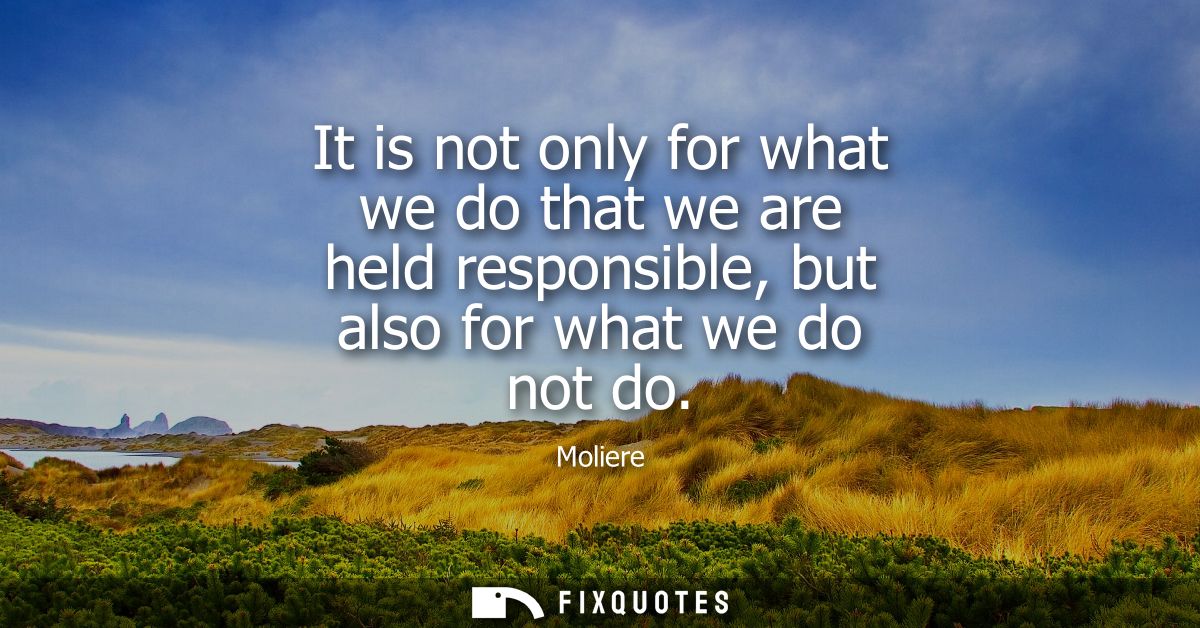
"It is not only for what we do that we are held responsible, but also for what we do not do"
About this Quote
Moliere’s line is a trapdoor disguised as a moral truism: you step onto what sounds like common sense and suddenly you’re falling into indictment. The phrasing widens the courtroom. Responsibility isn’t limited to the flashy sins that make good stories; it includes the quiet, curated absences that are easier to deny. Not doing becomes doing by other means.
As a comic playwright, Moliere understood that vice rarely announces itself with a villain’s cape. It hides in manners, in etiquette, in strategic silence. The quote’s bite comes from its double accounting: action is measurable, omission is plausible. People can narrate their inaction as prudence, neutrality, or good taste. Moliere yanks that cover off. He’s also poking at a society where reputation is managed like theater - where the elite perfect the art of appearing innocent by appearing inactive. If you’re absent at the moment someone needs you, you can still claim clean hands. Moliere’s point is that clean hands can be another kind of dirt.
The subtext is less about private conscience than public complicity. Omission is how institutions keep running while everyone insists they personally never struck the blow. It’s a line that anticipates modern moral evasions: “I didn’t say anything,” “I stayed out of it,” “That’s not my department.” In Moliere’s world - courtly, hierarchical, obsessed with decorum - refusing to act can be the most socially acceptable form of cruelty.
As a comic playwright, Moliere understood that vice rarely announces itself with a villain’s cape. It hides in manners, in etiquette, in strategic silence. The quote’s bite comes from its double accounting: action is measurable, omission is plausible. People can narrate their inaction as prudence, neutrality, or good taste. Moliere yanks that cover off. He’s also poking at a society where reputation is managed like theater - where the elite perfect the art of appearing innocent by appearing inactive. If you’re absent at the moment someone needs you, you can still claim clean hands. Moliere’s point is that clean hands can be another kind of dirt.
The subtext is less about private conscience than public complicity. Omission is how institutions keep running while everyone insists they personally never struck the blow. It’s a line that anticipates modern moral evasions: “I didn’t say anything,” “I stayed out of it,” “That’s not my department.” In Moliere’s world - courtly, hierarchical, obsessed with decorum - refusing to act can be the most socially acceptable form of cruelty.
Quote Details
| Topic | Ethics & Morality |
|---|
More Quotes by Moliere
Add to List