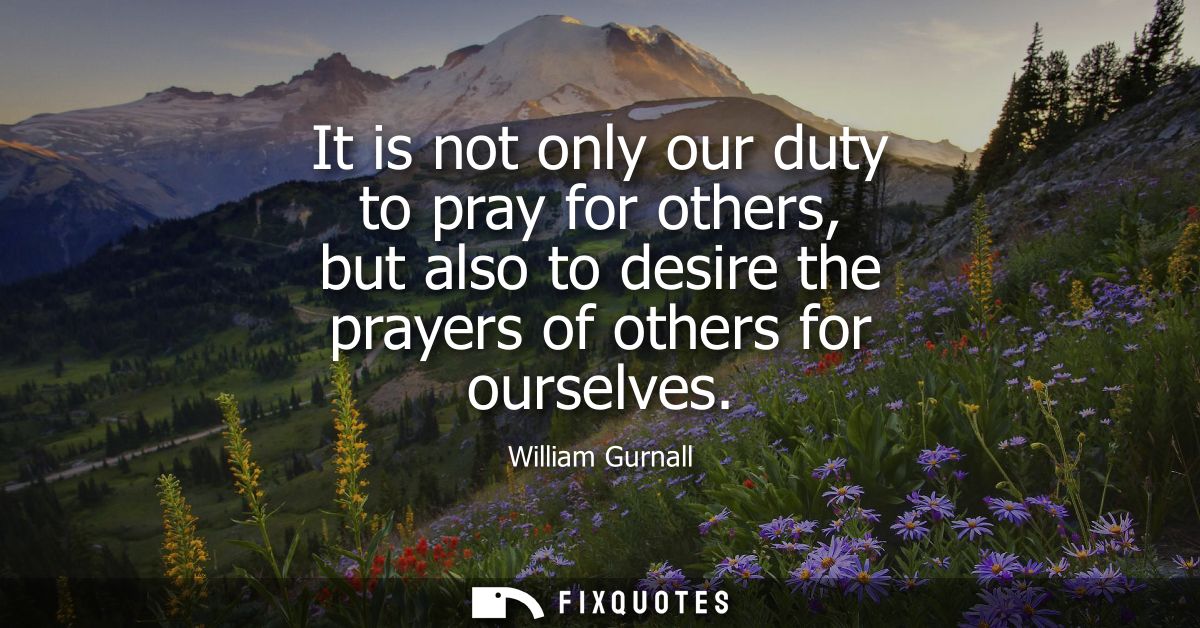
"It is not only our duty to pray for others, but also to desire the prayers of others for ourselves"
About this Quote
Prayer, in Gurnall's hands, is less a private hotline to heaven than a social technology for humility. The line pivots on a quiet correction: it is "not only" our duty to intercede, but to "desire" being interceded for. That second clause matters because it turns prayer from moral performance into admitted need. You can pray for others and still keep your ego intact; asking for their prayers breaks the seal on self-sufficiency.
Gurnall was a 17th-century English Puritan preacher best known for The Christian in Complete Armour, a manual for spiritual warfare shaped by civil conflict, doctrinal battles, and a culture that treated the soul as a contested battlefield. In that world, pride isn't a personality quirk; it's a tactical vulnerability. To want others praying for you is to confess you're not spiritually self-contained, that temptation and despair aren't solved by grit. The verb "desire" is pointed: not tolerate, not accept when offered, but actively want it. He's training a reflex of dependence that runs against the lone-believer instinct.
There's also a subtle political theology here. Prayer becomes a binding agent for the community: you are responsible for others, and you allow others to be responsible for you. That reciprocity checks the authoritarian impulse of the "strong" saint and the isolation of the struggling one. The sentence works because it smuggles a radical egalitarianism into a pious duty: everyone needs help, and everyone gets to give it.
Gurnall was a 17th-century English Puritan preacher best known for The Christian in Complete Armour, a manual for spiritual warfare shaped by civil conflict, doctrinal battles, and a culture that treated the soul as a contested battlefield. In that world, pride isn't a personality quirk; it's a tactical vulnerability. To want others praying for you is to confess you're not spiritually self-contained, that temptation and despair aren't solved by grit. The verb "desire" is pointed: not tolerate, not accept when offered, but actively want it. He's training a reflex of dependence that runs against the lone-believer instinct.
There's also a subtle political theology here. Prayer becomes a binding agent for the community: you are responsible for others, and you allow others to be responsible for you. That reciprocity checks the authoritarian impulse of the "strong" saint and the isolation of the struggling one. The sentence works because it smuggles a radical egalitarianism into a pious duty: everyone needs help, and everyone gets to give it.
Quote Details
| Topic | Prayer |
|---|
More Quotes by William
Add to List