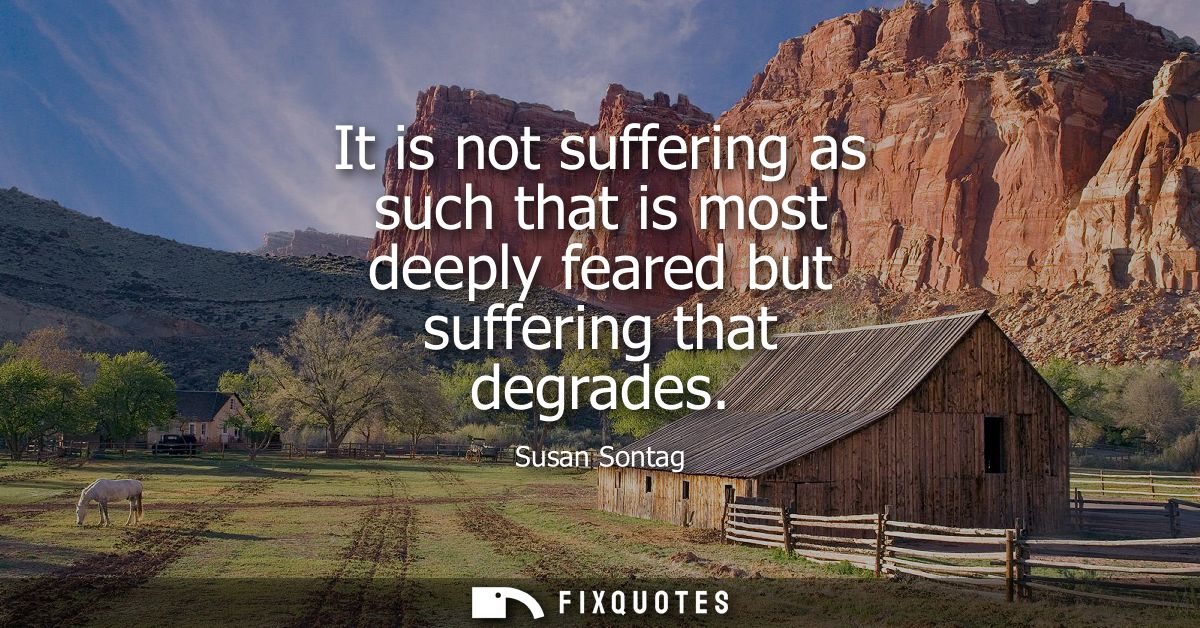
"It is not suffering as such that is most deeply feared but suffering that degrades"
About this Quote
The sentence works because it refuses the moral glow that often clings to hardship narratives. Modern culture sells “resilience” as a personal brand, implying that suffering can be converted into meaning if you manage it correctly. Sontag punctures that optimism. Some suffering doesn’t edify; it diminishes. It strips agency, privatizes shame, and rearranges the hierarchy between the one who hurts and the one who watches.
Context matters: Sontag’s career circles the ethics of looking, especially at pain - war photography, illness metaphors, the politics of empathy. She’s attentive to how institutions and audiences translate pain into instruction or entertainment. Degrading suffering is not just physical torment; it’s the kind tied to power: poverty that forces indignities, sickness treated as moral failure, violence that makes victims feel complicit in their own violation.
The subtext is almost a reprimand to the comfortable observer: if your compassion stops at “suffering is sad,” you’ve missed the sharper question of what kinds of suffering are designed to unmake a person.
Quote Details
| Topic | Fear |
|---|---|
| Source | Help us find the source |
| Cite |
Citation Formats
APA Style (7th ed.)
Sontag, Susan. (2026, January 16). It is not suffering as such that is most deeply feared but suffering that degrades. FixQuotes. https://fixquotes.com/quotes/it-is-not-suffering-as-such-that-is-most-deeply-91127/
Chicago Style
Sontag, Susan. "It is not suffering as such that is most deeply feared but suffering that degrades." FixQuotes. January 16, 2026. https://fixquotes.com/quotes/it-is-not-suffering-as-such-that-is-most-deeply-91127/.
MLA Style (9th ed.)
"It is not suffering as such that is most deeply feared but suffering that degrades." FixQuotes, 16 Jan. 2026, https://fixquotes.com/quotes/it-is-not-suffering-as-such-that-is-most-deeply-91127/. Accessed 9 Feb. 2026.