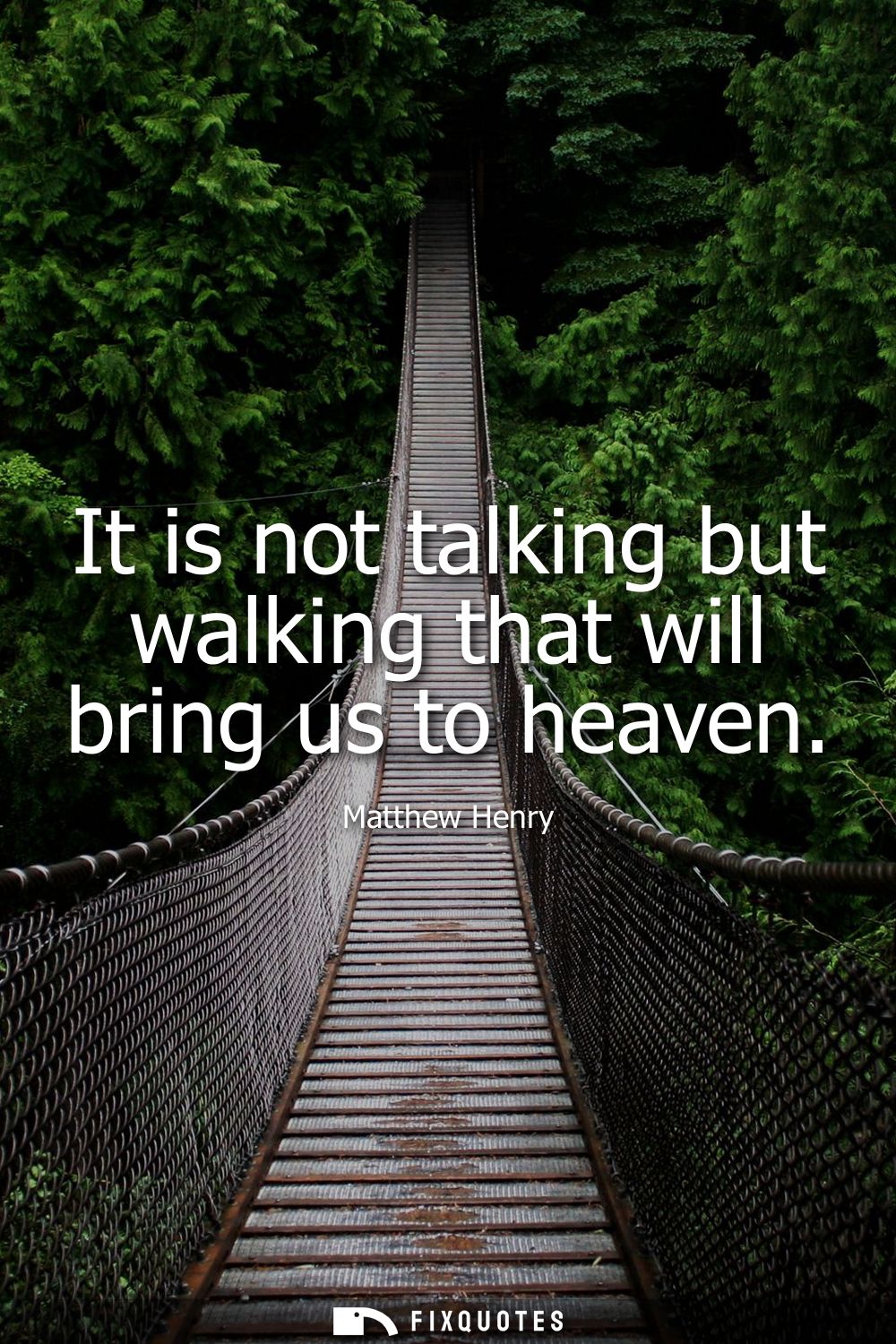
"It is not talking but walking that will bring us to heaven"
About this Quote
Heaven, in Matthew Henry's telling, is not won by eloquence but by evidence. The line lands like a rebuke to the most reliable form of religious self-deception: mistaking fluent profession for lived obedience. Henry, a prominent English Nonconformist minister writing in a culture where sermons were entertainment, argument, and identity badge, aims straight at the pious talker who can parse doctrine for hours yet keeps their habits intact.
The craftsmanship is in the blunt physicality of “walking.” Talking is cheap, weightless, endlessly repeatable; walking costs time, exposes you to weather, demands direction. Henry smuggles an ethic into a metaphor: faith is a practiced route, not a debated concept. The phrase also carries a communal sting. “Us” implicates preacher and listener alike, refusing the safe distance of moralizing. He’s not diagnosing “them,” he’s warning a whole congregation about how easily words become camouflage.
The subtext is a critique of performative religion before the term existed. In Henry’s Protestant milieu, where salvation was fiercely discussed, he shifts attention from verbal correctness to moral traction. You can hear the implicit argument with his age’s religious controversies: orthodoxy matters, but it doesn’t substitute for integrity.
“It is not talking but walking” also works as a miniature sermon structure: contrast, cadence, destination. Heaven is the horizon line, but the real target is Monday morning. The quote doesn’t flatter belief; it pressures it into shape.
The craftsmanship is in the blunt physicality of “walking.” Talking is cheap, weightless, endlessly repeatable; walking costs time, exposes you to weather, demands direction. Henry smuggles an ethic into a metaphor: faith is a practiced route, not a debated concept. The phrase also carries a communal sting. “Us” implicates preacher and listener alike, refusing the safe distance of moralizing. He’s not diagnosing “them,” he’s warning a whole congregation about how easily words become camouflage.
The subtext is a critique of performative religion before the term existed. In Henry’s Protestant milieu, where salvation was fiercely discussed, he shifts attention from verbal correctness to moral traction. You can hear the implicit argument with his age’s religious controversies: orthodoxy matters, but it doesn’t substitute for integrity.
“It is not talking but walking” also works as a miniature sermon structure: contrast, cadence, destination. Heaven is the horizon line, but the real target is Monday morning. The quote doesn’t flatter belief; it pressures it into shape.
Quote Details
| Topic | Faith |
|---|
More Quotes by Matthew
Add to List