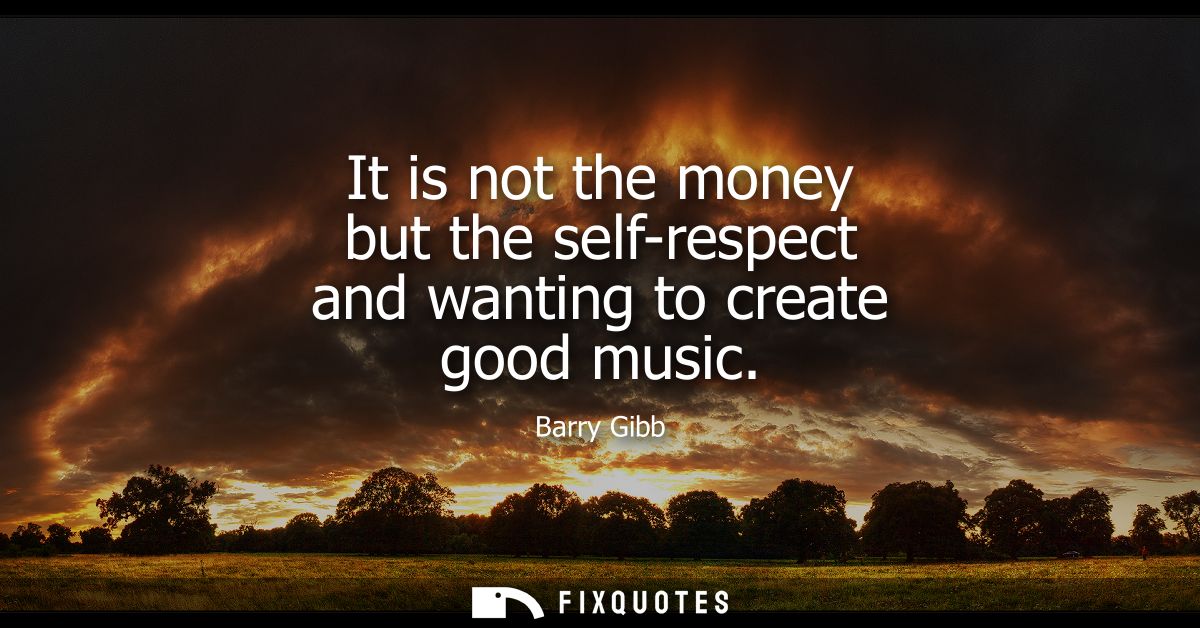
"It is not the money, but the self-respect and wanting to create good music"
About this Quote
The phrasing matters. “Not the money but” is a classic counterweight, but he doesn’t replace cash with vague purity. He replaces it with two concrete drives: dignity and craft. “Wanting to create good music” sounds almost plainspoken, which is the point. In pop, “good” is often treated as unserious compared to “important,” yet Gibb’s career is proof that meticulous, emotionally legible songwriting can be both mass and meaningful. The subtext is anti-cynicism: quality isn’t a marketing story; it’s a discipline.
Contextually, this is also a late-career value statement from someone who’s seen fame’s volatility: the Bee Gees’ meteoric disco-era dominance, the backlash that followed, the long slog of reinvention. Self-respect becomes a survival strategy. When trends turn, when audiences get fickle, when streaming flattens payouts into fractions, the only stable motivation left is the one that can’t be taken away: the insistence that the work should still be good, even when nobody’s paying attention.
Quote Details
| Topic | Music |
|---|---|
| Source | Help us find the source |
| Cite |
Citation Formats
APA Style (7th ed.)
Gibb, Barry. (2026, February 16). It is not the money, but the self-respect and wanting to create good music. FixQuotes. https://fixquotes.com/quotes/it-is-not-the-money-but-the-self-respect-and-139103/
Chicago Style
Gibb, Barry. "It is not the money, but the self-respect and wanting to create good music." FixQuotes. February 16, 2026. https://fixquotes.com/quotes/it-is-not-the-money-but-the-self-respect-and-139103/.
MLA Style (9th ed.)
"It is not the money, but the self-respect and wanting to create good music." FixQuotes, 16 Feb. 2026, https://fixquotes.com/quotes/it-is-not-the-money-but-the-self-respect-and-139103/. Accessed 2 Apr. 2026.