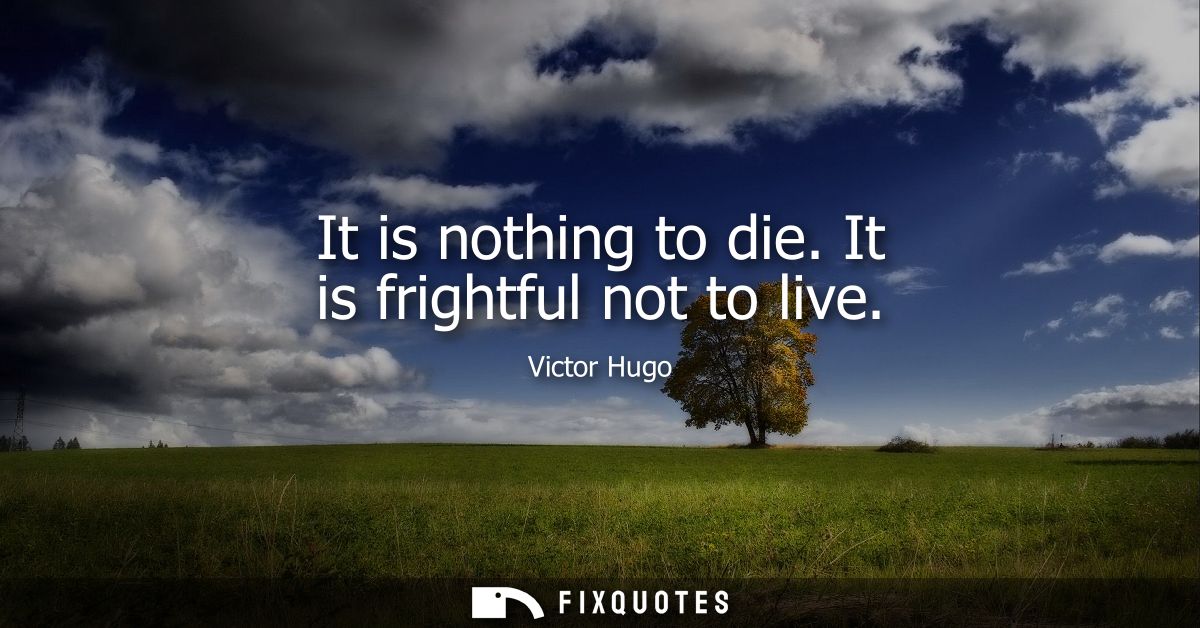
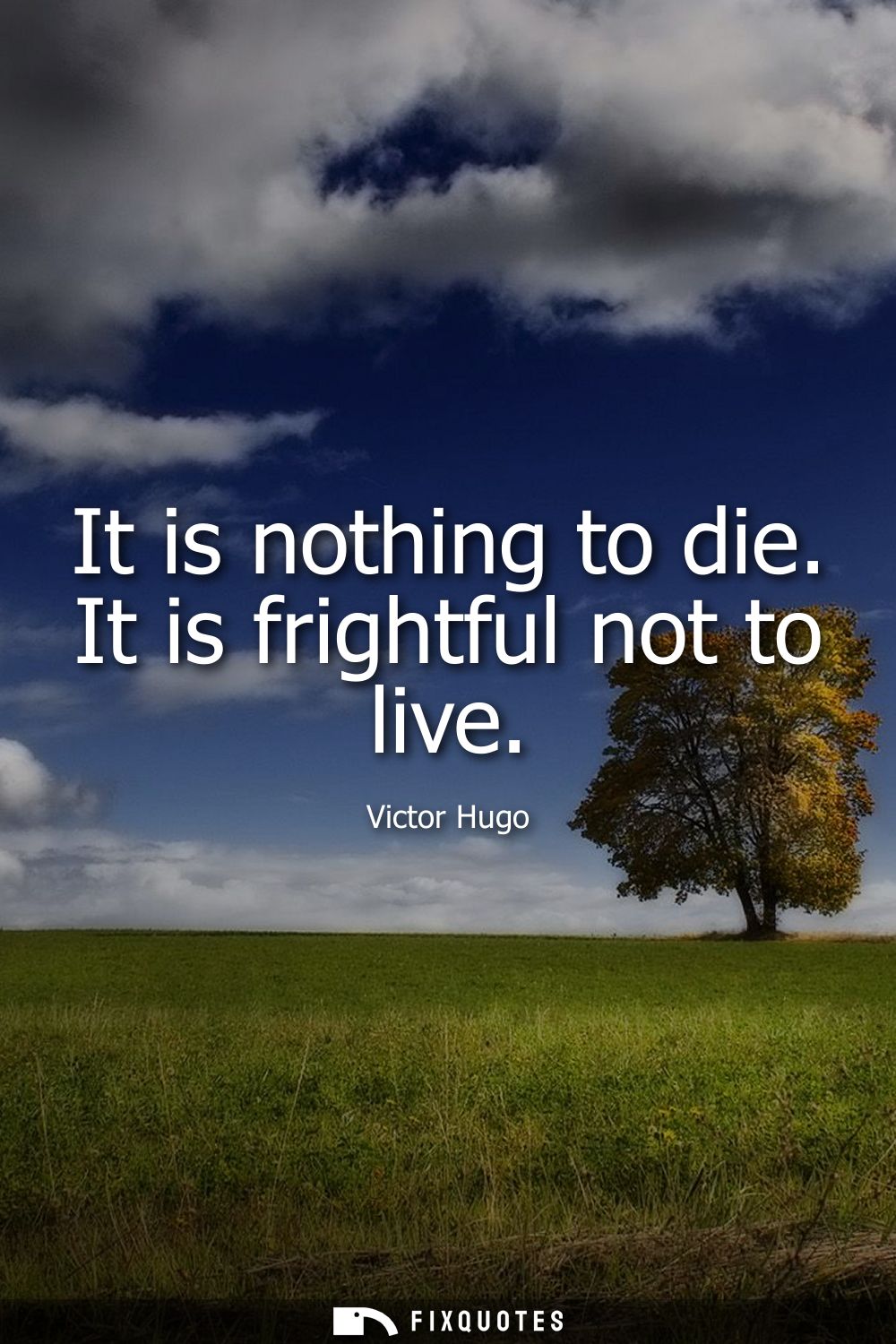
"It is nothing to die. It is frightful not to live"
About this Quote
Hugo lands the punch by flipping the usual terror: death isn’t the catastrophe; a life unlived is. The line works because it treats mortality as a clean fact and redirects dread toward something messier and more indicting: our capacity to waste our days while still breathing. “It is nothing” isn’t sentimental bravery. It’s a cold accounting move, stripping death of its melodrama so he can accuse the living of a quieter failure.
The subtext is moral, almost prosecutorial. Not to live doesn’t mean not to exist; it means refusing the obligations of being human: to love, to choose, to act, to risk. Hugo’s France is a useful backdrop here. He writes in the shadow of revolutions, coups, exile, and state violence - a world where people routinely die for politics, poverty, and principle. In that setting, to treat death as “nothing” can read as defiance against regimes that govern through fear. If power threatens you with the worst thing imaginable, Hugo’s response is: you’ve picked the wrong nightmare.
The sentence structure is part of the rhetoric. Two short clauses, balanced like a verdict, with “frightful” doing the heavy lifting: a word that belongs to the gut, not the lecture hall. Hugo isn’t romanticizing recklessness; he’s warning against a social and personal anesthesia - the respectable half-life of caution, conformity, and deferred courage. Death ends you once. Not living can be a daily practice.
The subtext is moral, almost prosecutorial. Not to live doesn’t mean not to exist; it means refusing the obligations of being human: to love, to choose, to act, to risk. Hugo’s France is a useful backdrop here. He writes in the shadow of revolutions, coups, exile, and state violence - a world where people routinely die for politics, poverty, and principle. In that setting, to treat death as “nothing” can read as defiance against regimes that govern through fear. If power threatens you with the worst thing imaginable, Hugo’s response is: you’ve picked the wrong nightmare.
The sentence structure is part of the rhetoric. Two short clauses, balanced like a verdict, with “frightful” doing the heavy lifting: a word that belongs to the gut, not the lecture hall. Hugo isn’t romanticizing recklessness; he’s warning against a social and personal anesthesia - the respectable half-life of caution, conformity, and deferred courage. Death ends you once. Not living can be a daily practice.
Quote Details
| Topic | Live in the Moment |
|---|---|
| Source | Help us find the source |
| Cite |
Citation Formats
APA Style (7th ed.)
Hugo, Victor. (2026, January 18). It is nothing to die. It is frightful not to live. FixQuotes. https://fixquotes.com/quotes/it-is-nothing-to-die-it-is-frightful-not-to-live-15981/
Chicago Style
Hugo, Victor. "It is nothing to die. It is frightful not to live." FixQuotes. January 18, 2026. https://fixquotes.com/quotes/it-is-nothing-to-die-it-is-frightful-not-to-live-15981/.
MLA Style (9th ed.)
"It is nothing to die. It is frightful not to live." FixQuotes, 18 Jan. 2026, https://fixquotes.com/quotes/it-is-nothing-to-die-it-is-frightful-not-to-live-15981/. Accessed 30 Mar. 2026.
More Quotes by Victor
Add to List