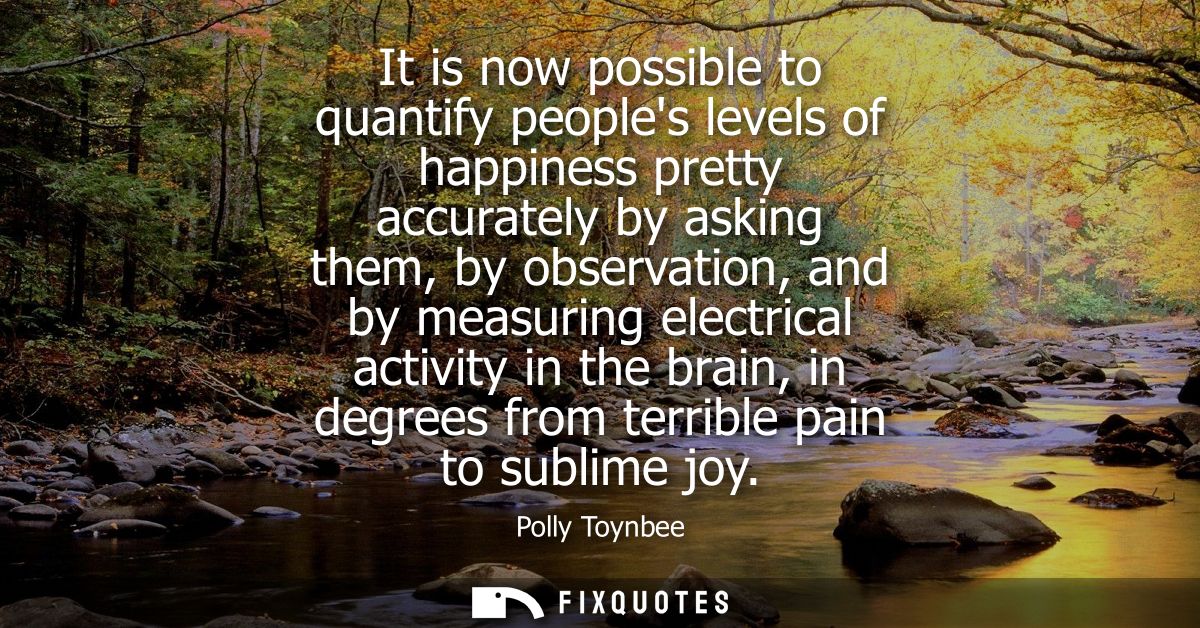
"It is now possible to quantify people's levels of happiness pretty accurately by asking them, by observation, and by measuring electrical activity in the brain, in degrees from terrible pain to sublime joy"
About this Quote
The rhetorical trick is the staircase of evidence. She starts with the oldest metric (self-report), adds the social gaze (observation), then lands on the most intimidating one (brain signals). That sequence isn’t just about accuracy; it’s about forcing legitimacy. Once you invoke neurons, the argument shifts from “people feel” to “facts exist.” “In degrees from terrible pain to sublime joy” widens the frame further, implying a continuous spectrum that can be tracked like inflation or unemployment.
Contextually, this fits a long-running UK argument Toynbee often circles: what should public policy optimize? GDP flatters markets; happiness flatters human lives. But the quote also carries a warning. Quantification doesn’t merely reveal happiness; it disciplines it. If institutions can measure your joy, they can set targets for it, market to it, medicalize it, and punish deviations from the approved baseline. Toynbee’s intent is both reformist and wary: measure well-being so it matters, but recognize that measurement is never innocent.
Quote Details
| Topic | Happiness |
|---|---|
| Source | Help us find the source |
| Cite |
Citation Formats
APA Style (7th ed.)
Toynbee, Polly. (2026, January 15). It is now possible to quantify people's levels of happiness pretty accurately by asking them, by observation, and by measuring electrical activity in the brain, in degrees from terrible pain to sublime joy. FixQuotes. https://fixquotes.com/quotes/it-is-now-possible-to-quantify-peoples-levels-of-163726/
Chicago Style
Toynbee, Polly. "It is now possible to quantify people's levels of happiness pretty accurately by asking them, by observation, and by measuring electrical activity in the brain, in degrees from terrible pain to sublime joy." FixQuotes. January 15, 2026. https://fixquotes.com/quotes/it-is-now-possible-to-quantify-peoples-levels-of-163726/.
MLA Style (9th ed.)
"It is now possible to quantify people's levels of happiness pretty accurately by asking them, by observation, and by measuring electrical activity in the brain, in degrees from terrible pain to sublime joy." FixQuotes, 15 Jan. 2026, https://fixquotes.com/quotes/it-is-now-possible-to-quantify-peoples-levels-of-163726/. Accessed 30 Mar. 2026.