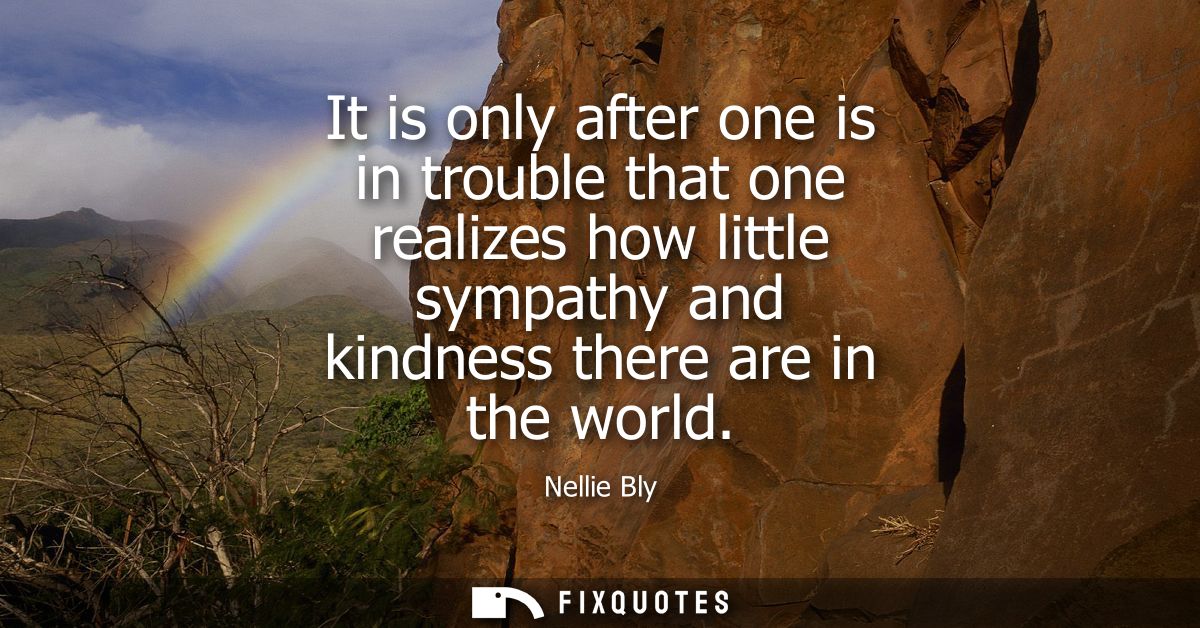
"It is only after one is in trouble that one realizes how little sympathy and kindness there are in the world"
About this Quote
Trouble, in Bly's formulation, is a brutal illumination: it turns the world into a ledger of who shows up and who keeps walking. The line is engineered to sting because it flips the comforting assumption that hardship automatically summons community. Instead, it suggests that solidarity is mostly a story we tell ourselves until we need it.
As a journalist who made a career out of entering other people's emergencies - exposing asylum abuse, documenting factory labor, reporting from the margins - Bly isn't offering a private lament. She's describing a social mechanism. Sympathy is often performative when the stakes are low: it's easy to praise resilience from a safe distance, easy to admire suffering as a moral fable. Actual trouble is messy, inconvenient, contagious. It asks for time, money, and risk. That is when the culture's supposed kindness reveals its price tag.
The sentence also carries a gendered, class-aware bite. For women and the poor in Bly's America, "trouble" could mean scandal, illness, poverty, institutionalization - conditions that didn't just invite neglect but actively produced shame. The subtext is that empathy is rationed along lines of respectability. If your misfortune can be blamed on you, society feels licensed to withdraw.
Bly's intent isn't nihilism; it's exposure. By making the realization arrive "only after" trouble, she indicts the comfortable for mistaking a polite society for a compassionate one, and challenges readers to practice a kind of care that doesn't wait for proximity or proof.
As a journalist who made a career out of entering other people's emergencies - exposing asylum abuse, documenting factory labor, reporting from the margins - Bly isn't offering a private lament. She's describing a social mechanism. Sympathy is often performative when the stakes are low: it's easy to praise resilience from a safe distance, easy to admire suffering as a moral fable. Actual trouble is messy, inconvenient, contagious. It asks for time, money, and risk. That is when the culture's supposed kindness reveals its price tag.
The sentence also carries a gendered, class-aware bite. For women and the poor in Bly's America, "trouble" could mean scandal, illness, poverty, institutionalization - conditions that didn't just invite neglect but actively produced shame. The subtext is that empathy is rationed along lines of respectability. If your misfortune can be blamed on you, society feels licensed to withdraw.
Bly's intent isn't nihilism; it's exposure. By making the realization arrive "only after" trouble, she indicts the comfortable for mistaking a polite society for a compassionate one, and challenges readers to practice a kind of care that doesn't wait for proximity or proof.
Quote Details
| Topic | Kindness |
|---|
More Quotes by Nellie
Add to List