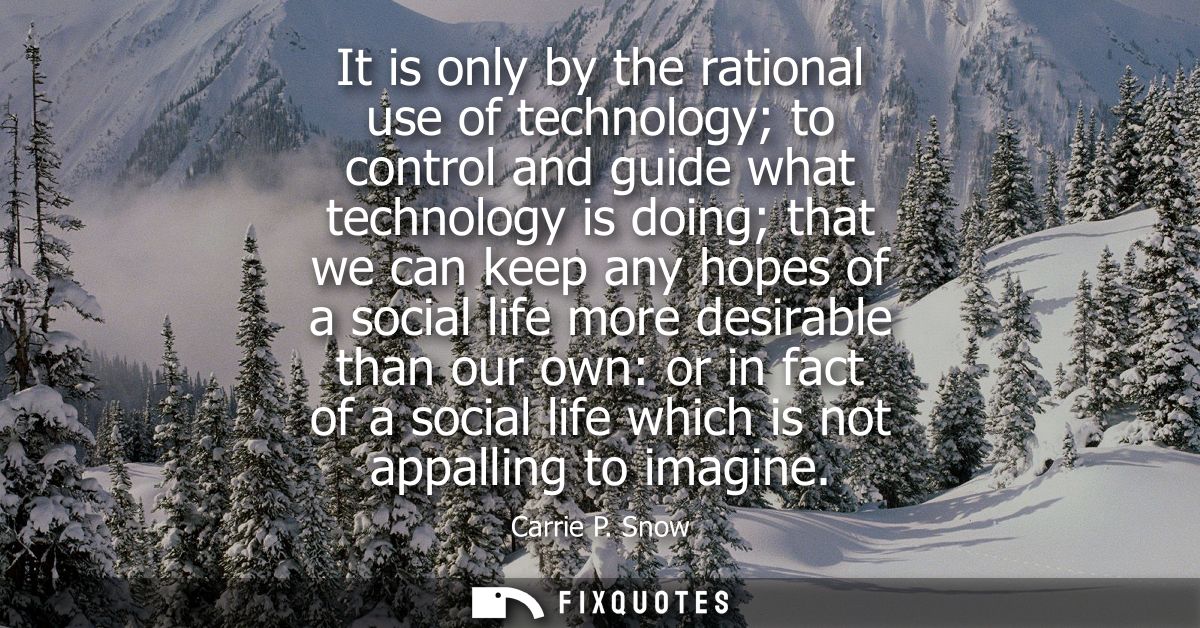
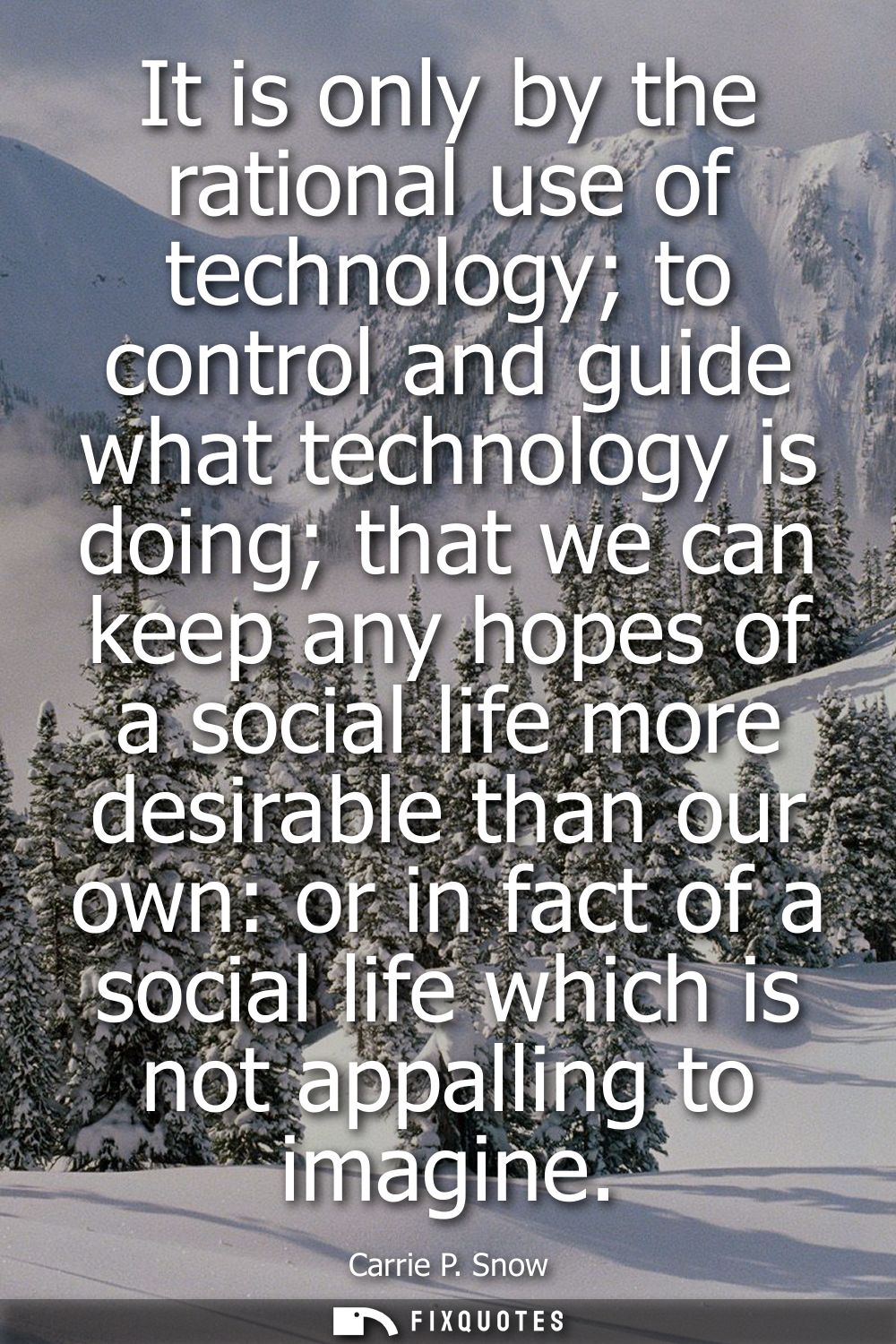
"It is only by the rational use of technology; to control and guide what technology is doing; that we can keep any hopes of a social life more desirable than our own: or in fact of a social life which is not appalling to imagine"
About this Quote
Snow’s sentence reads like a warning delivered in a calm voice precisely because panic has become useless. The structure does the work: “only by” slams the door on easy alternatives, and the doubled insistence on “control and guide” suggests she isn’t dazzled by technology’s self-mythology of inevitability. Tech, in her framing, is not a neutral river we float down; it’s a force with momentum, and momentum without governance becomes a kind of soft tyranny.
The phrase “rational use” is doing quiet ideological combat. It rejects both techno-utopian faith (progress will save us) and techno-phobic nostalgia (ditch the machines, return to purity). Rationality here isn’t coldness; it’s civic discipline. Snow is arguing for collective agency: a society that treats tools as tools, not as masters or idols.
Then she sharpens the blade with “keep any hopes.” Hope is reduced to a fragile commodity, something that must be protected from the very systems built to improve life. The most biting move is the comparative: “a social life more desirable than our own.” She assumes we already live in a tech-shaped present that may be falling short, and she asks for something more than maintenance. If we don’t intervene, she implies, the best-case scenario is stagnation; the realistic one is “appalling to imagine.”
Contextually, this belongs to a tradition of 20th-century technological anxiety that’s less about gadgets than governance: who decides, who profits, who bears the consequences. The intent isn’t to scold individuals for screen time; it’s to demand that modernity come with a steering wheel.
The phrase “rational use” is doing quiet ideological combat. It rejects both techno-utopian faith (progress will save us) and techno-phobic nostalgia (ditch the machines, return to purity). Rationality here isn’t coldness; it’s civic discipline. Snow is arguing for collective agency: a society that treats tools as tools, not as masters or idols.
Then she sharpens the blade with “keep any hopes.” Hope is reduced to a fragile commodity, something that must be protected from the very systems built to improve life. The most biting move is the comparative: “a social life more desirable than our own.” She assumes we already live in a tech-shaped present that may be falling short, and she asks for something more than maintenance. If we don’t intervene, she implies, the best-case scenario is stagnation; the realistic one is “appalling to imagine.”
Contextually, this belongs to a tradition of 20th-century technological anxiety that’s less about gadgets than governance: who decides, who profits, who bears the consequences. The intent isn’t to scold individuals for screen time; it’s to demand that modernity come with a steering wheel.
Quote Details
| Topic | Technology |
|---|
More Quotes by Carrie
Add to List