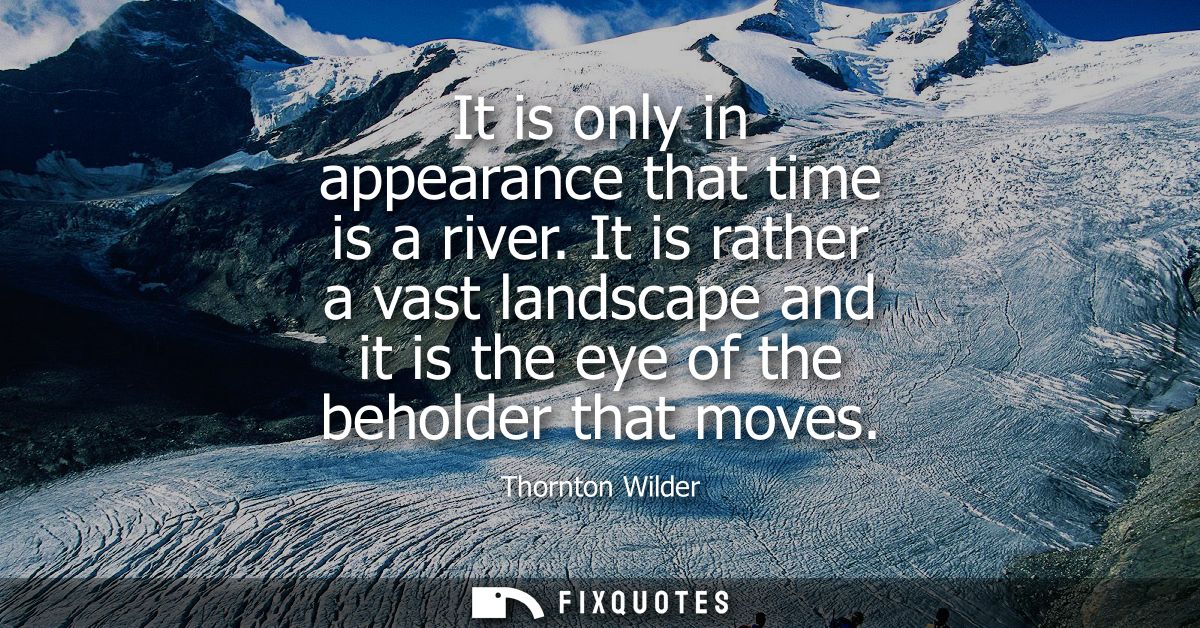
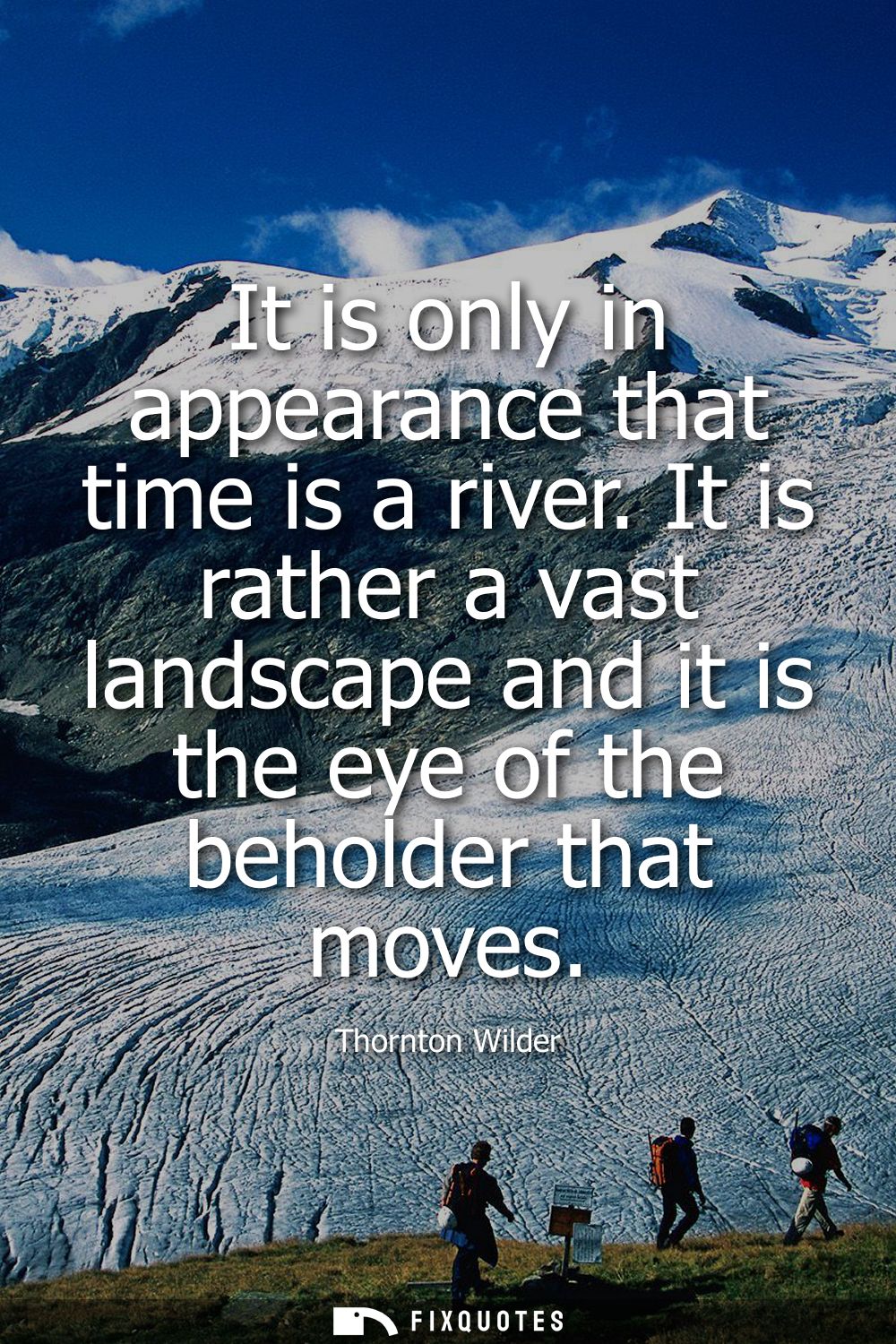
"It is only in appearance that time is a river. It is rather a vast landscape, and it is the eye of the beholder that moves"
About this Quote
The subtext is almost theatrical, which tracks for Wilder. His work (most famously Our Town) treats ordinary life as something you can step outside of and see whole, simultaneously intimate and cosmic. In that worldview, memory isn’t a flawed recording of the past; it’s a form of travel. Grief, nostalgia, and regret become evidence that the “past” still has terrain you can revisit and be hurt by. The future, too, is less a destination than an unvisited region of the same map.
Intent-wise, Wilder isn’t selling mystical comfort so much as moral urgency. If time isn’t a current dragging you forward, you can’t hide behind “that’s just how it goes.” Your attention becomes an ethical instrument: what you linger on, what you skip, what you refuse to notice. The “eye of the beholder” is a sharp reminder that living is a continual act of framing, and meaning is made, not delivered on a schedule.
Quote Details
| Topic | Time |
|---|---|
| Source | Help us find the source |
| Cite |
Citation Formats
APA Style (7th ed.)
Wilder, Thornton. (2026, February 19). It is only in appearance that time is a river. It is rather a vast landscape, and it is the eye of the beholder that moves. FixQuotes. https://fixquotes.com/quotes/it-is-only-in-appearance-that-time-is-a-river-it-35064/
Chicago Style
Wilder, Thornton. "It is only in appearance that time is a river. It is rather a vast landscape, and it is the eye of the beholder that moves." FixQuotes. February 19, 2026. https://fixquotes.com/quotes/it-is-only-in-appearance-that-time-is-a-river-it-35064/.
MLA Style (9th ed.)
"It is only in appearance that time is a river. It is rather a vast landscape, and it is the eye of the beholder that moves." FixQuotes, 19 Feb. 2026, https://fixquotes.com/quotes/it-is-only-in-appearance-that-time-is-a-river-it-35064/. Accessed 31 Mar. 2026.