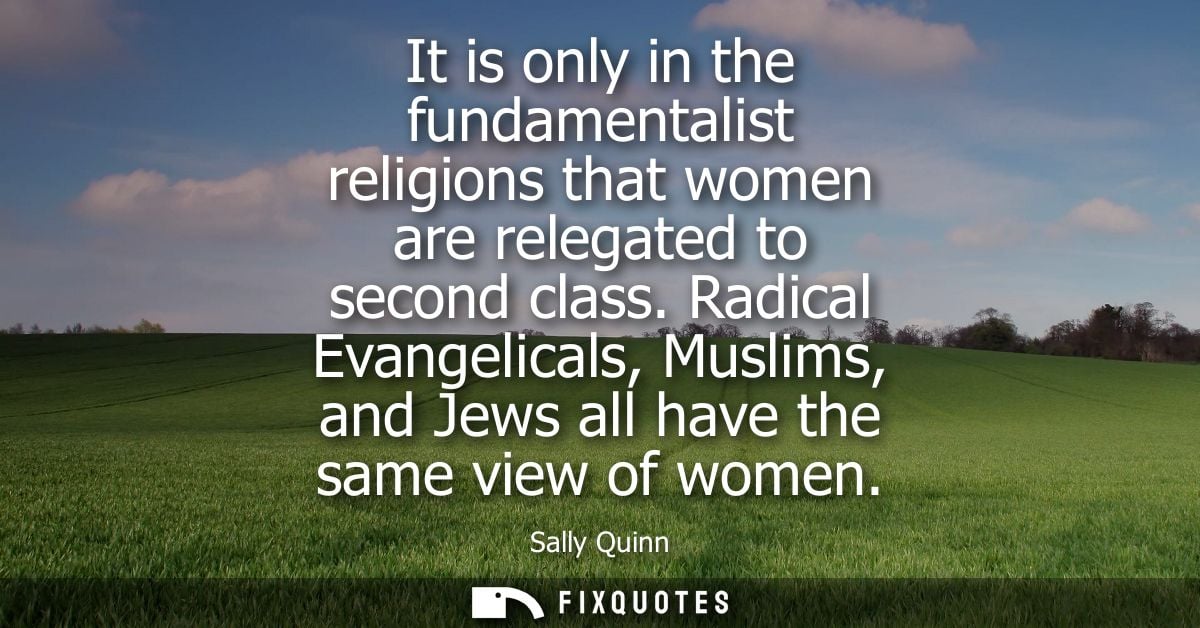
"It is only in the fundamentalist religions that women are relegated to second class. Radical Evangelicals, Muslims, and Jews all have the same view of women"
About this Quote
The subtext is as much about American politics and status as about religion. Naming “Radical Evangelicals” alongside “Muslims, and Jews” scrambles the usual post-9/11 hierarchy in which Islam is singled out as uniquely oppressive, while Christian fundamentalism is treated as a domestic quirk. Quinn is signaling a liberal, secular cosmopolitanism: the real divide isn’t East vs. West, it’s modernity vs. fundamentalism. It’s an attempt to universalize the critique and, implicitly, to deny any community the moral high ground on gender.
But the line also reveals journalism’s recurring temptation: to turn “fundamentalism” into a single ideology rather than a spectrum of practices, institutions, and internal dissent. By asserting “the same view of women,” Quinn erases difference between denominations, movements, and lived experiences - and collapses women inside these communities into symbols of patriarchal theology rather than political agents. The provocation is effective because it’s blunt; it’s also vulnerable because it’s blunt.
Quote Details
| Topic | Equality |
|---|---|
| Source | Help us find the source |
| Cite |
Citation Formats
APA Style (7th ed.)
Quinn, Sally. (2026, January 15). It is only in the fundamentalist religions that women are relegated to second class. Radical Evangelicals, Muslims, and Jews all have the same view of women. FixQuotes. https://fixquotes.com/quotes/it-is-only-in-the-fundamentalist-religions-that-147953/
Chicago Style
Quinn, Sally. "It is only in the fundamentalist religions that women are relegated to second class. Radical Evangelicals, Muslims, and Jews all have the same view of women." FixQuotes. January 15, 2026. https://fixquotes.com/quotes/it-is-only-in-the-fundamentalist-religions-that-147953/.
MLA Style (9th ed.)
"It is only in the fundamentalist religions that women are relegated to second class. Radical Evangelicals, Muslims, and Jews all have the same view of women." FixQuotes, 15 Jan. 2026, https://fixquotes.com/quotes/it-is-only-in-the-fundamentalist-religions-that-147953/. Accessed 4 Apr. 2026.