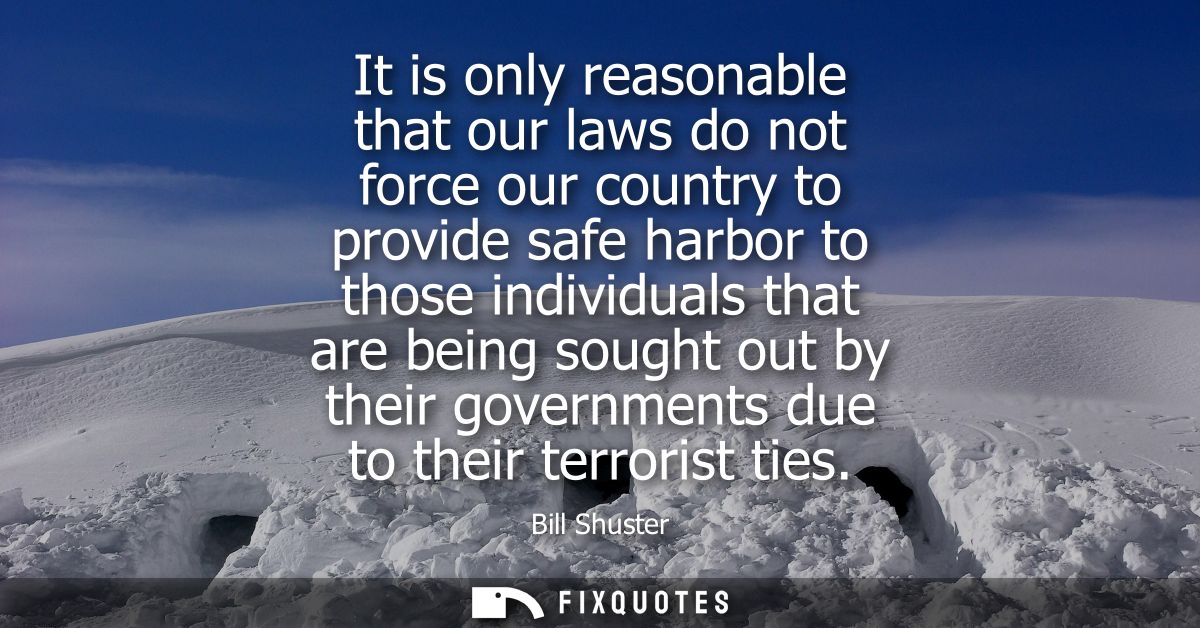
"It is only reasonable that our laws do not force our country to provide safe harbor to those individuals that are being sought out by their governments due to their terrorist ties"
About this Quote
The subtext is a familiar post-9/11 move in American politics: conflate immigration relief with national vulnerability, then treat restraint as negligence. “Safe harbor” borrows the language of shelter and complicity, implying that granting protection is tantamount to aiding an enemy. The kicker is “being sought out by their governments,” which quietly recasts foreign states as legitimate arbiters of guilt. That’s the rhetorical sleight of hand: it collapses the crucial distinction between being accused and being proven dangerous, and between democratic allies and regimes that use terrorism allegations as a dragnet.
Contextually, this reads like congressional-era security messaging shaped by the War on Terror and periodic spikes in fear around refugee flows. Its intent isn’t to litigate individual cases; it’s to build political permission for tighter asylum rules by making humanitarian discretion sound like a loophole terrorists exploit.
Quote Details
| Topic | Justice |
|---|---|
| Source | Help us find the source |
| Cite |
Citation Formats
APA Style (7th ed.)
Shuster, Bill. (2026, January 16). It is only reasonable that our laws do not force our country to provide safe harbor to those individuals that are being sought out by their governments due to their terrorist ties. FixQuotes. https://fixquotes.com/quotes/it-is-only-reasonable-that-our-laws-do-not-force-139249/
Chicago Style
Shuster, Bill. "It is only reasonable that our laws do not force our country to provide safe harbor to those individuals that are being sought out by their governments due to their terrorist ties." FixQuotes. January 16, 2026. https://fixquotes.com/quotes/it-is-only-reasonable-that-our-laws-do-not-force-139249/.
MLA Style (9th ed.)
"It is only reasonable that our laws do not force our country to provide safe harbor to those individuals that are being sought out by their governments due to their terrorist ties." FixQuotes, 16 Jan. 2026, https://fixquotes.com/quotes/it-is-only-reasonable-that-our-laws-do-not-force-139249/. Accessed 5 Mar. 2026.