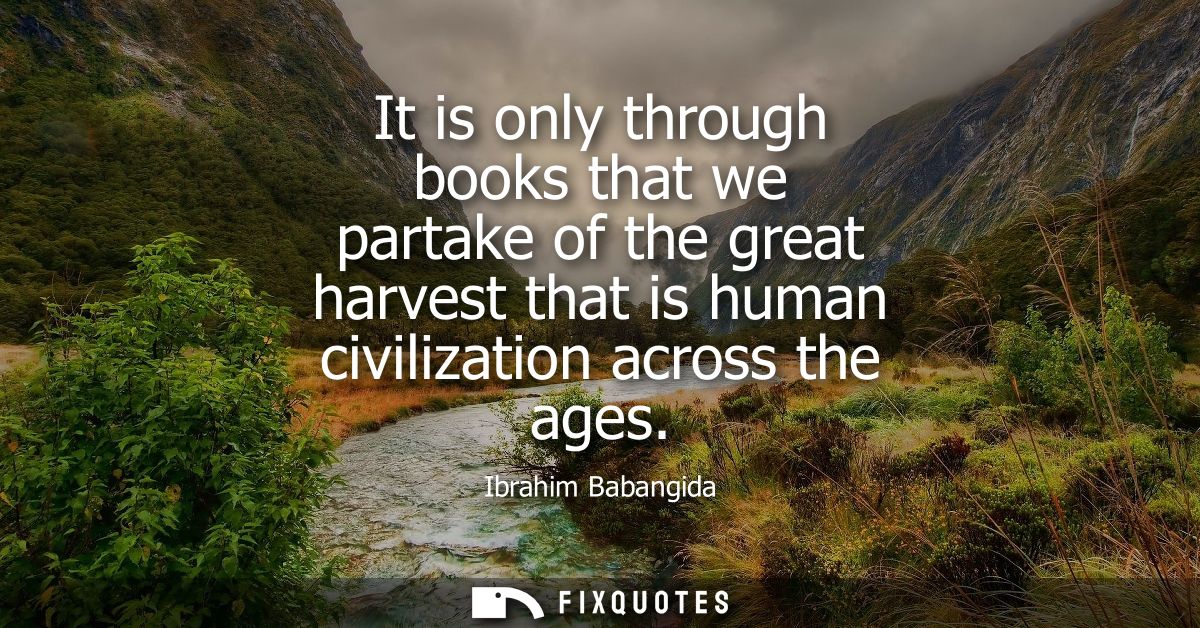
"It is only through books that we partake of the great harvest that is human civilization across the ages"
About this Quote
The specific intent is aspirational and disciplinary. Aspirational, because it invites citizens to see themselves as heirs to a long, transnational story rather than trapped in the present tense. Disciplinary, because it suggests a preferred route to legitimacy: literacy, canon, institutions. In a country like Nigeria, where colonial education systems privileged certain texts and languages, "only through books" carries a loaded implication about whose records count as civilization and whose memories get treated as folklore. Oral traditions, lived practice, and communal transmission are sidelined by design, not accident.
Coming from a statesman, the line also functions as soft power. It makes "civilization" feel like a shared, neutral good, while implying that the state - via schools, curricula, and libraries - can decide how that inheritance is accessed and interpreted. The quote's elegance is its moral leverage: it converts reading from a private hobby into civic participation, and it dares you to opt out.
Quote Details
| Topic | Book |
|---|---|
| Source | Help us find the source |
| Cite |
Citation Formats
APA Style (7th ed.)
Babangida, Ibrahim. (2026, January 16). It is only through books that we partake of the great harvest that is human civilization across the ages. FixQuotes. https://fixquotes.com/quotes/it-is-only-through-books-that-we-partake-of-the-90925/
Chicago Style
Babangida, Ibrahim. "It is only through books that we partake of the great harvest that is human civilization across the ages." FixQuotes. January 16, 2026. https://fixquotes.com/quotes/it-is-only-through-books-that-we-partake-of-the-90925/.
MLA Style (9th ed.)
"It is only through books that we partake of the great harvest that is human civilization across the ages." FixQuotes, 16 Jan. 2026, https://fixquotes.com/quotes/it-is-only-through-books-that-we-partake-of-the-90925/. Accessed 28 Mar. 2026.