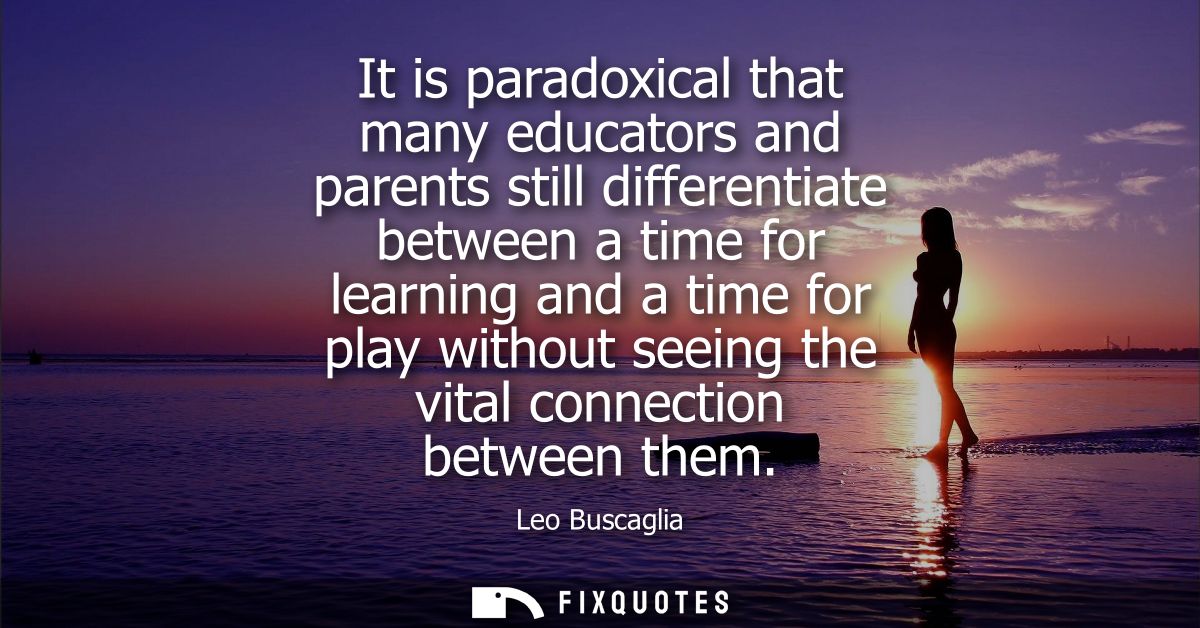
"It is paradoxical that many educators and parents still differentiate between a time for learning and a time for play without seeing the vital connection between them"
About this Quote
The intent here is corrective, but it’s also strategic. By addressing “educators and parents” together, Buscaglia collapses the usual blame game between school and home. Everyone is implicated in the same cultural habit: viewing play as the reward for discipline rather than the method by which real understanding often happens. The subtext is that our categories (“work” versus “play,” “serious” versus “fun”) are adult conveniences, not child truths. They reflect institutional needs - classroom control, measurable outcomes, fear of “wasted time” - more than they reflect how humans actually learn.
Context matters: Buscaglia built a public persona around humanistic education, emotional literacy, and the idea that warmth isn’t a distraction from rigor but part of it. In the late 20th century, as schooling tilted toward standardization and performance metrics, this stance reads less like sentimentality and more like resistance. The line works because it doesn’t romanticize play; it reframes it as vital infrastructure. If learning is retention plus transfer, play is where transfer gets rehearsed - where a kid tests rules, breaks them safely, and discovers why they exist.
Quote Details
| Topic | Learning |
|---|---|
| Source | Later attribution: Cool Stuff Your Parents Never Told You About Parenting (Foong Kwin Tan, 2013) modern compilationISBN: 9781479789757 · ID: XZp5xiHYHxAC
Evidence:
... It is paradoxical that many educators and parents still differentiate between a time for learning and a time for play without seeing the vital connection between them. (Leo F. Buscaglia) This quote was made by Prof Leo Buscaglia in ... |
| Cite |
Citation Formats
APA Style (7th ed.)
Buscaglia, Leo. (2026, March 3). It is paradoxical that many educators and parents still differentiate between a time for learning and a time for play without seeing the vital connection between them. FixQuotes. https://fixquotes.com/quotes/it-is-paradoxical-that-many-educators-and-parents-32504/
Chicago Style
Buscaglia, Leo. "It is paradoxical that many educators and parents still differentiate between a time for learning and a time for play without seeing the vital connection between them." FixQuotes. March 3, 2026. https://fixquotes.com/quotes/it-is-paradoxical-that-many-educators-and-parents-32504/.
MLA Style (9th ed.)
"It is paradoxical that many educators and parents still differentiate between a time for learning and a time for play without seeing the vital connection between them." FixQuotes, 3 Mar. 2026, https://fixquotes.com/quotes/it-is-paradoxical-that-many-educators-and-parents-32504/. Accessed 15 Mar. 2026.