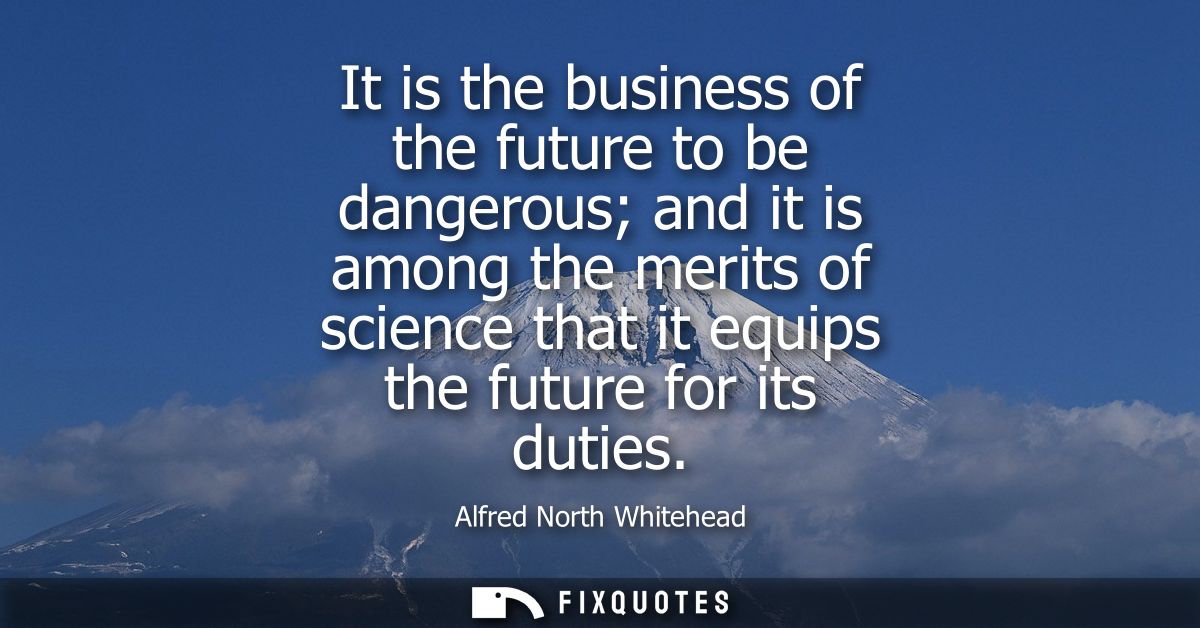
"It is the business of the future to be dangerous; and it is among the merits of science that it equips the future for its duties"
About this Quote
The sly pivot comes next: science doesn’t just predict the future, it “equips” it. Whitehead is refusing the comforting story that science is neutral knowledge piled in a museum. “Equips” is an action verb with military undertones: tools, training, readiness. Science earns its moral standing, in his view, not by being pure, but by being useful under pressure. The subtext is bracing: the same machinery that expands possibility also expands stakes. New powers generate new “duties,” and those duties arrive whether we feel mature enough to handle them.
Context matters. Writing in the shadow of industrial modernity and world war, Whitehead understood that rational technique can scale both welfare and catastrophe. He’s not scolding science; he’s assigning it adult responsibilities. If the future is dangerous, then the most “meritorious” knowledge is the kind that prepares societies to meet their own inventions without collapsing into panic, superstition, or wishful thinking.
Quote Details
| Topic | Science |
|---|---|
| Source | Verified source: Science and the Modern World (Alfred North Whitehead, 1925)
Evidence: It is the business of the future to be dangerous; and it is among the merits of science that it equips the future for its duties. (Chapter XIII: Requisites for Social Progress (p. 291)). This line appears in Alfred North Whitehead’s book Science and the Modern World, which is explicitly labeled as the Lowell Lectures, 1925. The Project Gutenberg transcription shows the Macmillan imprint and publication details indicating publication in October 1925 and includes the sentence in Chapter XIII ('Requisites for Social Progress'). Wikiquote independently indexes the same sentence to Ch. 13, p. 291 (matching the Gutenberg page numbering). Other candidates (1) ... Alfred North Whitehead said more than half a century ago , in words that might have been written to ... It is the... |
| Cite |
Citation Formats
APA Style (7th ed.)
Whitehead, Alfred North. (2026, February 11). It is the business of the future to be dangerous; and it is among the merits of science that it equips the future for its duties. FixQuotes. https://fixquotes.com/quotes/it-is-the-business-of-the-future-to-be-dangerous-12787/
Chicago Style
Whitehead, Alfred North. "It is the business of the future to be dangerous; and it is among the merits of science that it equips the future for its duties." FixQuotes. February 11, 2026. https://fixquotes.com/quotes/it-is-the-business-of-the-future-to-be-dangerous-12787/.
MLA Style (9th ed.)
"It is the business of the future to be dangerous; and it is among the merits of science that it equips the future for its duties." FixQuotes, 11 Feb. 2026, https://fixquotes.com/quotes/it-is-the-business-of-the-future-to-be-dangerous-12787/. Accessed 8 Apr. 2026.