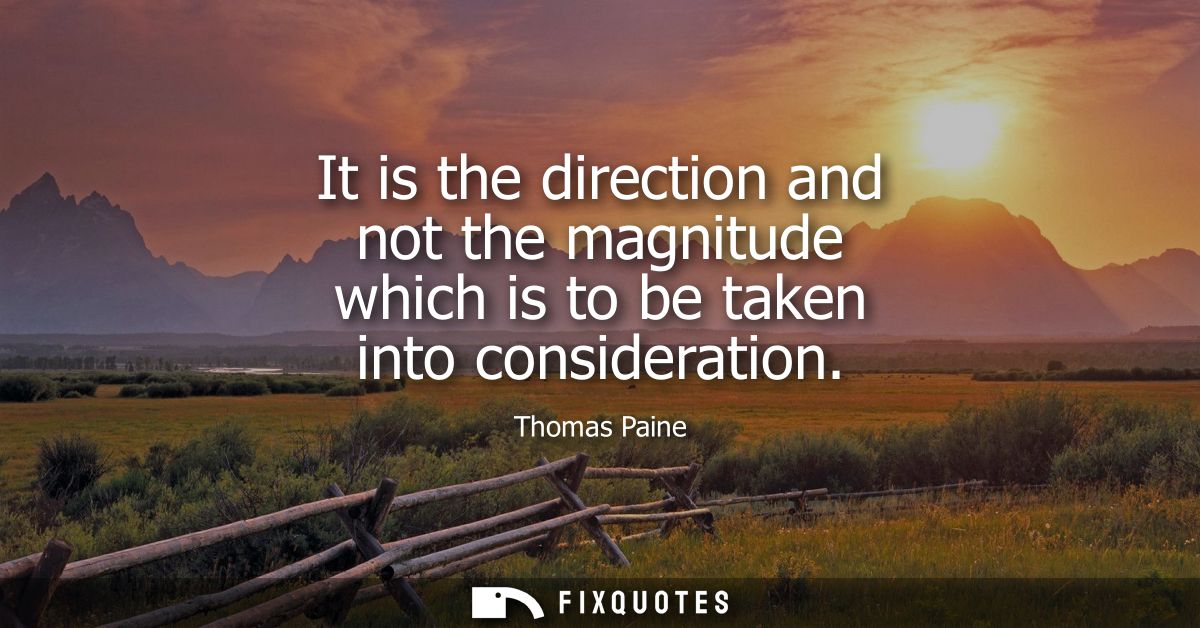
"It is the direction, and not the magnitude, which is to be taken into consideration"
About this Quote
The phrasing has the clipped logic of Enlightenment argument, but it’s also a moral ambush. “Magnitude” flatters the ego and the crowd; it’s measurable, reportable, a number you can cheer. “Direction” is harder. It forces an evaluation of purpose, principles, and trajectory - the kind of thinking that threatens complacency and exposes hypocrisy. Paine’s subtext is that citizens should judge reforms and revolutions by where they lead, not by how dramatic they look in the moment.
Context matters: Paine was a professional persuader in an age when pamphlets were political weapons. This sentence reads like a portable rule of judgment, designed to travel from debates about monarchy and rights into any argument where spectacle might replace ethics. It’s also quietly democratic. If direction is the standard, ordinary people don’t need insider metrics to assess power; they need a compass: liberty, representation, human dignity. Magnitude can be purchased. Direction has to be chosen.
Quote Details
| Topic | Wisdom |
|---|---|
| Source | Help us find the source |
| Cite |
Citation Formats
APA Style (7th ed.)
Paine, Thomas. (2026, February 20). It is the direction, and not the magnitude, which is to be taken into consideration. FixQuotes. https://fixquotes.com/quotes/it-is-the-direction-and-not-the-magnitude-which-23986/
Chicago Style
Paine, Thomas. "It is the direction, and not the magnitude, which is to be taken into consideration." FixQuotes. February 20, 2026. https://fixquotes.com/quotes/it-is-the-direction-and-not-the-magnitude-which-23986/.
MLA Style (9th ed.)
"It is the direction, and not the magnitude, which is to be taken into consideration." FixQuotes, 20 Feb. 2026, https://fixquotes.com/quotes/it-is-the-direction-and-not-the-magnitude-which-23986/. Accessed 3 Apr. 2026.