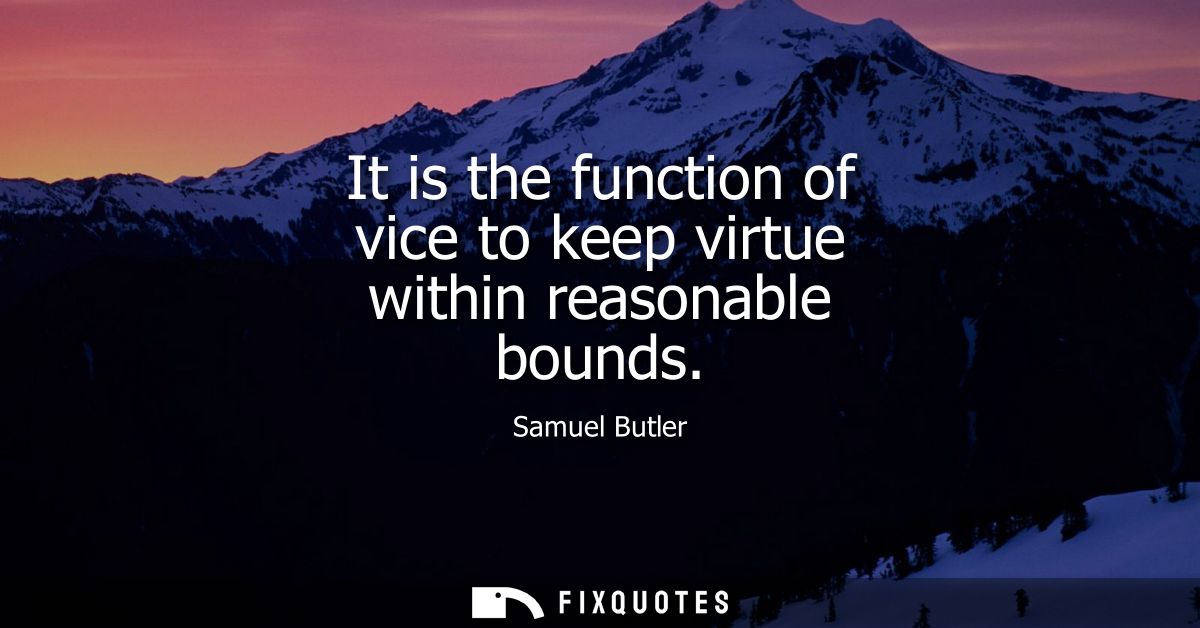
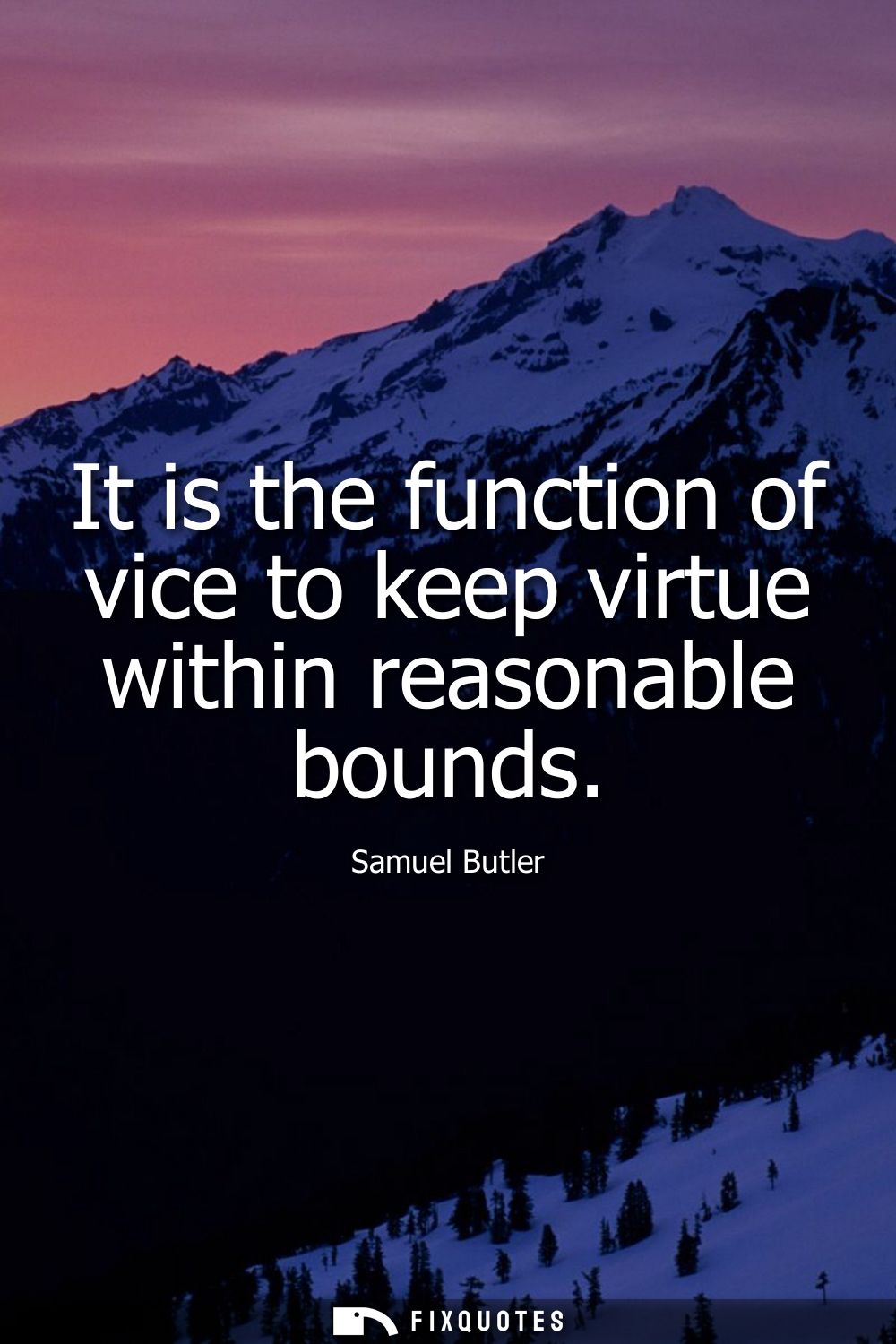
"It is the function of vice to keep virtue within reasonable bounds"
About this Quote
Vice, in Samuel Butler's hands, isn't a lurid temptation so much as a regulatory mechanism: the misbehavior that keeps moral certainty from turning into moral tyranny. "Function" is the tell. He drains the drama out of sin and gives it a job description, treating ethics like an ecosystem with checks and balances. Virtue, in this framing, isn't automatically admirable; unbounded virtue is a threat, the kind that metastasizes into zealotry, sanctimony, and social policing. Butler's wit is that he smuggles a critique of moral absolutism into what sounds like a backhanded defense of wrongdoing.
The line lands because it reverses the usual Victorian moral math. Rather than vice eroding virtue, vice protects society from virtue's worst impulses: self-righteous crusades, punitive reforms, the smug conviction that purity justifies cruelty. "Reasonable bounds" is the quiet punchline, the phrase you might use for taxes or parking regulations, not salvation. It implies that virtue needs containment, that the "good" can become unreasonable when it forgets it's human.
Context matters. Butler wrote in an era that prized propriety while fermenting with doubt: Darwin rearranged humanity's place in creation; industrial capitalism exposed the gap between moral rhetoric and material exploitation; religious certainty met scientific erosion. Butler, a skeptical satirist-poet, often aimed at institutional piety and the comfortable hypocrisies it enabled. The subtext is less "go sin" than "distrust anyone who claims to be purely good". A little vice becomes a vaccine against the authoritarian side of righteousness.
The line lands because it reverses the usual Victorian moral math. Rather than vice eroding virtue, vice protects society from virtue's worst impulses: self-righteous crusades, punitive reforms, the smug conviction that purity justifies cruelty. "Reasonable bounds" is the quiet punchline, the phrase you might use for taxes or parking regulations, not salvation. It implies that virtue needs containment, that the "good" can become unreasonable when it forgets it's human.
Context matters. Butler wrote in an era that prized propriety while fermenting with doubt: Darwin rearranged humanity's place in creation; industrial capitalism exposed the gap between moral rhetoric and material exploitation; religious certainty met scientific erosion. Butler, a skeptical satirist-poet, often aimed at institutional piety and the comfortable hypocrisies it enabled. The subtext is less "go sin" than "distrust anyone who claims to be purely good". A little vice becomes a vaccine against the authoritarian side of righteousness.
Quote Details
| Topic | Ethics & Morality |
|---|---|
| Source | Help us find the source |
| Cite |
Citation Formats
APA Style (7th ed.)
Butler, Samuel. (2026, January 18). It is the function of vice to keep virtue within reasonable bounds. FixQuotes. https://fixquotes.com/quotes/it-is-the-function-of-vice-to-keep-virtue-within-18139/
Chicago Style
Butler, Samuel. "It is the function of vice to keep virtue within reasonable bounds." FixQuotes. January 18, 2026. https://fixquotes.com/quotes/it-is-the-function-of-vice-to-keep-virtue-within-18139/.
MLA Style (9th ed.)
"It is the function of vice to keep virtue within reasonable bounds." FixQuotes, 18 Jan. 2026, https://fixquotes.com/quotes/it-is-the-function-of-vice-to-keep-virtue-within-18139/. Accessed 7 Mar. 2026.
More Quotes by Samuel
Add to List