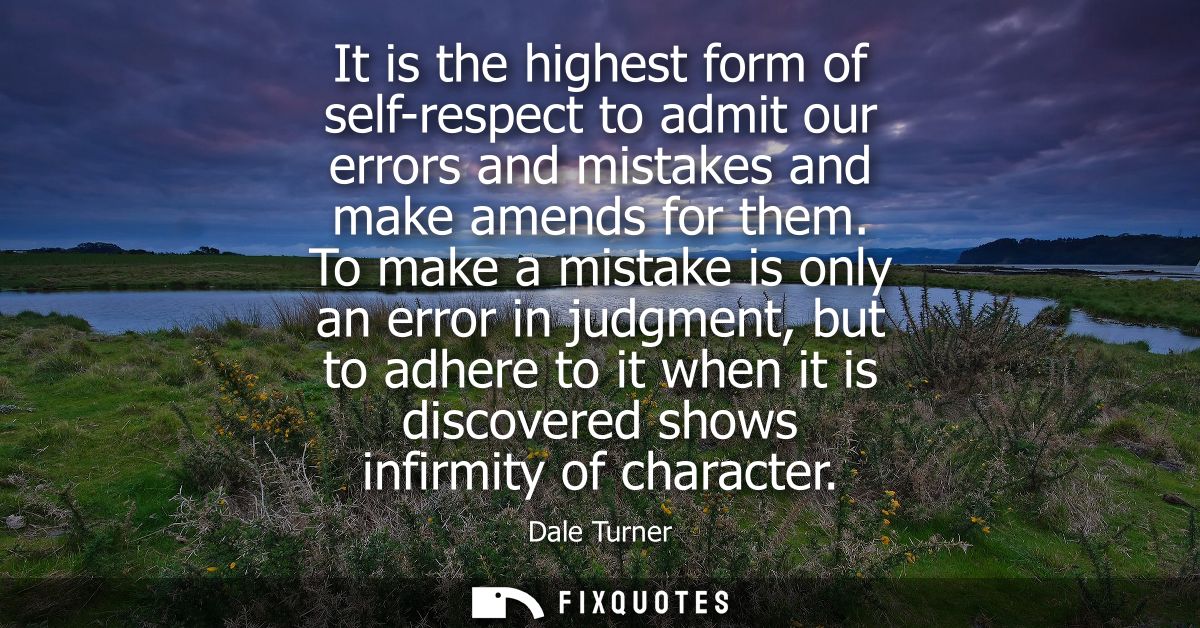
"It is the highest form of self-respect to admit our errors and mistakes and make amends for them. To make a mistake is only an error in judgment, but to adhere to it when it is discovered shows infirmity of character"
About this Quote
Turner flips the usual script on pride: self-respect isn’t the swagger of being right, it’s the stamina to be wrong in public and then do the repair work. The first sentence sounds almost like a motivational maxim, but its real move is more pointed. By calling admission and amends “the highest form,” he demotes the everyday version of self-respect most people practice: defensiveness, image management, the careful curating of a life without receipts.
The subtext is a critique of how we treat mistakes as identity threats rather than information. Turner separates the initial mistake from what comes after it, and that’s where the moral argument lives. “Error in judgment” frames the misstep as cognitive and ordinary, a momentary misread of facts, impulse, or context. It’s forgivable because it’s human. The condemnation arrives with “adhere to it when it is discovered.” Once reality has tapped you on the shoulder, stubbornness stops being an accident and becomes a choice.
“Infirmity of character” is old-school phrasing, but it’s doing modern work: diagnosing the pathology beneath doubling down. Not ignorance, but fragility. The person who can’t retract is protecting ego, status, or tribe at the expense of truth. That’s why “make amends” matters; Turner isn’t praising mere confession as a performance. He’s insisting on consequence and restitution, the unglamorous follow-through that tests whether humility is real.
As a writerly observation, it reads like a rebuttal to a culture that rewards certainty and punishes revision. Turner argues that character isn’t proved by never falling; it’s proved by how quickly you stop insisting you didn’t.
The subtext is a critique of how we treat mistakes as identity threats rather than information. Turner separates the initial mistake from what comes after it, and that’s where the moral argument lives. “Error in judgment” frames the misstep as cognitive and ordinary, a momentary misread of facts, impulse, or context. It’s forgivable because it’s human. The condemnation arrives with “adhere to it when it is discovered.” Once reality has tapped you on the shoulder, stubbornness stops being an accident and becomes a choice.
“Infirmity of character” is old-school phrasing, but it’s doing modern work: diagnosing the pathology beneath doubling down. Not ignorance, but fragility. The person who can’t retract is protecting ego, status, or tribe at the expense of truth. That’s why “make amends” matters; Turner isn’t praising mere confession as a performance. He’s insisting on consequence and restitution, the unglamorous follow-through that tests whether humility is real.
As a writerly observation, it reads like a rebuttal to a culture that rewards certainty and punishes revision. Turner argues that character isn’t proved by never falling; it’s proved by how quickly you stop insisting you didn’t.
Quote Details
| Topic | Learning from Mistakes |
|---|
More Quotes by Dale
Add to List