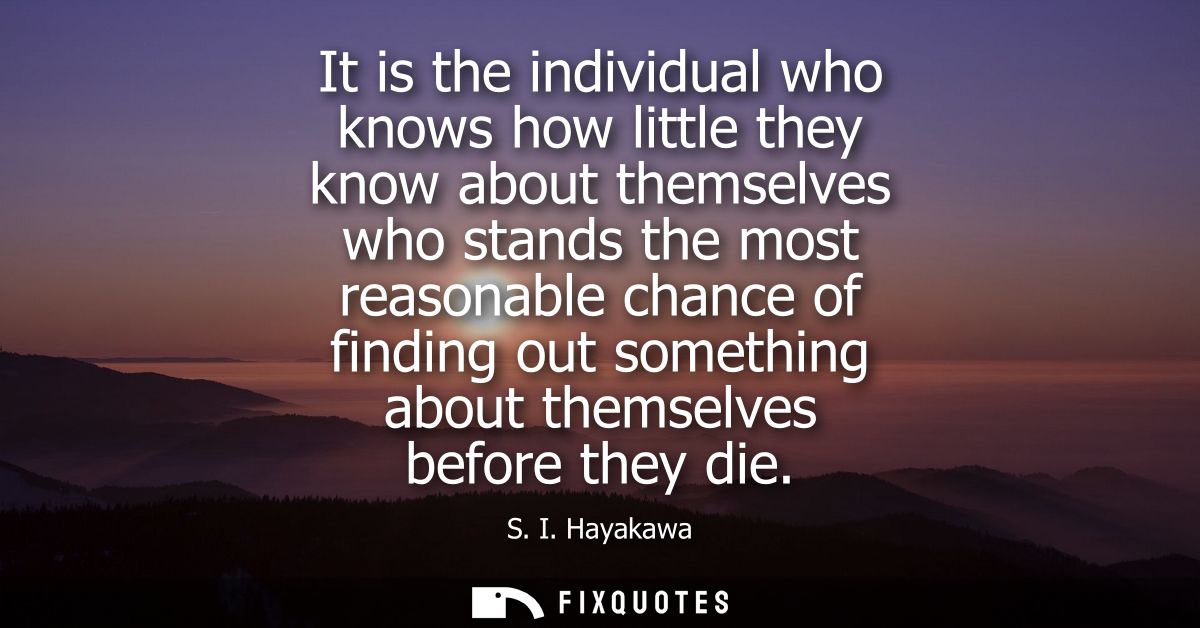
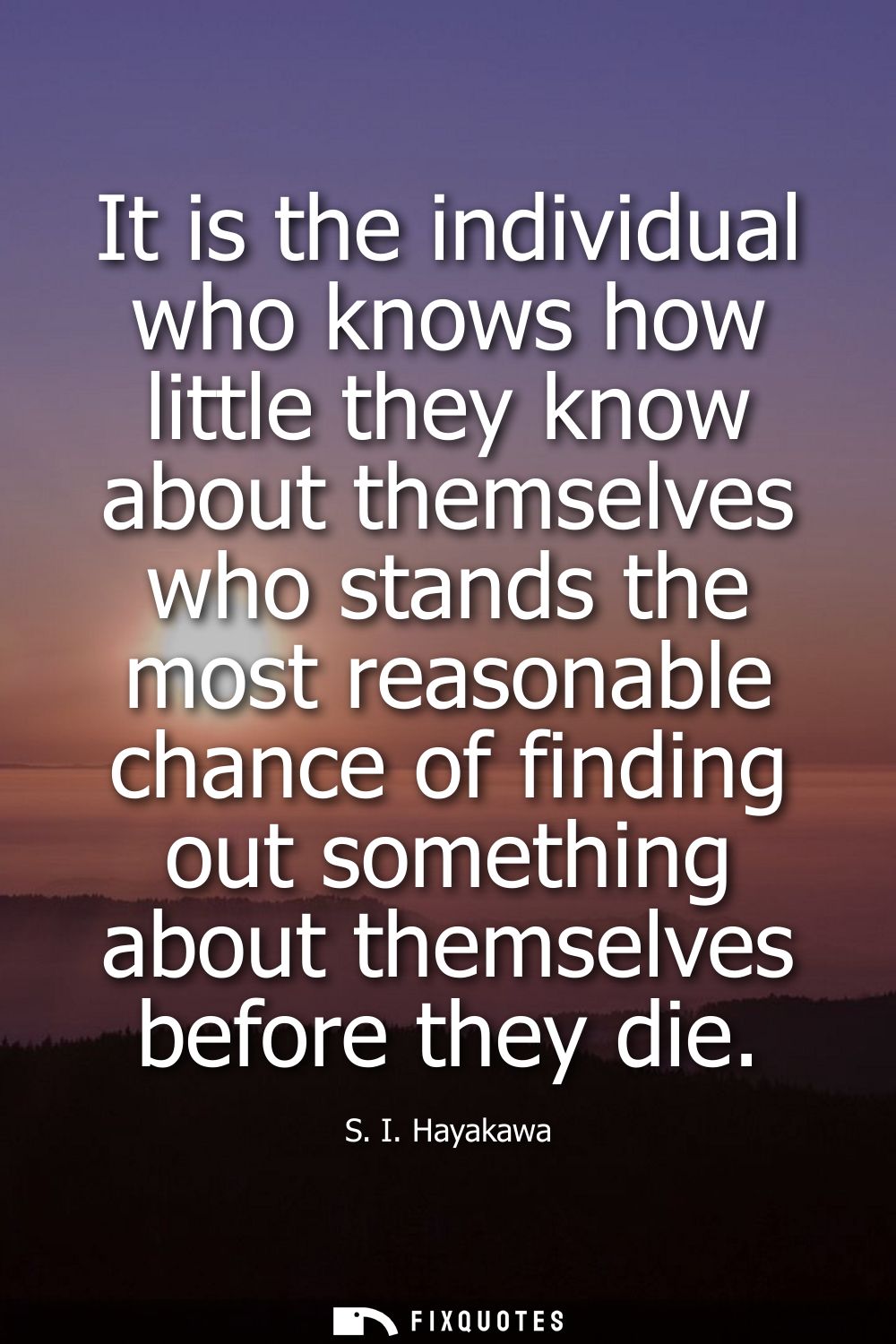
"It is the individual who knows how little they know about themselves who stands the most reasonable chance of finding out something about themselves before they die"
About this Quote
The phrasing matters. "Reasonable chance" is a politician's realism, not a mystic's promise. He doesn't sell enlightenment; he sells odds. That small, pragmatic qualifier smuggles in a worldview shaped by public life: the self is not a private essence waiting to be uncovered, but a messy, evolving record of decisions, motives, rationalizations, and blind spots. The ones most likely to learn are those least invested in defending a flattering narrative.
Hayakawa's background deepens the subtext. Before politics, he was a semanticist, attentive to how language distorts perception. Read that way, the quote warns that we are especially vulnerable to our own rhetoric, the internal slogans that justify habits and harden into identity. Admitting "how little" you know is not self-abasement; it's an anti-propaganda measure.
The closing pressure of "before they die" turns introspection into a deadline. It's not morbid so much as bracing: self-knowledge is finite work, competed against time, ego, and the comfort of certainty.
Quote Details
| Topic | Wisdom |
|---|---|
| Source | Help us find the source |
| Cite |
Citation Formats
APA Style (7th ed.)
Hayakawa, S. I. (2026, January 16). It is the individual who knows how little they know about themselves who stands the most reasonable chance of finding out something about themselves before they die. FixQuotes. https://fixquotes.com/quotes/it-is-the-individual-who-knows-how-little-they-109407/
Chicago Style
Hayakawa, S. I. "It is the individual who knows how little they know about themselves who stands the most reasonable chance of finding out something about themselves before they die." FixQuotes. January 16, 2026. https://fixquotes.com/quotes/it-is-the-individual-who-knows-how-little-they-109407/.
MLA Style (9th ed.)
"It is the individual who knows how little they know about themselves who stands the most reasonable chance of finding out something about themselves before they die." FixQuotes, 16 Jan. 2026, https://fixquotes.com/quotes/it-is-the-individual-who-knows-how-little-they-109407/. Accessed 17 Mar. 2026.