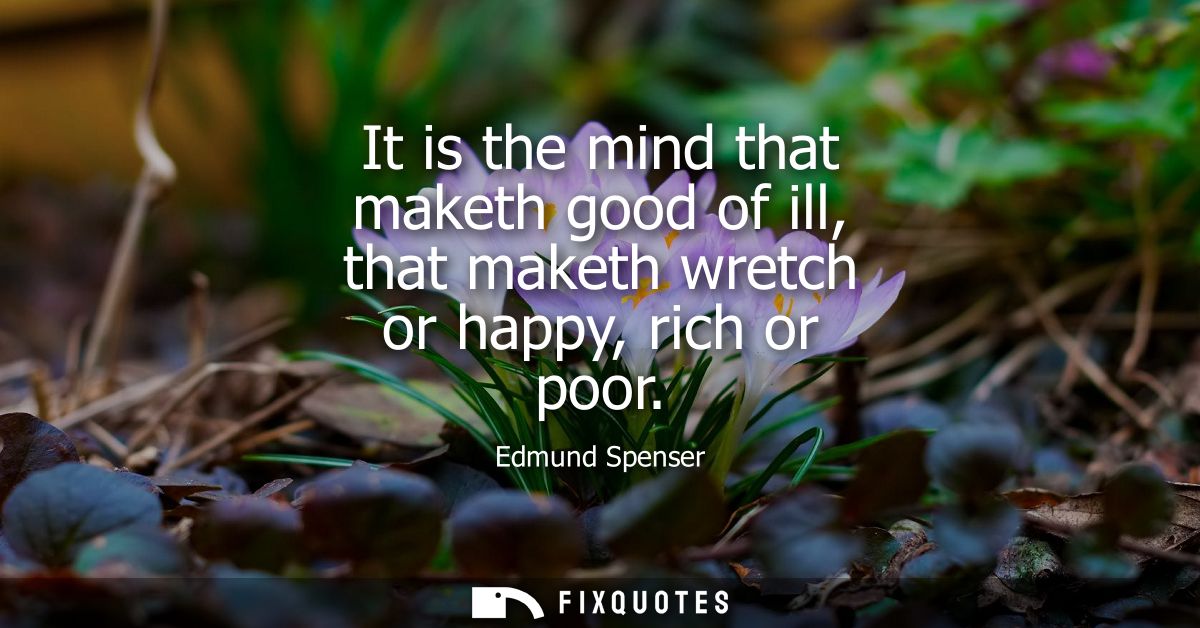
"It is the mind that maketh good of ill, that maketh wretch or happy, rich or poor"
About this Quote
The subtext is a moral economy disguised as psychology. Spenser’s world is hierarchical, anxious about disorder, and invested in discipline - of the self, the nation, the soul. This sentiment fits the Elizabethan project: cultivate subjects who can endure hardship, justify inequality, and frame deprivation as a test of virtue rather than a political failure. In that sense it’s both empowering and quietly coercive. It offers consolation while inoculating power against critique.
Poetically, the rhythm and parallelism act like a spell. By stacking opposites - wretch/happy, rich/poor - Spenser collapses social categories into mental states, turning external status into an internal verdict. It’s an early-modern version of the mindset doctrine, but with sharper stakes: salvation, not self-help. The intent isn’t to deny suffering; it’s to domesticate it, to make the mind a fortress where fortune can’t get the last word.
Quote Details
| Topic | Wisdom |
|---|---|
| Source | Help us find the source |
| Cite |
Citation Formats
APA Style (7th ed.)
Spenser, Edmund. (2026, January 17). It is the mind that maketh good of ill, that maketh wretch or happy, rich or poor. FixQuotes. https://fixquotes.com/quotes/it-is-the-mind-that-maketh-good-of-ill-that-33983/
Chicago Style
Spenser, Edmund. "It is the mind that maketh good of ill, that maketh wretch or happy, rich or poor." FixQuotes. January 17, 2026. https://fixquotes.com/quotes/it-is-the-mind-that-maketh-good-of-ill-that-33983/.
MLA Style (9th ed.)
"It is the mind that maketh good of ill, that maketh wretch or happy, rich or poor." FixQuotes, 17 Jan. 2026, https://fixquotes.com/quotes/it-is-the-mind-that-maketh-good-of-ill-that-33983/. Accessed 5 Apr. 2026.