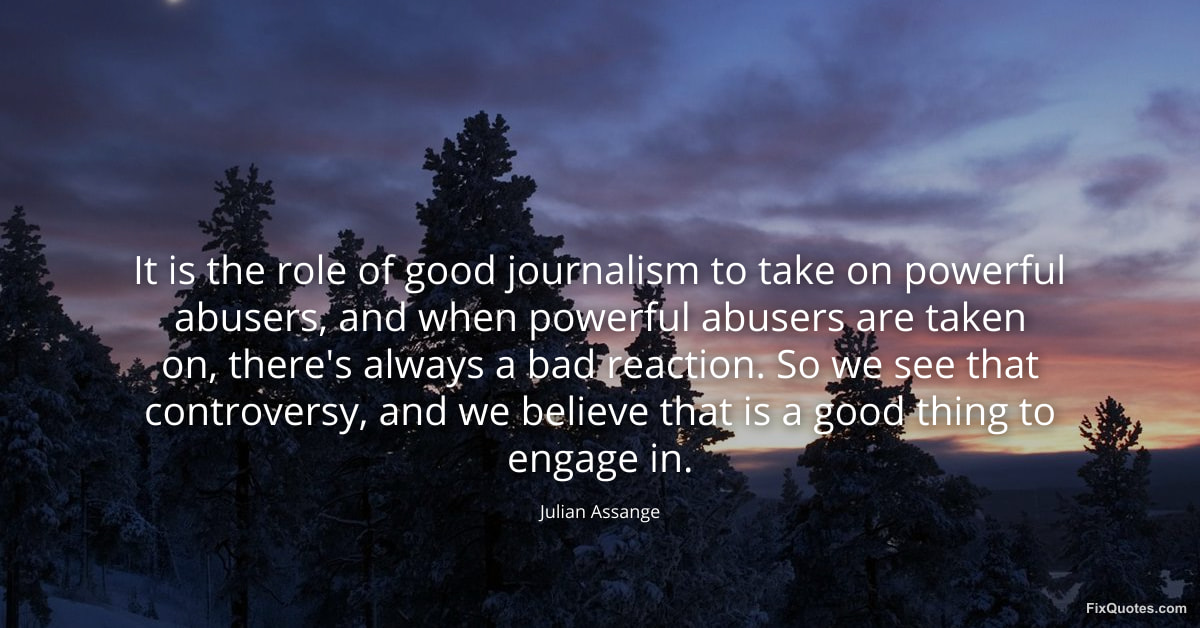
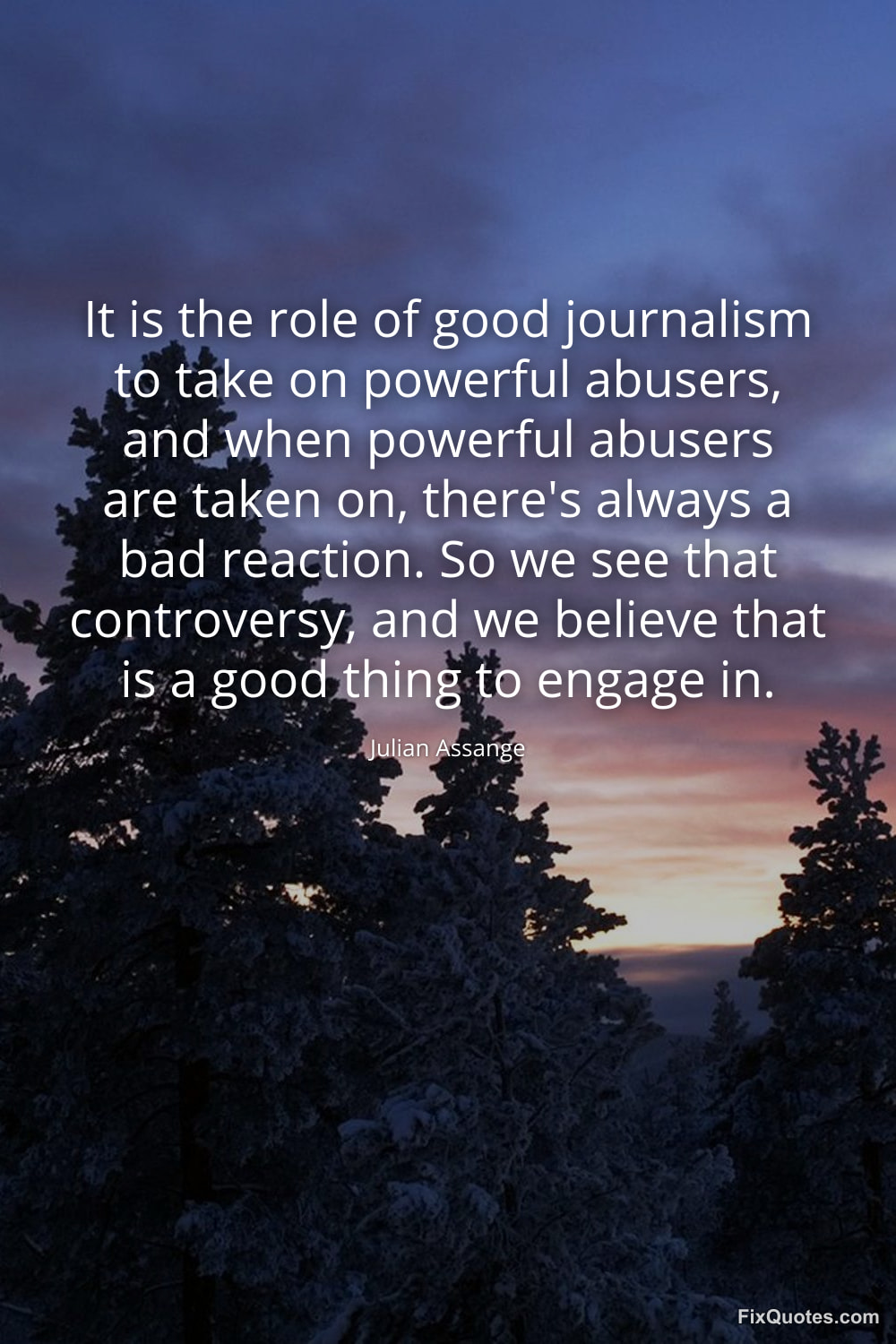
"It is the role of good journalism to take on powerful abusers, and when powerful abusers are taken on, there's always a bad reaction. So we see that controversy, and we believe that is a good thing to engage in"
About this Quote
The subtext is a bid to monopolize moral high ground in an arena where legitimacy is constantly contested. “Powerful abusers” is a deliberately capacious label: governments, corporations, intelligence agencies, legacy media editors, even critics can be swept under it. Once you accept that frame, the world splits into two camps - abusers and those who “take them on” - and nuance starts to look like collaboration.
Context matters because Assange’s brand, and WikiLeaks’ impact, sit right at the fault line between transparency and recklessness. Post-2010, amid revelations, accusations of harm, and his own legal jeopardy, he needed a narrative that made turbulence feel like mission. The phrase “a good thing to engage in” is especially telling: controversy isn’t collateral damage; it’s fuel. He’s not just describing journalism’s adversarial role. He’s selling an ethic where friction is the metric, and where the mess around the story becomes part of the story’s moral alibi.
Quote Details
| Topic | Justice |
|---|---|
| Source | Help us find the source |
| Cite |
Citation Formats
APA Style (7th ed.)
Assange, Julian. (2026, January 15). It is the role of good journalism to take on powerful abusers, and when powerful abusers are taken on, there's always a bad reaction. So we see that controversy, and we believe that is a good thing to engage in. FixQuotes. https://fixquotes.com/quotes/it-is-the-role-of-good-journalism-to-take-on-148817/
Chicago Style
Assange, Julian. "It is the role of good journalism to take on powerful abusers, and when powerful abusers are taken on, there's always a bad reaction. So we see that controversy, and we believe that is a good thing to engage in." FixQuotes. January 15, 2026. https://fixquotes.com/quotes/it-is-the-role-of-good-journalism-to-take-on-148817/.
MLA Style (9th ed.)
"It is the role of good journalism to take on powerful abusers, and when powerful abusers are taken on, there's always a bad reaction. So we see that controversy, and we believe that is a good thing to engage in." FixQuotes, 15 Jan. 2026, https://fixquotes.com/quotes/it-is-the-role-of-good-journalism-to-take-on-148817/. Accessed 2 Apr. 2026.