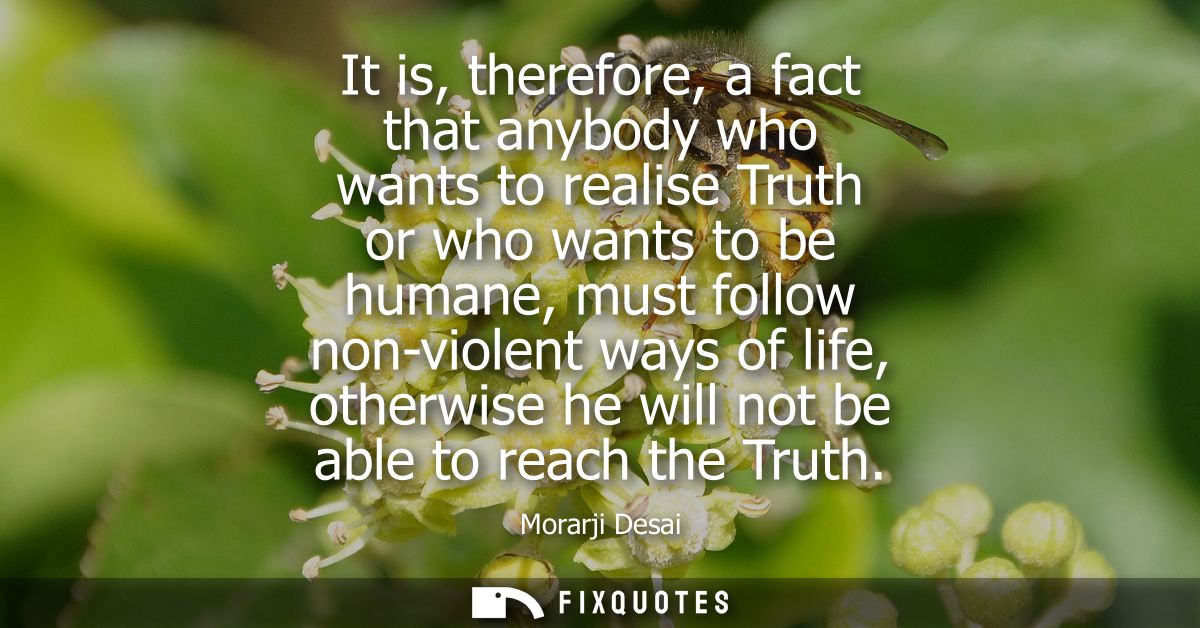
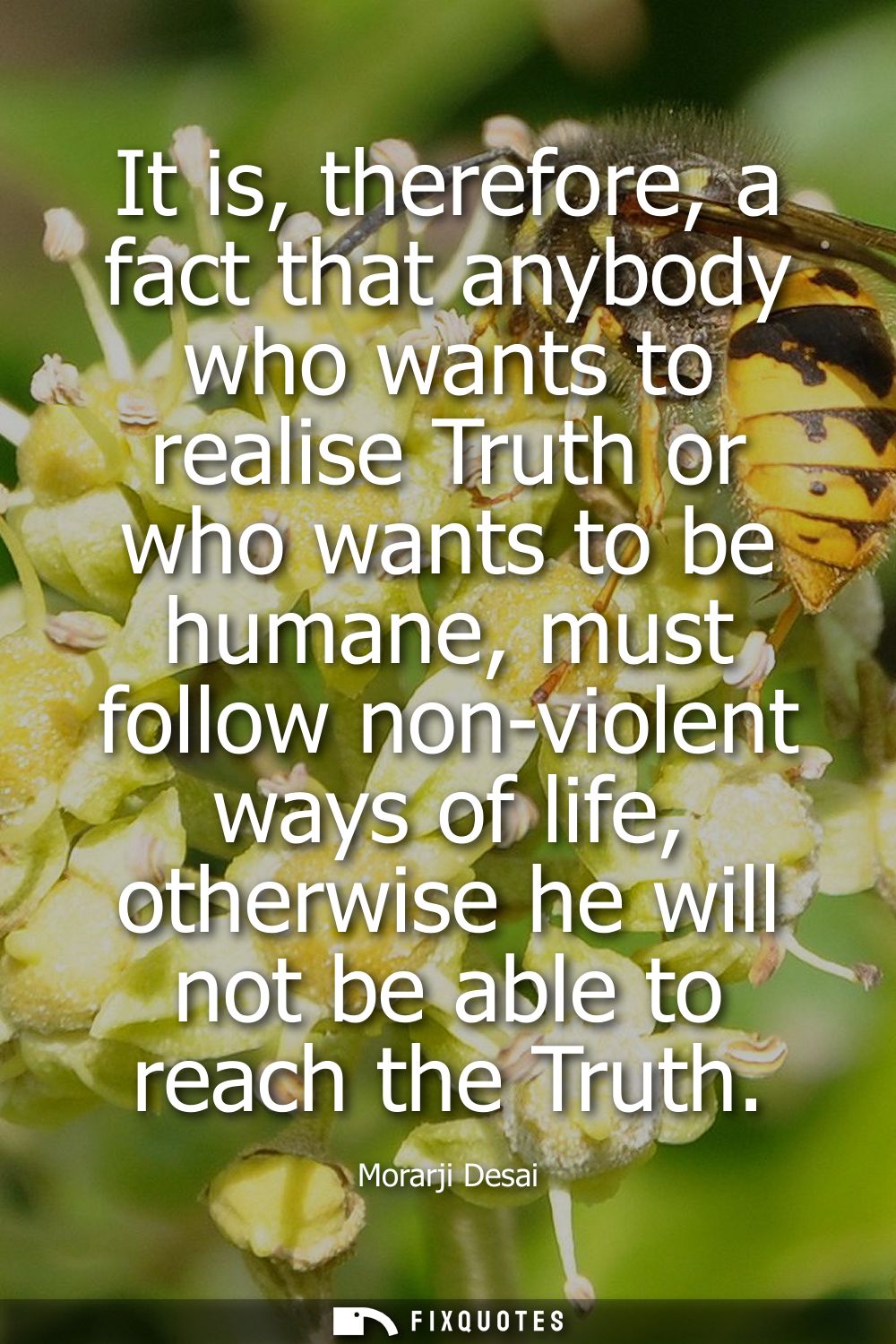
"It is, therefore, a fact that anybody who wants to realise Truth or who wants to be humane must follow non-violent ways of life, otherwise he will not be able to reach the Truth"
About this Quote
The subtext is aimed at a young state still wrestling with the temptations of power. Post-independence India inherited colonial instruments of control, and its politics often oscillated between Gandhian symbolism and the realpolitik of governing. Desai, who cultivated an austere, morally policing public persona, is asserting a Gandhian lineage while also issuing a warning to rivals: a politics that uses intimidation, corruption, or state violence isn’t merely unethical; it is epistemically compromised. Violence distorts perception. It manufactures consent, yes, but also manufactures lies you need to keep the machinery running.
“Humane” sits beside “Truth” on purpose. Desai collapses ethics and knowledge into the same discipline: nonviolence isn’t just kindness; it’s a method for staying reality-based. That’s also where the line courts controversy. By declaring nonviolence the gatekeeper to Truth, he risks turning a spiritual-political strategy into an exclusionary credential, a way to delegitimize dissent as morally unfit. The rhetoric is absolute because the stakes, in his view, are civilizational: a nation’s character is built in its everyday tactics, not its slogans.
Quote Details
| Topic | Truth |
|---|---|
| Source | Help us find the source |
| Cite |
Citation Formats
APA Style (7th ed.)
Desai, Morarji. (2026, February 16). It is, therefore, a fact that anybody who wants to realise Truth or who wants to be humane must follow non-violent ways of life, otherwise he will not be able to reach the Truth. FixQuotes. https://fixquotes.com/quotes/it-is-therefore-a-fact-that-anybody-who-wants-to-151859/
Chicago Style
Desai, Morarji. "It is, therefore, a fact that anybody who wants to realise Truth or who wants to be humane must follow non-violent ways of life, otherwise he will not be able to reach the Truth." FixQuotes. February 16, 2026. https://fixquotes.com/quotes/it-is-therefore-a-fact-that-anybody-who-wants-to-151859/.
MLA Style (9th ed.)
"It is, therefore, a fact that anybody who wants to realise Truth or who wants to be humane must follow non-violent ways of life, otherwise he will not be able to reach the Truth." FixQuotes, 16 Feb. 2026, https://fixquotes.com/quotes/it-is-therefore-a-fact-that-anybody-who-wants-to-151859/. Accessed 11 Mar. 2026.