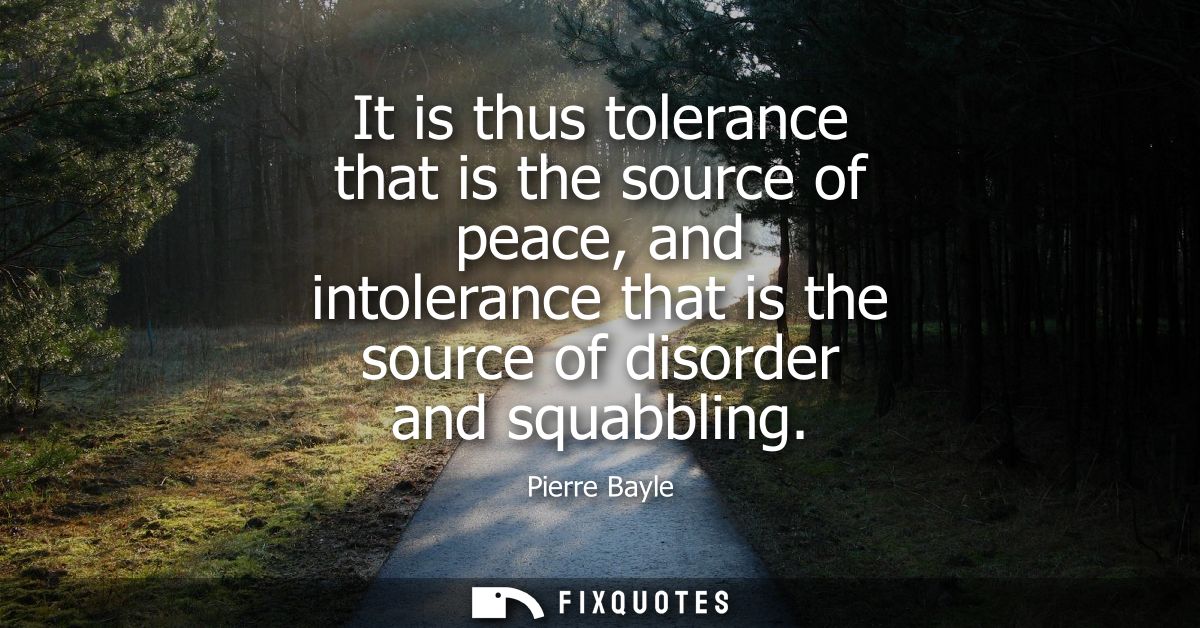
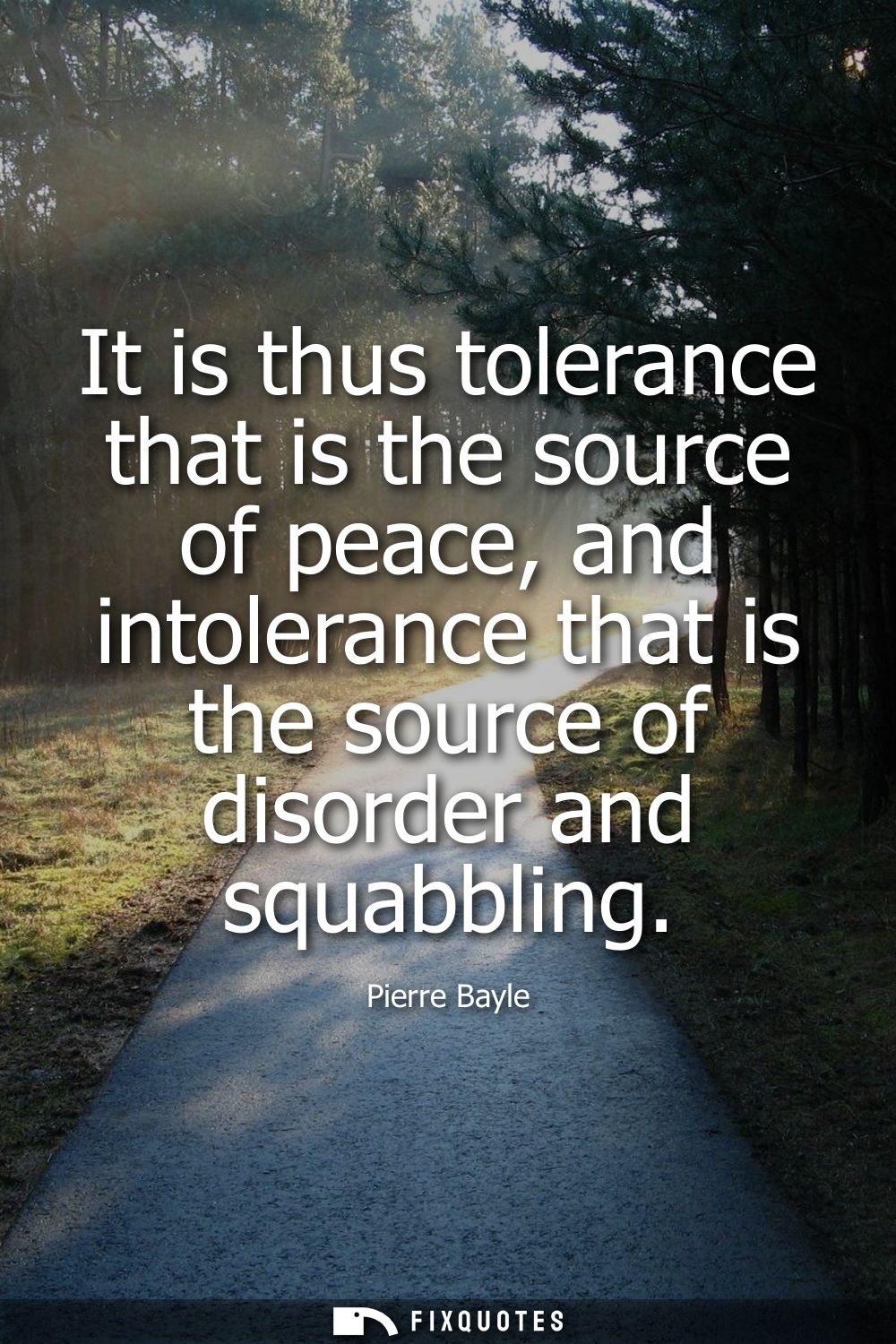
"It is thus tolerance that is the source of peace, and intolerance that is the source of disorder and squabbling"
About this Quote
The subtext is strategic and slightly subversive. Bayle isn't asking Catholics and Protestants to settle their metaphysics. He's downgrading theology as a basis for governance and upgrading coexistence as a measurable public good. "Squabbling" is doing cultural work here: it shrinks grand claims of holy purification into the petty reality they produce - feuds, factionalism, neighbor-against-neighbor policing. He's also taking a quiet jab at power: intolerance isn't just a private vice, it's something institutions administer, and it predictably creates instability that then justifies more repression.
Intent-wise, Bayle is arguing for a society that can survive pluralism. Tolerance becomes a peace treaty among imperfect humans, not a sentimental embrace. The sentence is neat, almost mathematical - source leads to outcome - because he's trying to make tolerance sound less like charity and more like common sense statecraft. In a Europe addicted to confessional uniformity, that clarity was its own provocation.
Quote Details
| Topic | Peace |
|---|---|
| Source | Verified source: A Philosophical Commentary on "Compel them to come in" (Pierre Bayle, 1708)
Evidence: Toleration therefore is the very Bond of Peace, and Non-Toleration the Source of Confusion and Squabble. (Part I, page 33 in the online edition (marked "[I-33]")). This is an English translation (1708) of Pierre Bayle’s 1686 French work commonly known as the Commentaire philosophique sur ces paroles de Jésus-Christ : « Contrains-les d’entrer ». The wording you provided (“It is thus tolerance that is the source of peace, and intolerance that is the source of disorder and squabbling”) is a modern paraphrase/variant. The closest primary-source wording I could verify directly in Bayle is the translator’s sentence above, located in the section arguing from pagan and philosophical sectarian diversity to show that intolerance (not tolerance) produces civil disorder. I did not locate, in a primary Bayle text viewable in this search session, the exact modern wording with “disorder and squabbling,” but I did find a French variant circulating online: “C’est donc la tolérance qui est la source de la paix, et l’intolérance qui est la source du désordre et des chamailleries.” That French sentence was found on a blog-like secondary page and is not, by itself, sufficient to establish Bayle’s exact original French phrasing or page location in a 1686 edition. Other candidates (1) Quote Junkie (Hagopian Institute, 2008) compilation95.3% ... Pierre Bayle It is thus tolerance that is the source of peace, and intolerance that is the source of disorder and... |
| Cite |
Citation Formats
APA Style (7th ed.)
Bayle, Pierre. (2026, February 11). It is thus tolerance that is the source of peace, and intolerance that is the source of disorder and squabbling. FixQuotes. https://fixquotes.com/quotes/it-is-thus-tolerance-that-is-the-source-of-peace-22636/
Chicago Style
Bayle, Pierre. "It is thus tolerance that is the source of peace, and intolerance that is the source of disorder and squabbling." FixQuotes. February 11, 2026. https://fixquotes.com/quotes/it-is-thus-tolerance-that-is-the-source-of-peace-22636/.
MLA Style (9th ed.)
"It is thus tolerance that is the source of peace, and intolerance that is the source of disorder and squabbling." FixQuotes, 11 Feb. 2026, https://fixquotes.com/quotes/it-is-thus-tolerance-that-is-the-source-of-peace-22636/. Accessed 5 Apr. 2026.