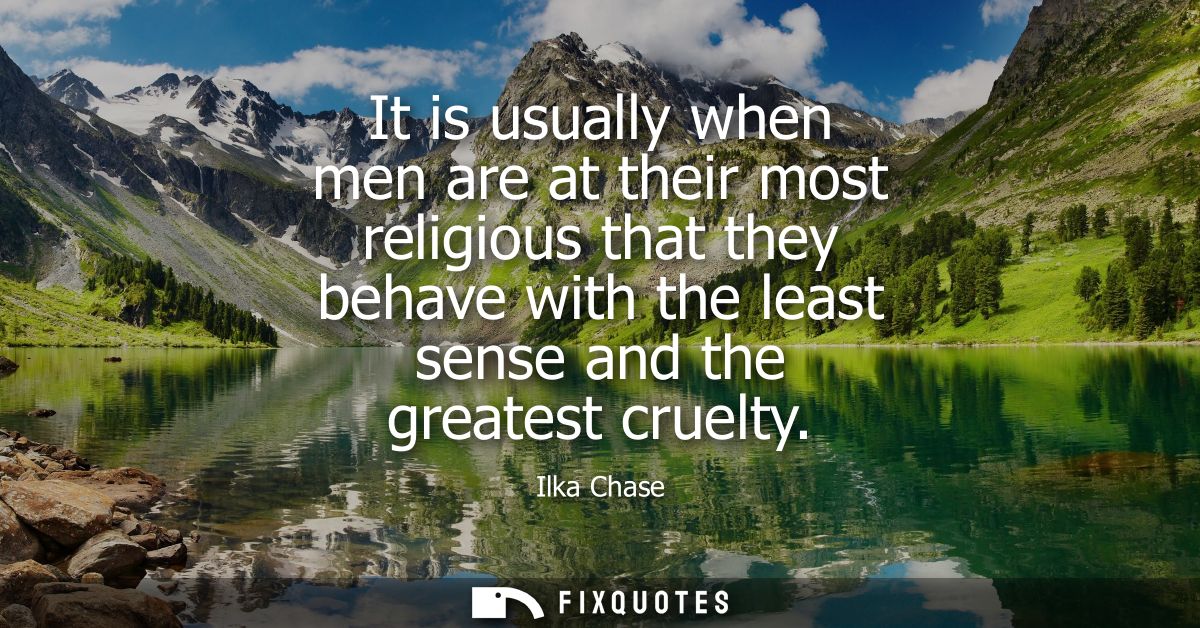
"It is usually when men are at their most religious that they behave with the least sense and the greatest cruelty"
About this Quote
That line lands like a slap because it refuses the comforting idea that piety reliably produces virtue. Coming from Ilka Chase, an actress who lived through the rise of mass media, wartime nationalism, and mid-century moral panics, it reads less like abstract philosophy and more like backstage reportage: she’s describing what happens when conviction becomes performance.
The phrasing does two things at once. “Usually” gives her deniability - she’s not claiming all religious people are irrational or cruel - but it also signals a pattern she thinks is common enough to trust. Then she sharpens the blade with “most religious,” not “most faithful” or “most spiritual.” That’s a tell. “Religious” here points to outward intensity: the loud, public, group-sustained version of belief that can turn into identity and status. When belief becomes a badge, “sense” (judgment, proportion, humility) is the first casualty, because moderation reads as betrayal.
The subtext is about permission. Elevated religiosity can create a moral fast lane where ordinary restraints don’t apply: cruelty reframed as duty, intolerance as righteousness, punishment as “love.” Chase is also calling out the emotional payoff: certainty is intoxicating, especially in anxious times. It simplifies messy human problems into clean categories of pure and impure, saved and damned, us and them.
Her intent isn’t to sneer at religion as such; it’s to warn how easily moral language can be weaponized when a community confuses fervor with goodness. In that sense, the quote is less anti-religious than anti-sanctimony - a critique of zeal as a social force, not belief as a private one.
The phrasing does two things at once. “Usually” gives her deniability - she’s not claiming all religious people are irrational or cruel - but it also signals a pattern she thinks is common enough to trust. Then she sharpens the blade with “most religious,” not “most faithful” or “most spiritual.” That’s a tell. “Religious” here points to outward intensity: the loud, public, group-sustained version of belief that can turn into identity and status. When belief becomes a badge, “sense” (judgment, proportion, humility) is the first casualty, because moderation reads as betrayal.
The subtext is about permission. Elevated religiosity can create a moral fast lane where ordinary restraints don’t apply: cruelty reframed as duty, intolerance as righteousness, punishment as “love.” Chase is also calling out the emotional payoff: certainty is intoxicating, especially in anxious times. It simplifies messy human problems into clean categories of pure and impure, saved and damned, us and them.
Her intent isn’t to sneer at religion as such; it’s to warn how easily moral language can be weaponized when a community confuses fervor with goodness. In that sense, the quote is less anti-religious than anti-sanctimony - a critique of zeal as a social force, not belief as a private one.
Quote Details
| Topic | Faith |
|---|
More Quotes by Ilka
Add to List