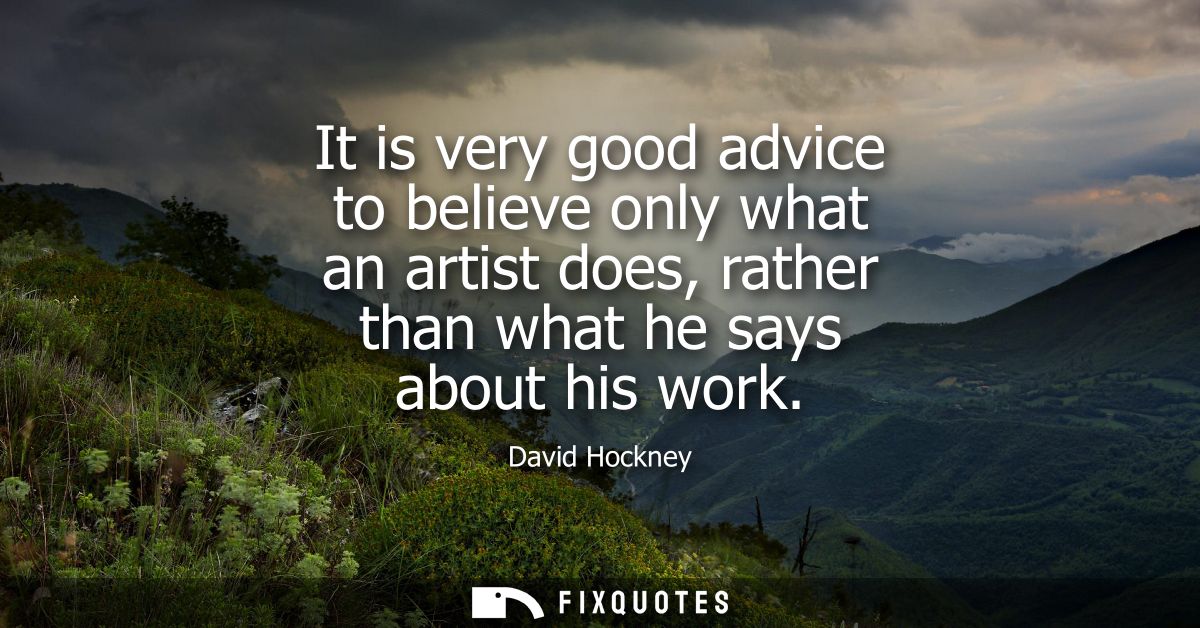
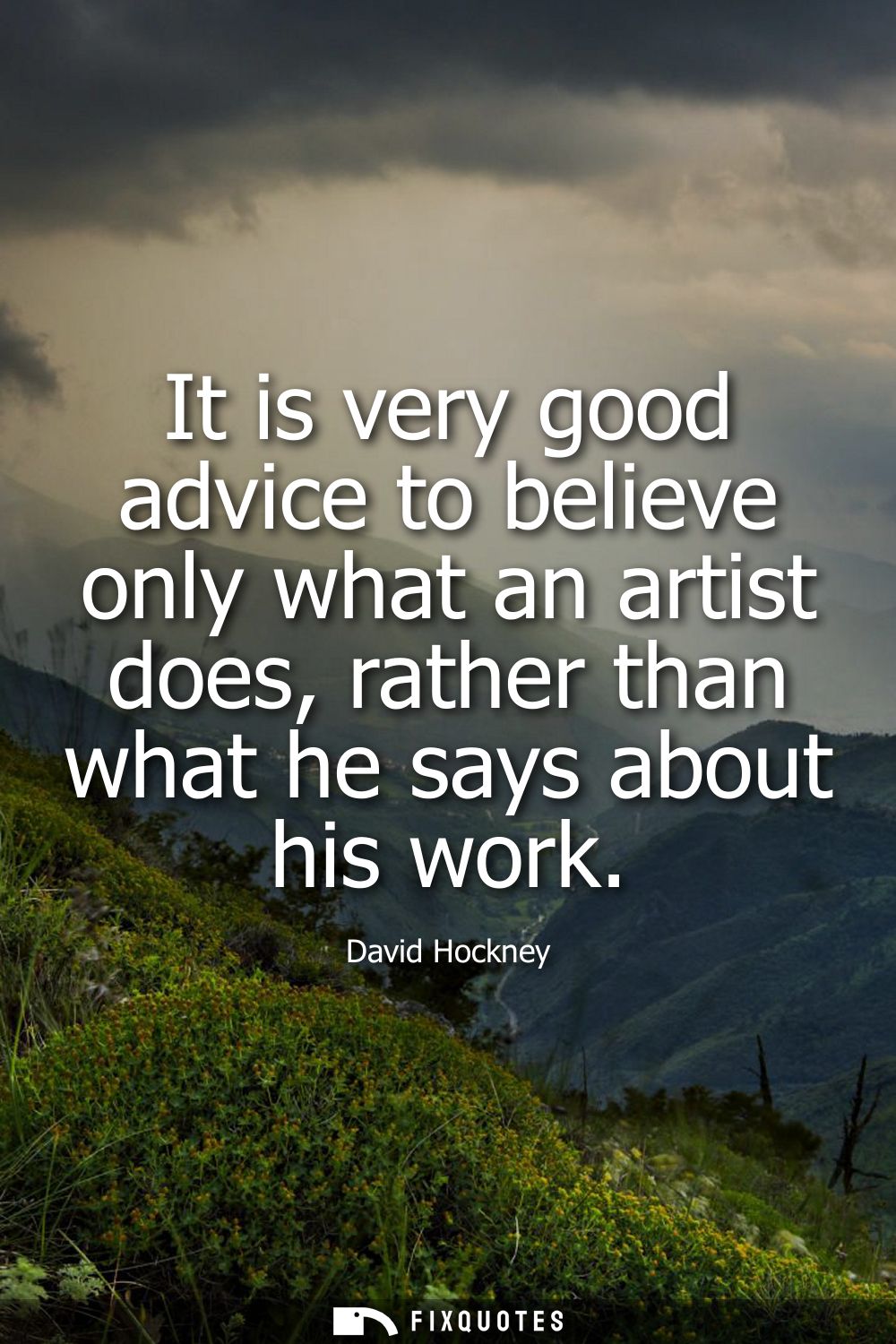
"It is very good advice to believe only what an artist does, rather than what he says about his work"
About this Quote
The intent is practical, even protective. When artists talk about their work, they’re often negotiating a room: collectors, critics, curators, interviewers, their own myths. Speech is social; it’s strategic, defensive, sometimes performative. An artist can misremember, posture, simplify, or deliberately misdirect. The work, by contrast, is a record of attention. It reveals what the artist can’t stop circling: the problems they obsess over, the forms they trust, the things they’re willing to sacrifice for an image.
There’s subtext here, too: Hockney is staking a claim for looking over listening, for visual evidence over interpretive gatekeeping. Coming from a painter who has moved between photography, stage design, iPad drawings, and obsessive studies of perception, it’s also autobiographical. His career argues that the real “statement” is method: how you see, how you build an image, how you keep revising what counts as real. The quote isn’t anti-intellectual; it’s anti-alibi. If you want to understand an artist, don’t chase their explanations. Track their decisions.
Quote Details
| Topic | Art |
|---|---|
| Source | Help us find the source |
| Cite |
Citation Formats
APA Style (7th ed.)
Hockney, David. (2026, January 15). It is very good advice to believe only what an artist does, rather than what he says about his work. FixQuotes. https://fixquotes.com/quotes/it-is-very-good-advice-to-believe-only-what-an-143526/
Chicago Style
Hockney, David. "It is very good advice to believe only what an artist does, rather than what he says about his work." FixQuotes. January 15, 2026. https://fixquotes.com/quotes/it-is-very-good-advice-to-believe-only-what-an-143526/.
MLA Style (9th ed.)
"It is very good advice to believe only what an artist does, rather than what he says about his work." FixQuotes, 15 Jan. 2026, https://fixquotes.com/quotes/it-is-very-good-advice-to-believe-only-what-an-143526/. Accessed 4 Mar. 2026.