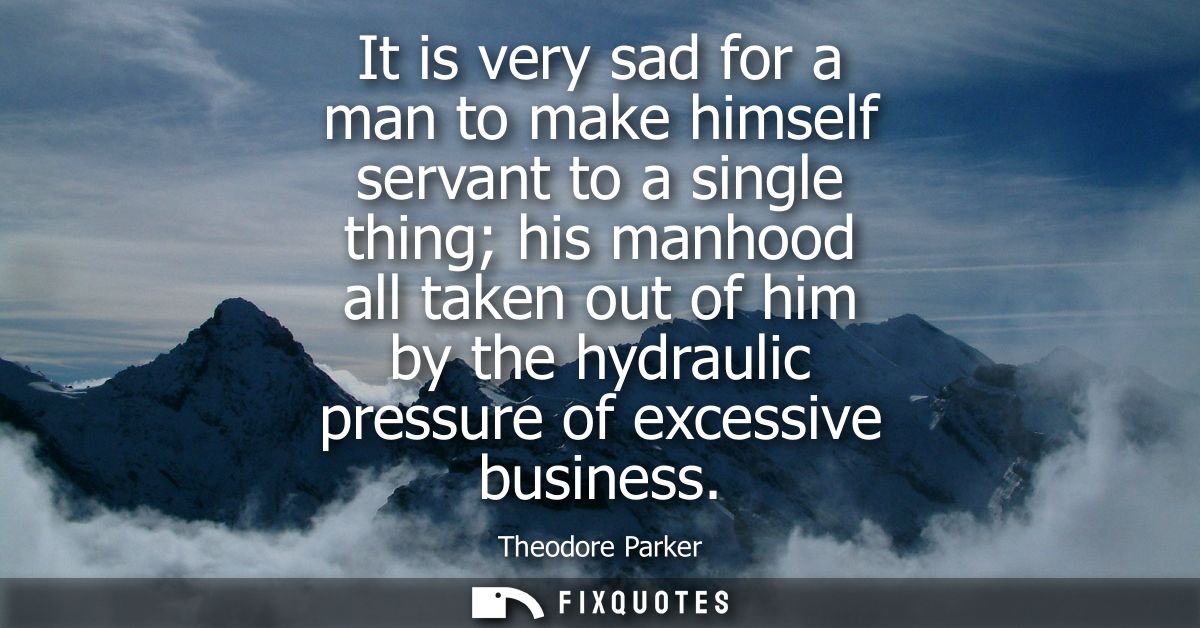
"It is very sad for a man to make himself servant to a single thing; his manhood all taken out of him by the hydraulic pressure of excessive business"
About this Quote
The phrasing “make himself servant” is also a quiet indictment. No tyrant needs to show up. The surrender is voluntary, even virtuous-seeming. That’s the subtext: the new bondage arrives disguised as responsibility, ambition, even providence. Parker’s moral vocabulary centers “manhood,” not in the chest-thumping sense, but as shorthand for full human agency - a person capable of conscience, community, and spiritual depth. Excessive business doesn’t merely exhaust; it hollows out, “all taken out of him,” leaving a functioning worker where a whole person used to be.
Context matters: Parker was a Unitarian reformer active in abolitionism and social critique, watching a market society accelerate and tighten its grip on daily life. The sentence is a theological intervention in economic language. It implies that a life consumed by “business” is not just unhealthy but spiritually deforming - a misdirection of devotion. Work becomes an idol, and the cost is the self.
Quote Details
| Topic | Work-Life Balance |
|---|---|
| Source | Help us find the source |
| Cite |
Citation Formats
APA Style (7th ed.)
Parker, Theodore. (2026, January 18). It is very sad for a man to make himself servant to a single thing; his manhood all taken out of him by the hydraulic pressure of excessive business. FixQuotes. https://fixquotes.com/quotes/it-is-very-sad-for-a-man-to-make-himself-servant-9842/
Chicago Style
Parker, Theodore. "It is very sad for a man to make himself servant to a single thing; his manhood all taken out of him by the hydraulic pressure of excessive business." FixQuotes. January 18, 2026. https://fixquotes.com/quotes/it-is-very-sad-for-a-man-to-make-himself-servant-9842/.
MLA Style (9th ed.)
"It is very sad for a man to make himself servant to a single thing; his manhood all taken out of him by the hydraulic pressure of excessive business." FixQuotes, 18 Jan. 2026, https://fixquotes.com/quotes/it-is-very-sad-for-a-man-to-make-himself-servant-9842/. Accessed 16 Feb. 2026.