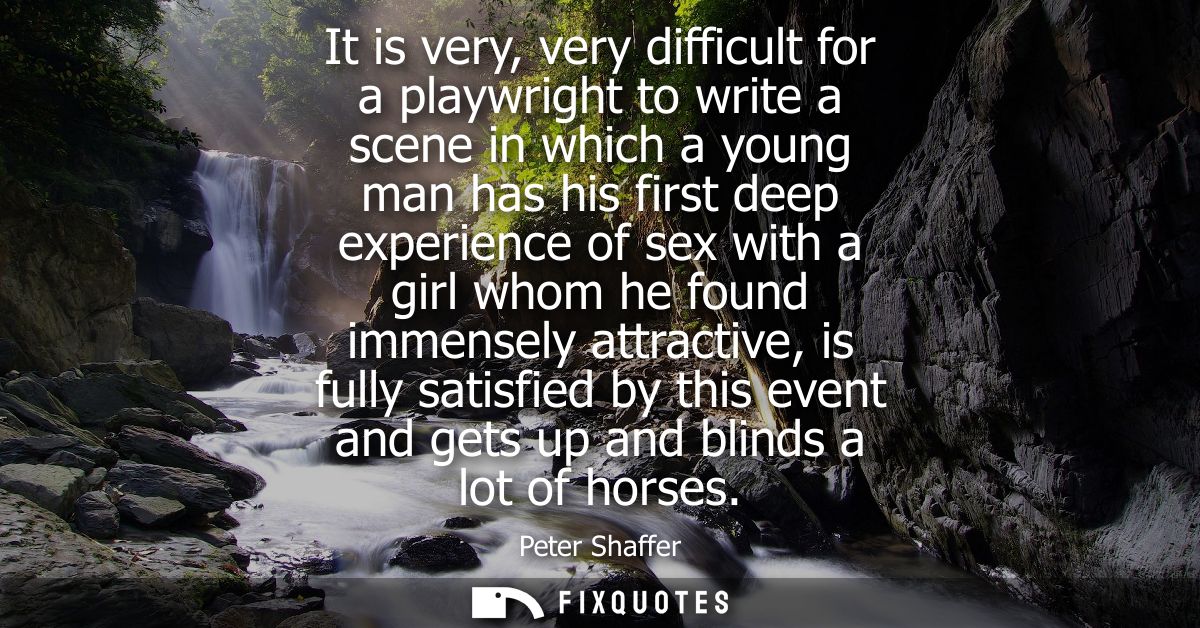
"It is very, very difficult for a playwright to write a scene in which a young man has his first deep experience of sex with a girl whom he found immensely attractive, is fully satisfied by this event and gets up and blinds a lot of horses"
About this Quote
The subtext is a critique of narrative appetite. A young man has consensual, pleasurable sex with someone he desires, feels content, and... what then? Contentment doesn’t generate scenes; it closes them. Theatre runs on imbalance: shame, longing, taboo, spiritual hunger, the itch that won’t stop. Shaffer’s syntax does the work: the clause piles up normality (“immensely attractive,” “fully satisfied”) until it becomes a trap, forcing the punchline to land as an indictment of our demand for crisis.
Contextually, it’s hard not to hear the ghost of Equus in the room. Shaffer wrote a play where erotic awakening, religious awe, and cruelty collapse into a single, theatrical image. He’s admitting that the kind of charged, symbol-heavy extremity that made Equus possible isn’t an accident; it’s a structural pressure. The quote doubles as craft advice and self-satire: if you want the audience’s attention, don’t give them healthy sexuality and a tidy resolution. Give them a rupture that reads like destiny.
Quote Details
| Topic | Writing |
|---|---|
| Source | Help us find the source |
| Cite |
Citation Formats
APA Style (7th ed.)
Shaffer, Peter. (2026, January 16). It is very, very difficult for a playwright to write a scene in which a young man has his first deep experience of sex with a girl whom he found immensely attractive, is fully satisfied by this event and gets up and blinds a lot of horses. FixQuotes. https://fixquotes.com/quotes/it-is-very-very-difficult-for-a-playwright-to-109417/
Chicago Style
Shaffer, Peter. "It is very, very difficult for a playwright to write a scene in which a young man has his first deep experience of sex with a girl whom he found immensely attractive, is fully satisfied by this event and gets up and blinds a lot of horses." FixQuotes. January 16, 2026. https://fixquotes.com/quotes/it-is-very-very-difficult-for-a-playwright-to-109417/.
MLA Style (9th ed.)
"It is very, very difficult for a playwright to write a scene in which a young man has his first deep experience of sex with a girl whom he found immensely attractive, is fully satisfied by this event and gets up and blinds a lot of horses." FixQuotes, 16 Jan. 2026, https://fixquotes.com/quotes/it-is-very-very-difficult-for-a-playwright-to-109417/. Accessed 27 Mar. 2026.