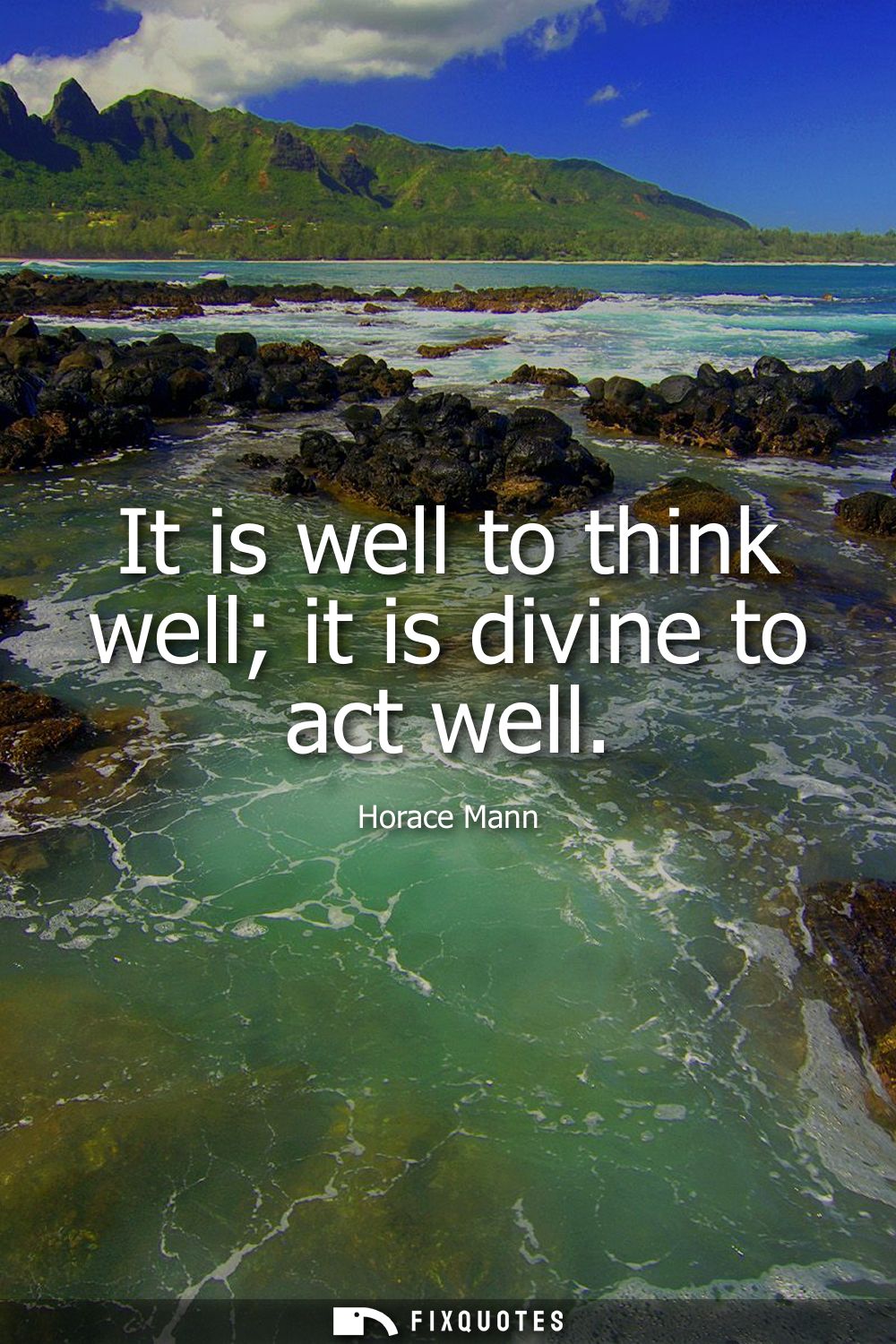
"It is well to think well; it is divine to act well"
About this Quote
Mann’s line flatters the armchair moralist for a beat, then quietly demotes them. “It is well to think well” gives intellectual virtue its due: reflection matters, principles matter, conscience matters. But he’s writing as an educator and reformer in an America busy building schools, cities, and inequalities at the same time. In that context, “well” is the polite baseline; “divine” is the provocation. He’s not praising piety so much as shaming complacency. If you stop at good thoughts, you’ve done something decent. If you convert thought into conduct, you’ve crossed into the realm of the sacred.
The craft is in the symmetry. Two clauses, same cadence, same verb structure, one small swap that changes everything: think becomes act. It’s a rhetorical staircase, and the last step is a dare. Mann understood a central weakness of reform culture: the temptation to treat enlightened opinions as a substitute for labor. The subtext is pointedly political. In a society where education was pitched as a moral engine, “thinking well” could mean endorsing lofty ideals while tolerating brutal realities; “acting well” demands institution-building, voting, funding, teaching, risking reputation.
Calling action “divine” also redefines holiness as public behavior, not private belief. For an educator, that’s strategic: it shifts virtue from the sermon to the classroom, from intention to policy, from self-image to measurable impact. The line lands because it refuses to let morality be merely a mood.
The craft is in the symmetry. Two clauses, same cadence, same verb structure, one small swap that changes everything: think becomes act. It’s a rhetorical staircase, and the last step is a dare. Mann understood a central weakness of reform culture: the temptation to treat enlightened opinions as a substitute for labor. The subtext is pointedly political. In a society where education was pitched as a moral engine, “thinking well” could mean endorsing lofty ideals while tolerating brutal realities; “acting well” demands institution-building, voting, funding, teaching, risking reputation.
Calling action “divine” also redefines holiness as public behavior, not private belief. For an educator, that’s strategic: it shifts virtue from the sermon to the classroom, from intention to policy, from self-image to measurable impact. The line lands because it refuses to let morality be merely a mood.
Quote Details
| Topic | Ethics & Morality |
|---|---|
| Source | Help us find the source |
| Cite |
Citation Formats
APA Style (7th ed.)
Mann, Horace. (2026, January 18). It is well to think well; it is divine to act well. FixQuotes. https://fixquotes.com/quotes/it-is-well-to-think-well-it-is-divine-to-act-well-5246/
Chicago Style
Mann, Horace. "It is well to think well; it is divine to act well." FixQuotes. January 18, 2026. https://fixquotes.com/quotes/it-is-well-to-think-well-it-is-divine-to-act-well-5246/.
MLA Style (9th ed.)
"It is well to think well; it is divine to act well." FixQuotes, 18 Jan. 2026, https://fixquotes.com/quotes/it-is-well-to-think-well-it-is-divine-to-act-well-5246/. Accessed 11 Mar. 2026.
More Quotes by Horace
Add to List