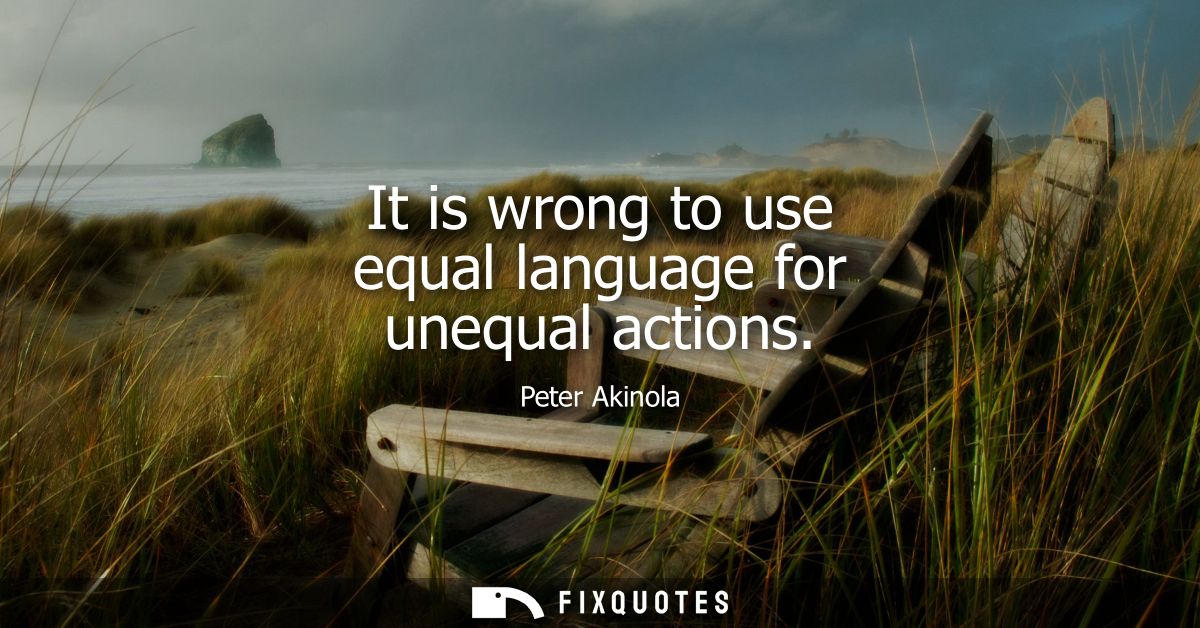
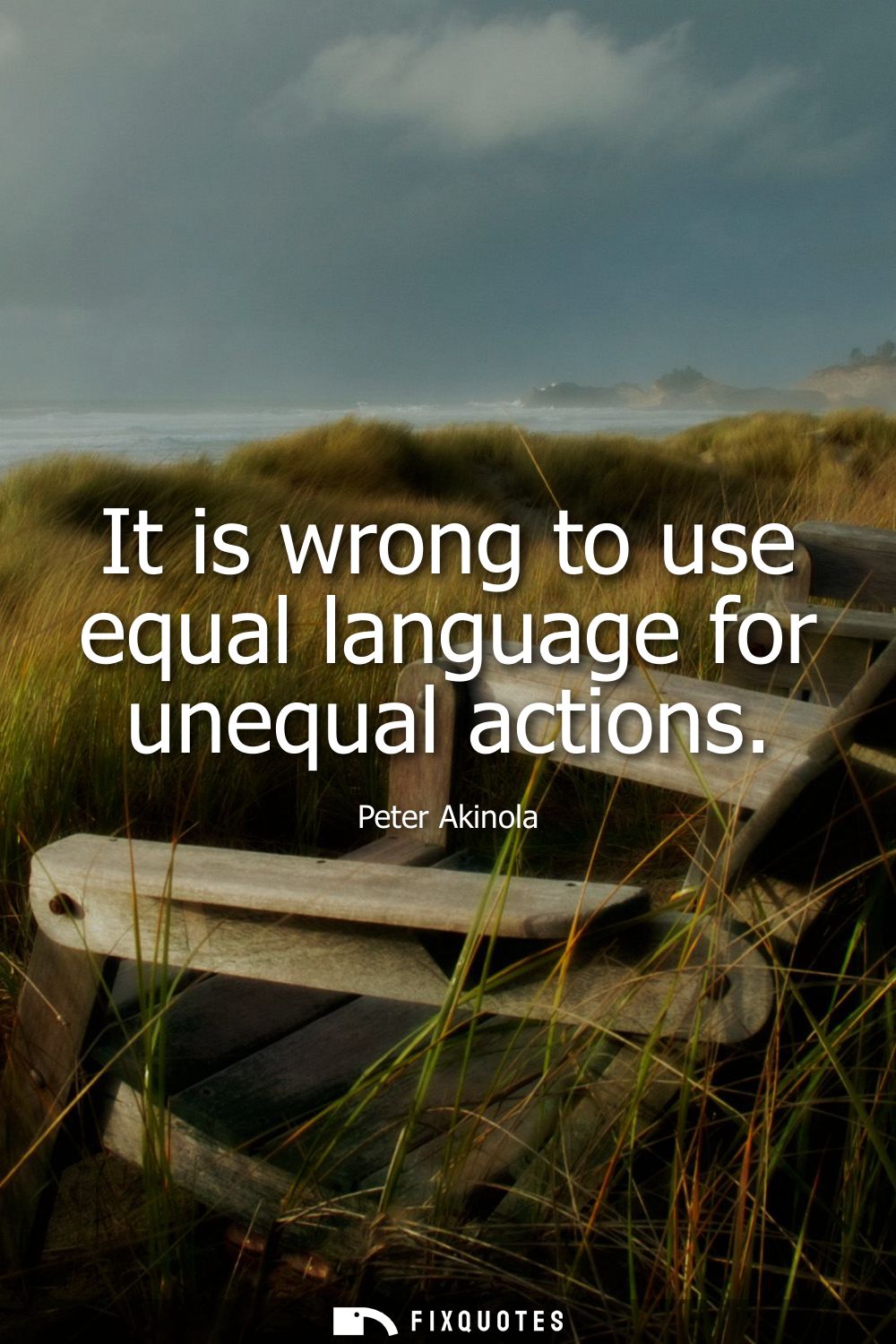
"It is wrong to use equal language for unequal actions"
About this Quote
Akinola's line is a demand that rhetoric stop laundering moral differences. "Equal language" is the press release, the diplomatic statement, the polite euphemism that files everything down to the same bland category: "mistakes were made", "both sides", "an incident occurred". Against that flattening, he insists on hierarchy - not of people, but of deeds. Some acts, in his view, deserve the verbal weight of condemnation; others merit restraint, mercy, or simple description. Calling them by the same name is not neutrality, it's a kind of complicity.
The phrasing is deceptively spare. By focusing on "language" rather than law or punishment, Akinola targets the first battlefield where institutions often lose their nerve: naming. The subtext is pastoral and political at once. A cleric is supposed to be a custodian of moral vocabulary; when that vocabulary is diluted, the community's capacity to judge - and to feel appropriate shame or outrage - erodes. He's also pushing back against modern habits of equivalence: the tendency to treat all conflicts as symmetrical, all offenses as comparable, all disagreements as two valid "perspectives."
Context matters because Akinola has been a combative public religious figure, especially in debates where Western media frameworks prized "balance". Read that way, the quote doubles as a warning shot at journalists, diplomats, and church bodies: stop pretending your even-handed language is fairness when it may be evasion. It's a call for discrimination in the older sense - the courage to draw lines, publicly, with words that actually mean something.
The phrasing is deceptively spare. By focusing on "language" rather than law or punishment, Akinola targets the first battlefield where institutions often lose their nerve: naming. The subtext is pastoral and political at once. A cleric is supposed to be a custodian of moral vocabulary; when that vocabulary is diluted, the community's capacity to judge - and to feel appropriate shame or outrage - erodes. He's also pushing back against modern habits of equivalence: the tendency to treat all conflicts as symmetrical, all offenses as comparable, all disagreements as two valid "perspectives."
Context matters because Akinola has been a combative public religious figure, especially in debates where Western media frameworks prized "balance". Read that way, the quote doubles as a warning shot at journalists, diplomats, and church bodies: stop pretending your even-handed language is fairness when it may be evasion. It's a call for discrimination in the older sense - the courage to draw lines, publicly, with words that actually mean something.
Quote Details
| Topic | Ethics & Morality |
|---|---|
| Source | Help us find the source |
| Cite |
Citation Formats
APA Style (7th ed.)
Akinola, Peter. (2026, January 16). It is wrong to use equal language for unequal actions. FixQuotes. https://fixquotes.com/quotes/it-is-wrong-to-use-equal-language-for-unequal-133454/
Chicago Style
Akinola, Peter. "It is wrong to use equal language for unequal actions." FixQuotes. January 16, 2026. https://fixquotes.com/quotes/it-is-wrong-to-use-equal-language-for-unequal-133454/.
MLA Style (9th ed.)
"It is wrong to use equal language for unequal actions." FixQuotes, 16 Jan. 2026, https://fixquotes.com/quotes/it-is-wrong-to-use-equal-language-for-unequal-133454/. Accessed 28 Mar. 2026.
More Quotes by Peter
Add to List