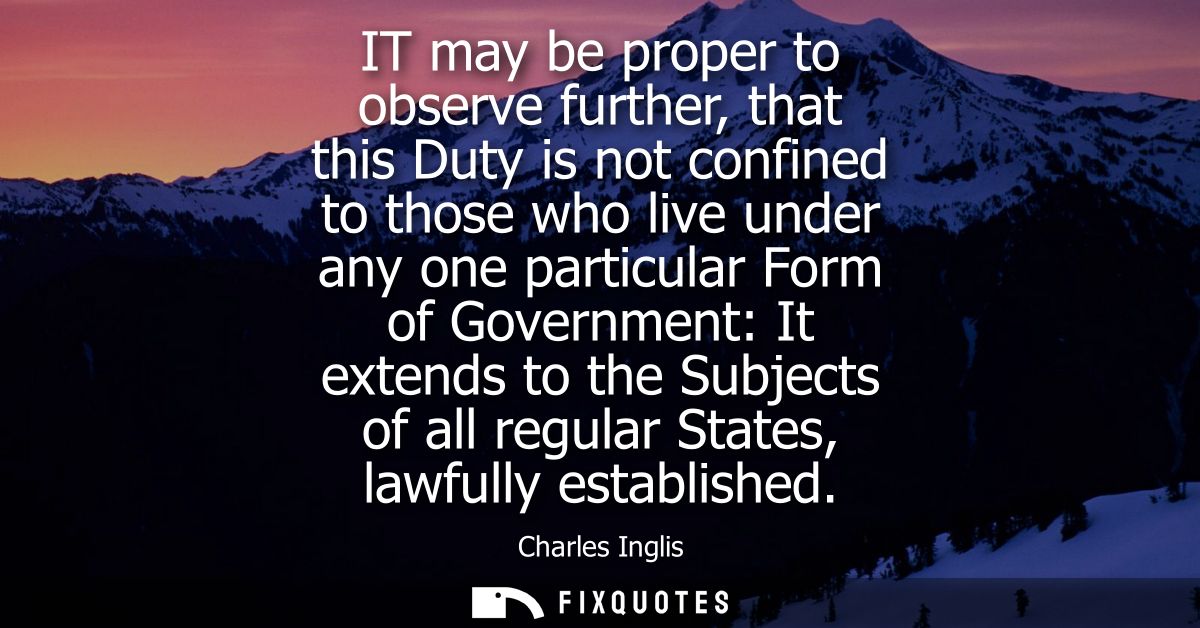
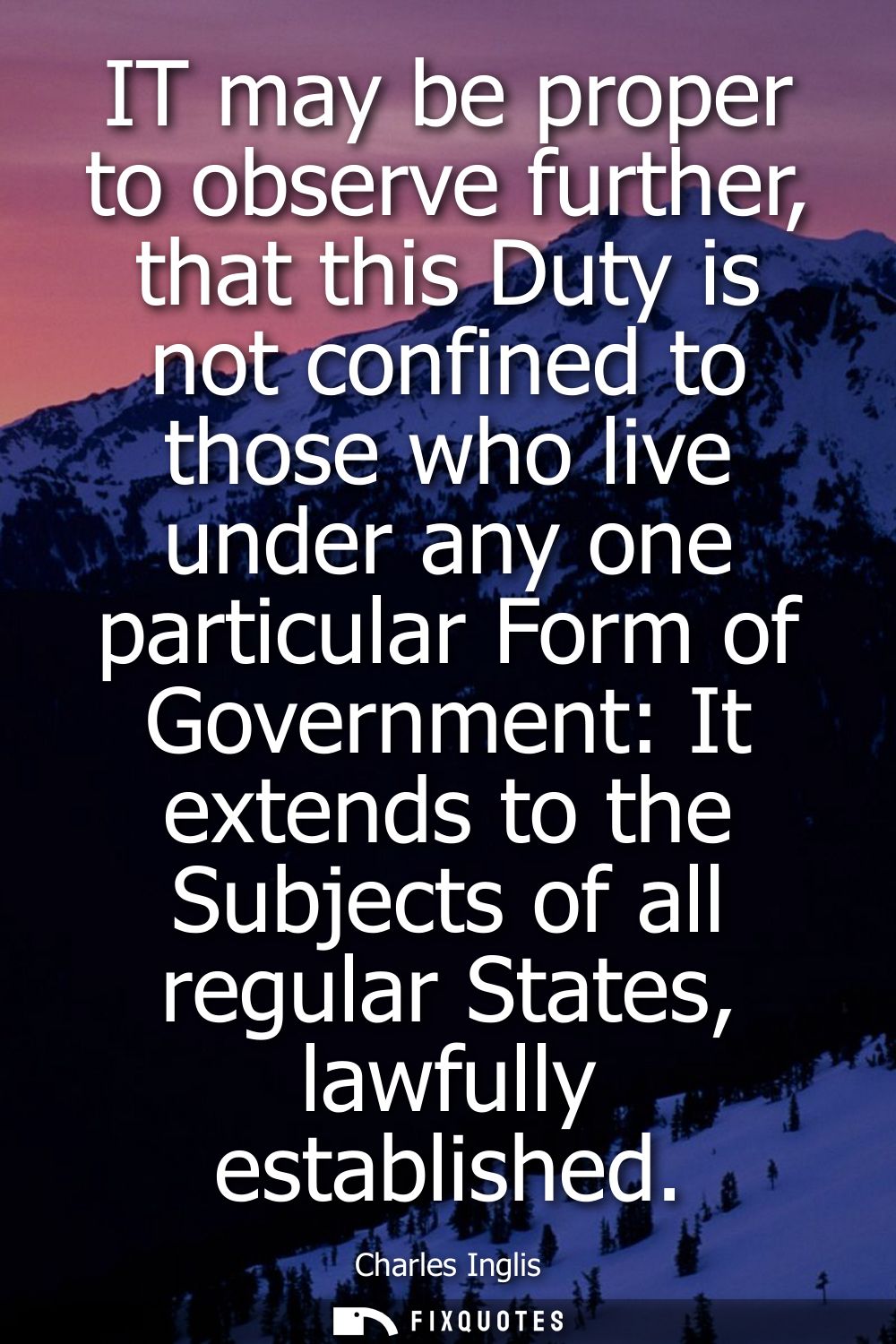
"IT may be proper to observe further, that this Duty is not confined to those who live under any one particular Form of Government: It extends to the Subjects of all regular States, lawfully established"
About this Quote
The key phrase is “lawfully established,” a velvet rope disguised as a definition. It sounds neutral but functions like a gatekeeping device: once a regime is labeled “regular” and “lawful,” subjects’ obligations are settled in advance. That collapses the moral space where revolutions try to argue: that legality can be corrupted, that authority can forfeit legitimacy, that conscience can outrank the state.
Context sharpens the intent. Inglis was a prominent Loyalist Anglican clergyman during the American Revolution, writing against the Patriot case for rebellion. His rhetoric borrows the Church’s aura of permanence to counter a political movement built on improvisation and rupture. The subtext is pastoral but prosecutorial: if you disobey established government, you are not merely choosing a side; you are defecting from the architecture that keeps society “regular” at all. It’s an argument designed less to persuade rebels than to steady the wavering - offering a clean moral rule in a time when legality itself was being renegotiated.
Quote Details
| Topic | Justice |
|---|---|
| Source | Help us find the source |
| Cite |
Citation Formats
APA Style (7th ed.)
Inglis, Charles. (2026, January 17). IT may be proper to observe further, that this Duty is not confined to those who live under any one particular Form of Government: It extends to the Subjects of all regular States, lawfully established. FixQuotes. https://fixquotes.com/quotes/it-may-be-proper-to-observe-further-that-this-49659/
Chicago Style
Inglis, Charles. "IT may be proper to observe further, that this Duty is not confined to those who live under any one particular Form of Government: It extends to the Subjects of all regular States, lawfully established." FixQuotes. January 17, 2026. https://fixquotes.com/quotes/it-may-be-proper-to-observe-further-that-this-49659/.
MLA Style (9th ed.)
"IT may be proper to observe further, that this Duty is not confined to those who live under any one particular Form of Government: It extends to the Subjects of all regular States, lawfully established." FixQuotes, 17 Jan. 2026, https://fixquotes.com/quotes/it-may-be-proper-to-observe-further-that-this-49659/. Accessed 10 Feb. 2026.