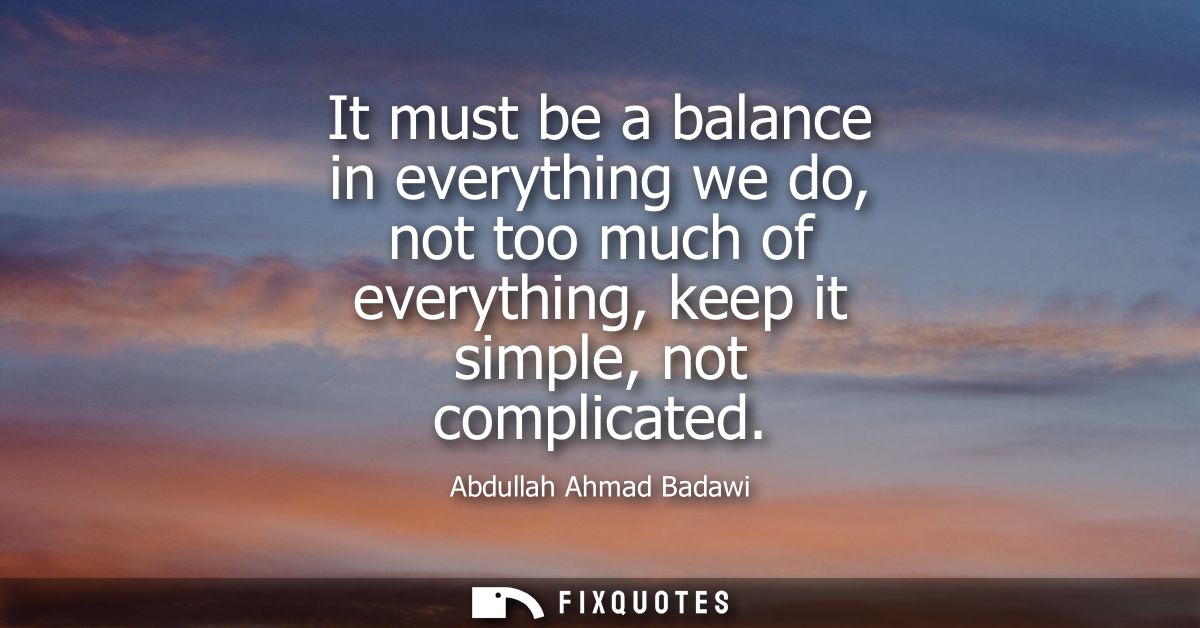
"It must be a balance in everything we do, not too much of everything, keep it simple, not complicated"
About this Quote
The phrasing also reveals a governing style that prizes social harmony over ideological purity. “Keep it simple, not complicated” reads like a rebuttal to technocratic overreach and partisan theatrics at the same time. It’s an appeal to common sense, a way to position leadership as housekeeping rather than crusade. In Southeast Asian political contexts especially, “balance” can function as code for stability: keeping multiple constituencies, ethnic communities, and economic interests from tipping into open conflict. Simplicity becomes a political aesthetic, suggesting calm competence in an environment where complexity can look like excuse-making.
Subtextually, this is a defensive kind of idealism. It assumes extremity is the main danger and that the public wants a referee, not a revolutionary. That makes the quote rhetorically effective: it flatters listeners as reasonable adults. It also invites critique: “balance” can be prudence, or it can be a way to avoid accountability. The line works because it offers a soothing philosophy that sounds like principle while remaining flexible enough to govern by circumstance.
Quote Details
| Topic | Life |
|---|---|
| Source | Help us find the source |
| Cite |
Citation Formats
APA Style (7th ed.)
Badawi, Abdullah Ahmad. (2026, January 17). It must be a balance in everything we do, not too much of everything, keep it simple, not complicated. FixQuotes. https://fixquotes.com/quotes/it-must-be-a-balance-in-everything-we-do-not-too-44799/
Chicago Style
Badawi, Abdullah Ahmad. "It must be a balance in everything we do, not too much of everything, keep it simple, not complicated." FixQuotes. January 17, 2026. https://fixquotes.com/quotes/it-must-be-a-balance-in-everything-we-do-not-too-44799/.
MLA Style (9th ed.)
"It must be a balance in everything we do, not too much of everything, keep it simple, not complicated." FixQuotes, 17 Jan. 2026, https://fixquotes.com/quotes/it-must-be-a-balance-in-everything-we-do-not-too-44799/. Accessed 27 Mar. 2026.