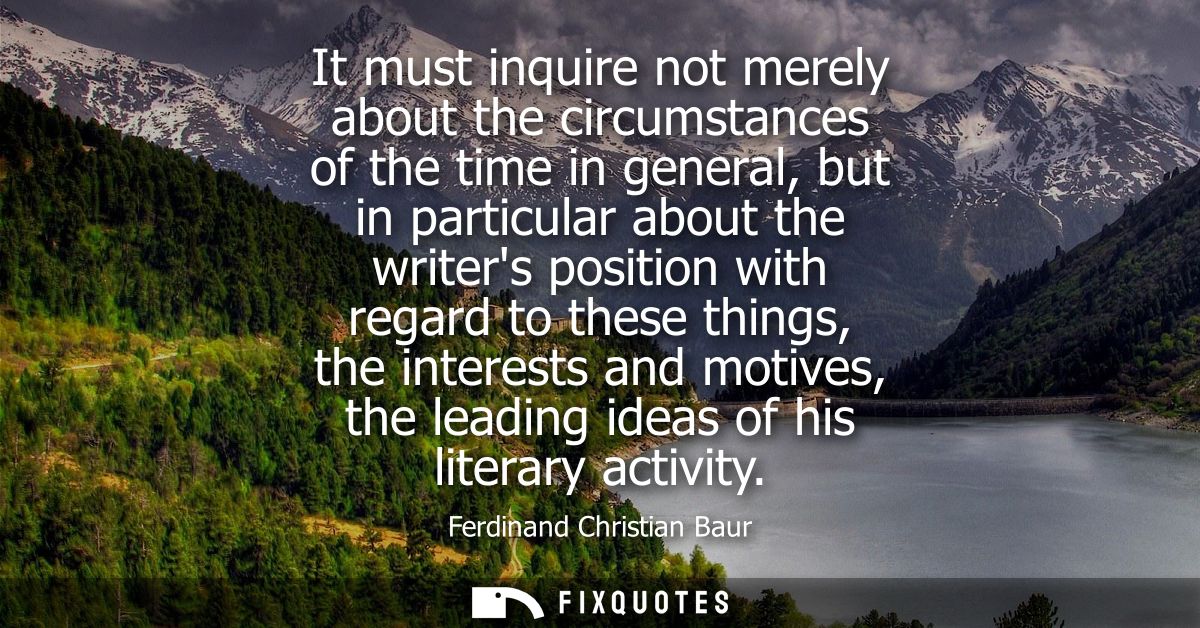
"It must inquire not merely about the circumstances of the time in general, but in particular about the writer's position with regard to these things, the interests and motives, the leading ideas of his literary activity"
About this Quote
The phrase “position with regard to these things” smuggles in a whole program: authors don’t just reflect an era, they negotiate it. They have stakes. They choose angles. They play to factions. Baur’s list - “interests and motives,” “leading ideas,” “literary activity” - reads like a checklist for unmasking. It’s also a warning against pious neutrality: if you treat a writer’s claims as pure truth without asking what they’re trying to do, you’ve already been persuaded.
Context matters because Baur’s own field was scripture, where questions of authorship, dating, and agenda are dynamite. His higher-critical approach (famously applied to the New Testament) reframed theological texts as products of conflict, development, and institutional need. The subtext is bracingly modern: interpretation isn’t just decoding meaning; it’s reconstructing strategy. What looks like doctrine may be persuasion. What looks like timelessness may be a well-designed intervention in a very particular fight.
Quote Details
| Topic | Writing |
|---|---|
| Source | Help us find the source |
| Cite |
Citation Formats
APA Style (7th ed.)
Baur, Ferdinand Christian. (2026, January 16). It must inquire not merely about the circumstances of the time in general, but in particular about the writer's position with regard to these things, the interests and motives, the leading ideas of his literary activity. FixQuotes. https://fixquotes.com/quotes/it-must-inquire-not-merely-about-the-95344/
Chicago Style
Baur, Ferdinand Christian. "It must inquire not merely about the circumstances of the time in general, but in particular about the writer's position with regard to these things, the interests and motives, the leading ideas of his literary activity." FixQuotes. January 16, 2026. https://fixquotes.com/quotes/it-must-inquire-not-merely-about-the-95344/.
MLA Style (9th ed.)
"It must inquire not merely about the circumstances of the time in general, but in particular about the writer's position with regard to these things, the interests and motives, the leading ideas of his literary activity." FixQuotes, 16 Jan. 2026, https://fixquotes.com/quotes/it-must-inquire-not-merely-about-the-95344/. Accessed 12 Feb. 2026.