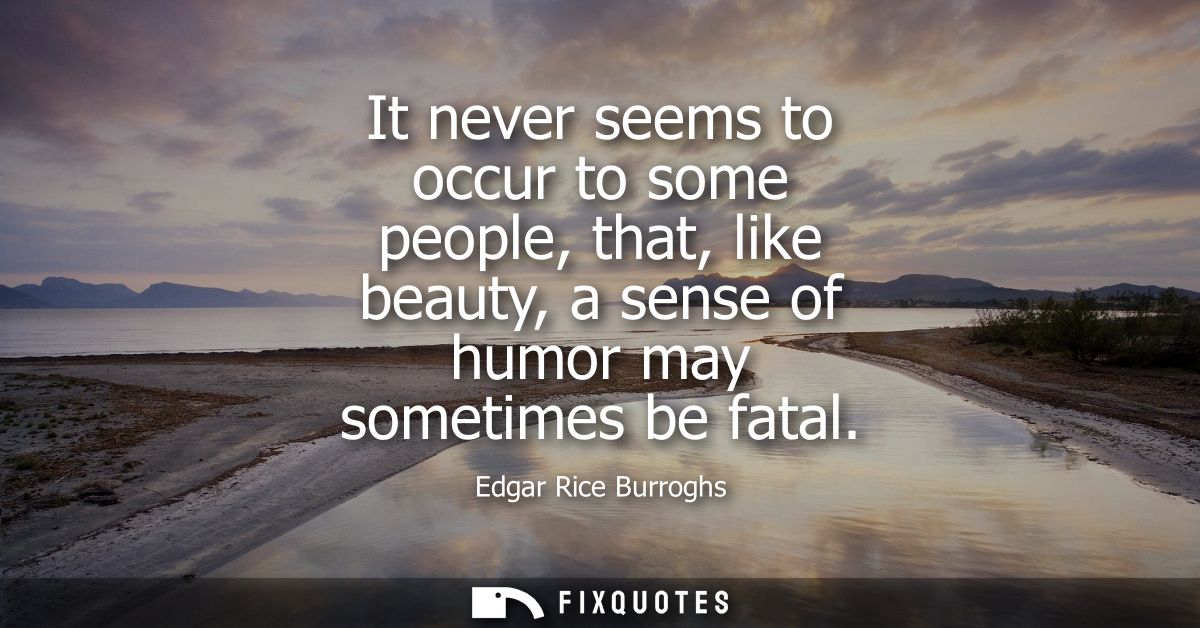
"It never seems to occur to some people, that, like beauty, a sense of humor may sometimes be fatal"
About this Quote
A sense of humor is usually sold as social lubricant, a harmless flex of intelligence. Burroughs flips it into a liability, even a weapon: something that can get you killed for the same reason beauty can get you targeted, envied, pursued, or punished. The line works because it refuses the comforting idea that charm is always protective. In his adventure universe, the traits that make you stand out are precisely the traits that put a mark on you.
The intent is slyly corrective. Burroughs aims at “some people” who treat wit as consequence-free, as if a well-timed joke is exempt from the rules governing pride, power, and violence. The subtext is that humor is not neutral; it’s status play. A joke can expose hypocrisy, puncture authority, or signal superiority. That’s fun when you’re safe. It’s “fatal” when the wrong person is listening, or when the joke reveals you as unafraid, unmanageable, or simply too visible.
Context matters: Burroughs wrote in a popular early-20th-century mode where masculinity, honor codes, and social hierarchies collide in frontier spaces and imperial fantasies. In those settings, beauty and humor operate like currency and provocation at once. Both invite attention; both invite retaliation. The cynicism isn’t anti-laughter so much as anti-naivete: if you can’t imagine humor having consequences, you probably haven’t met the kind of power that can’t tolerate being laughed at.
The intent is slyly corrective. Burroughs aims at “some people” who treat wit as consequence-free, as if a well-timed joke is exempt from the rules governing pride, power, and violence. The subtext is that humor is not neutral; it’s status play. A joke can expose hypocrisy, puncture authority, or signal superiority. That’s fun when you’re safe. It’s “fatal” when the wrong person is listening, or when the joke reveals you as unafraid, unmanageable, or simply too visible.
Context matters: Burroughs wrote in a popular early-20th-century mode where masculinity, honor codes, and social hierarchies collide in frontier spaces and imperial fantasies. In those settings, beauty and humor operate like currency and provocation at once. Both invite attention; both invite retaliation. The cynicism isn’t anti-laughter so much as anti-naivete: if you can’t imagine humor having consequences, you probably haven’t met the kind of power that can’t tolerate being laughed at.
Quote Details
| Topic | Witty One-Liners |
|---|---|
| Source | Help us find the source |
More Quotes by Edgar
Add to List