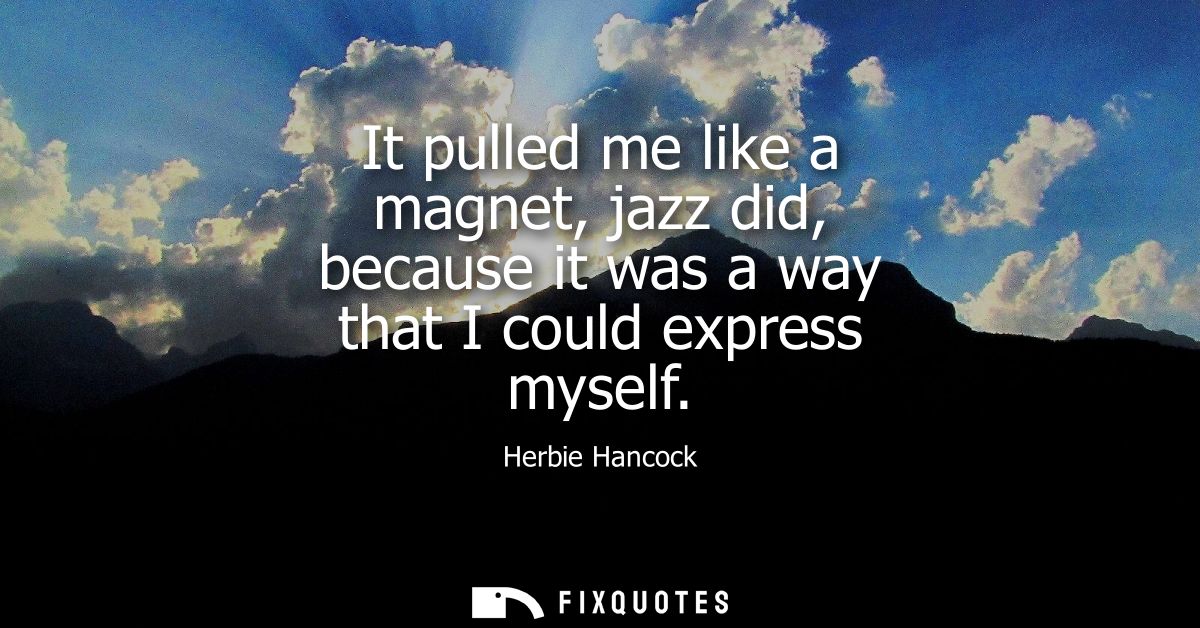
"It pulled me like a magnet, jazz did, because it was a way that I could express myself"
About this Quote
The second half lands even harder: “because it was a way that I could express myself.” Hancock isn’t praising jazz as an abstract genre or a museum tradition. He’s describing it as a technology of selfhood, a system built for turning inner weather into sound in real time. Jazz offers a rare combination: rules dense enough to test a brain like his, and freedom immediate enough to make personality audible. Your touch, your timing, your risk tolerance, your willingness to be wrong in public - all become the message.
There’s also a quiet cultural argument inside the simplicity. For a Black American musician coming of age in the postwar era, “express myself” carries the weight of contested space: who gets to be complex, experimental, and not merely entertaining. Hancock’s career - from Miles Davis to Headhunters to electronic innovation - backs up the claim. Jazz pulled because it allowed movement: across styles, across audiences, across the boundary between discipline and discovery.
Quote Details
| Topic | Music |
|---|---|
| Source | Help us find the source |
| Cite |
Citation Formats
APA Style (7th ed.)
Hancock, Herbie. (2026, January 15). It pulled me like a magnet, jazz did, because it was a way that I could express myself. FixQuotes. https://fixquotes.com/quotes/it-pulled-me-like-a-magnet-jazz-did-because-it-155831/
Chicago Style
Hancock, Herbie. "It pulled me like a magnet, jazz did, because it was a way that I could express myself." FixQuotes. January 15, 2026. https://fixquotes.com/quotes/it-pulled-me-like-a-magnet-jazz-did-because-it-155831/.
MLA Style (9th ed.)
"It pulled me like a magnet, jazz did, because it was a way that I could express myself." FixQuotes, 15 Jan. 2026, https://fixquotes.com/quotes/it-pulled-me-like-a-magnet-jazz-did-because-it-155831/. Accessed 12 Feb. 2026.