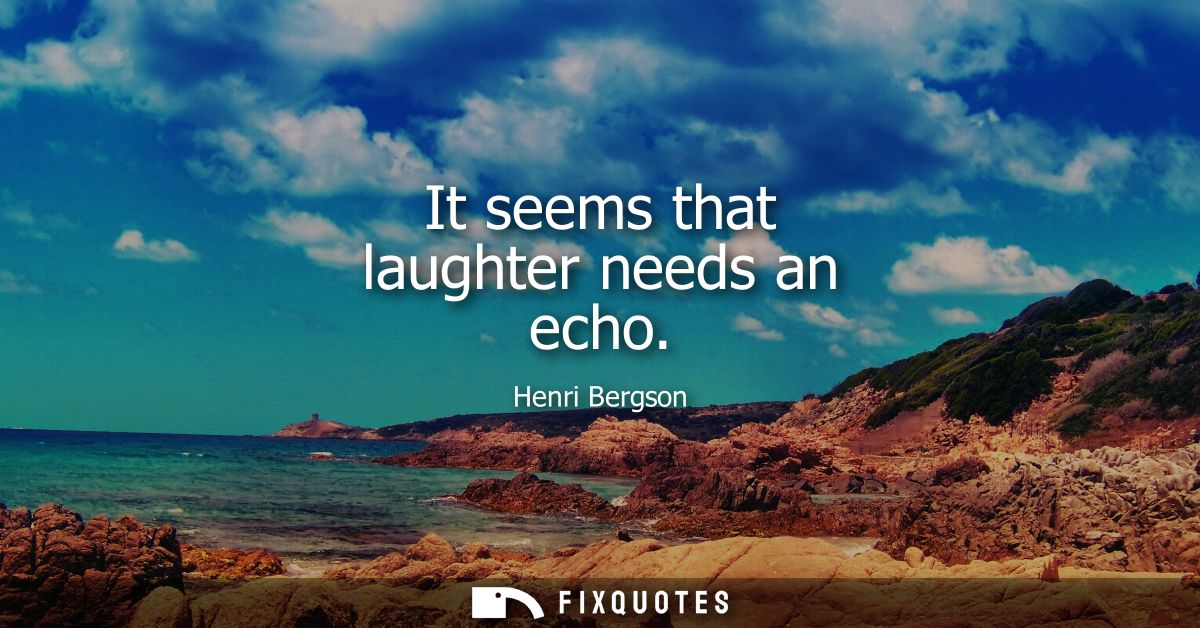
"It seems that laughter needs an echo"
About this Quote
Laughter, Bergson suggests, is rarely a solitary act of pure feeling; it’s a social signal hunting for confirmation. “It seems” is doing quiet philosophical work here: not a decree, but an observation about human behavior that invites you to notice how often a joke dies in silence, how quickly humor blooms when a room gives it back. The “echo” turns laughter into something like a call-and-response ritual, where the sound matters less than the shared recognition behind it.
Bergson’s larger project in Laughter (1900) treats comedy as a social corrective: we laugh when we catch a person behaving mechanically, rigidly, out of sync with the flexible demands of living with others. Read through that lens, the echo isn’t just companionship; it’s enforcement. When a group laughs together, it’s a soft sanction, a way of saying: don’t be that. The line hints at laughter’s double edge: communal warmth on the surface, communal pressure underneath.
The context matters because Bergson is writing in a modernizing France obsessed with crowds, manners, and the choreography of public life. The “echo” is the audience, the salon, the boulevard, the theater: spaces where identity is negotiated in real time. Even today, you can hear Bergson in the mechanics of virality - laugh tracks, reaction videos, meme culture - all engineered echoes that certify what’s funny. The subtext is blunt: humor isn’t only about amusement; it’s about belonging, and belonging is policed by who laughs back.
Bergson’s larger project in Laughter (1900) treats comedy as a social corrective: we laugh when we catch a person behaving mechanically, rigidly, out of sync with the flexible demands of living with others. Read through that lens, the echo isn’t just companionship; it’s enforcement. When a group laughs together, it’s a soft sanction, a way of saying: don’t be that. The line hints at laughter’s double edge: communal warmth on the surface, communal pressure underneath.
The context matters because Bergson is writing in a modernizing France obsessed with crowds, manners, and the choreography of public life. The “echo” is the audience, the salon, the boulevard, the theater: spaces where identity is negotiated in real time. Even today, you can hear Bergson in the mechanics of virality - laugh tracks, reaction videos, meme culture - all engineered echoes that certify what’s funny. The subtext is blunt: humor isn’t only about amusement; it’s about belonging, and belonging is policed by who laughs back.
Quote Details
| Topic | Funny |
|---|---|
| Source | Help us find the source |
| Cite |
Citation Formats
APA Style (7th ed.)
Bergson, Henri. (2026, January 18). It seems that laughter needs an echo. FixQuotes. https://fixquotes.com/quotes/it-seems-that-laughter-needs-an-echo-2647/
Chicago Style
Bergson, Henri. "It seems that laughter needs an echo." FixQuotes. January 18, 2026. https://fixquotes.com/quotes/it-seems-that-laughter-needs-an-echo-2647/.
MLA Style (9th ed.)
"It seems that laughter needs an echo." FixQuotes, 18 Jan. 2026, https://fixquotes.com/quotes/it-seems-that-laughter-needs-an-echo-2647/. Accessed 27 Mar. 2026.
More Quotes by Henri
Add to List