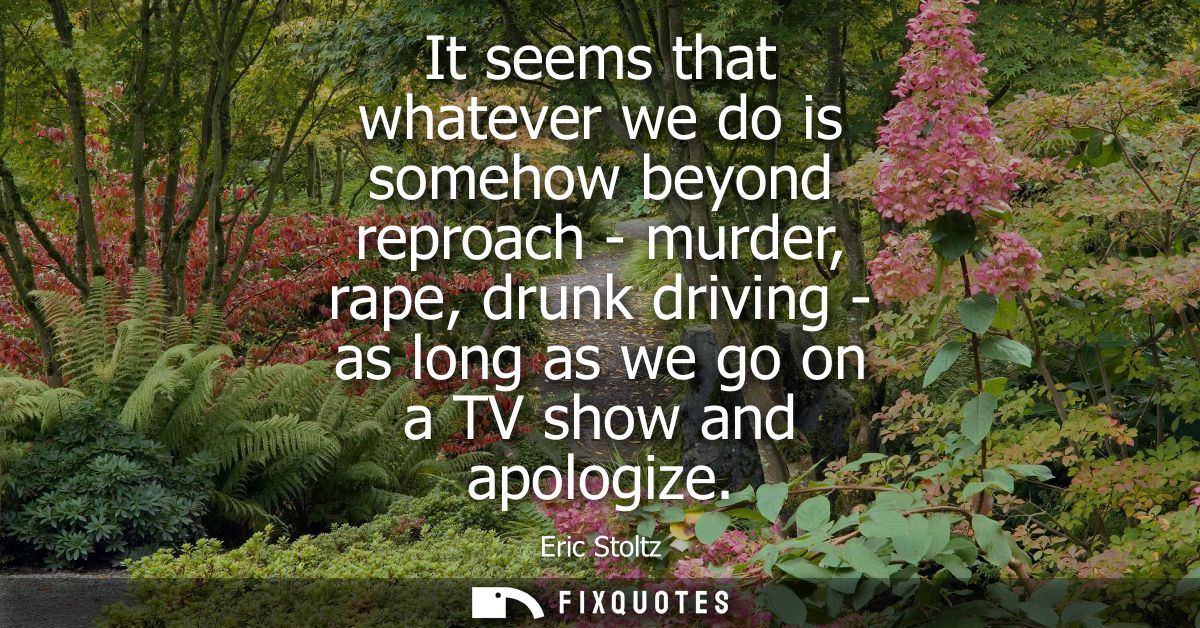
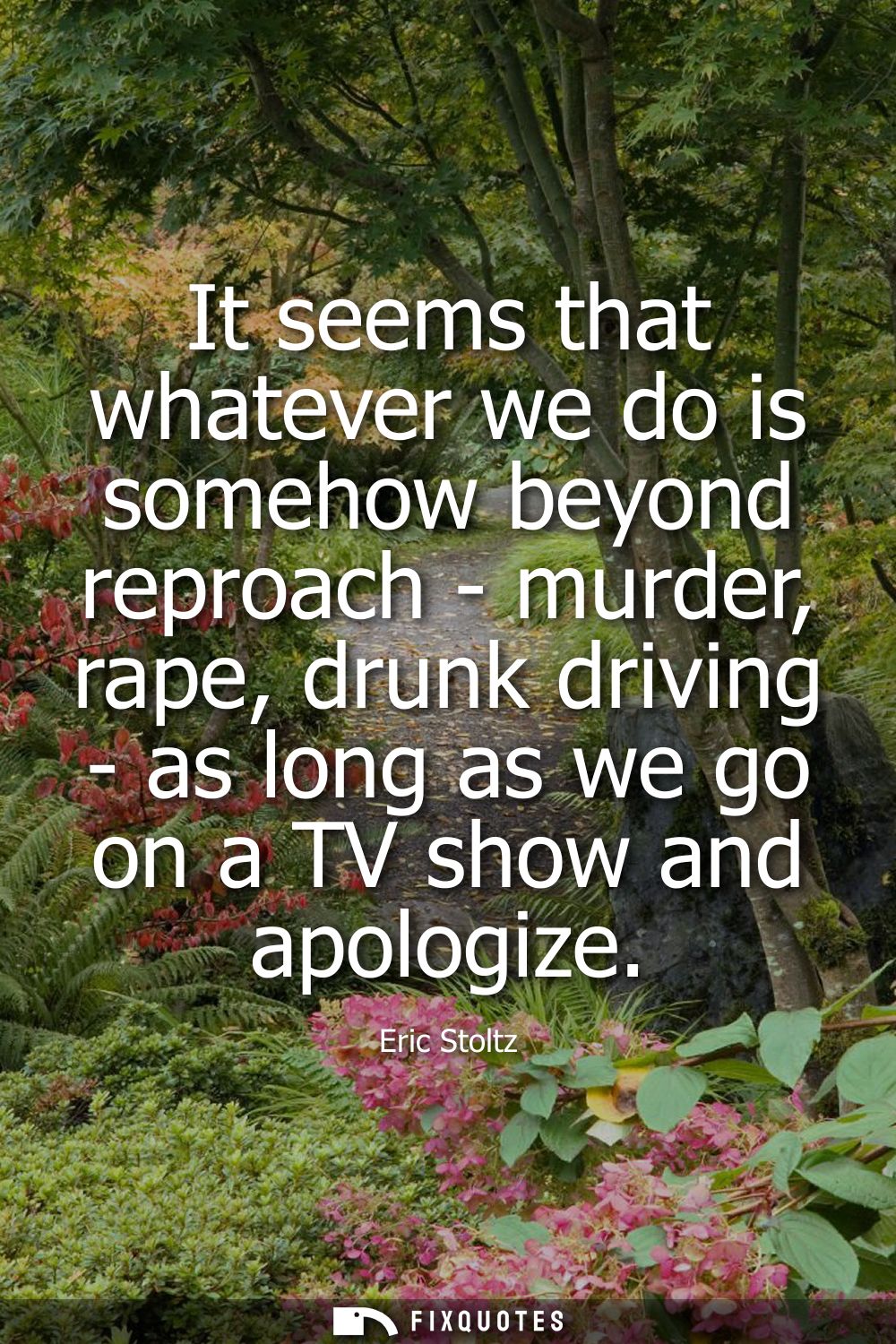
"It seems that whatever we do is somehow beyond reproach - murder, rape, drunk driving - as long as we go on a TV show and apologize"
About this Quote
The line works because it attacks the performance economy, not merely bad behavior. “Go on a TV show and apologize” frames accountability as content: a consumable narrative arc where harm becomes backstory and repentance becomes a rebrand. The subtext is cynical but accurate: public shame has been domesticated into programming, packaged with ad breaks, and sold as catharsis for viewers who want resolution without consequence.
Contextually, it lands in a late-20th/early-21st-century media landscape where talk shows, tabloid TV, and now social platforms turn crisis management into a genre. Stoltz, as an actor, is especially positioned to notice the trick: we reward the best performance, even when the stakes aren’t a role but other people’s lives. The target isn’t apology itself; it’s the industry that converts it into absolution.
Quote Details
| Topic | Ethics & Morality |
|---|---|
| Source | Help us find the source |
| Cite |
Citation Formats
APA Style (7th ed.)
Stoltz, Eric. (2026, January 16). It seems that whatever we do is somehow beyond reproach - murder, rape, drunk driving - as long as we go on a TV show and apologize. FixQuotes. https://fixquotes.com/quotes/it-seems-that-whatever-we-do-is-somehow-beyond-122380/
Chicago Style
Stoltz, Eric. "It seems that whatever we do is somehow beyond reproach - murder, rape, drunk driving - as long as we go on a TV show and apologize." FixQuotes. January 16, 2026. https://fixquotes.com/quotes/it-seems-that-whatever-we-do-is-somehow-beyond-122380/.
MLA Style (9th ed.)
"It seems that whatever we do is somehow beyond reproach - murder, rape, drunk driving - as long as we go on a TV show and apologize." FixQuotes, 16 Jan. 2026, https://fixquotes.com/quotes/it-seems-that-whatever-we-do-is-somehow-beyond-122380/. Accessed 28 Mar. 2026.