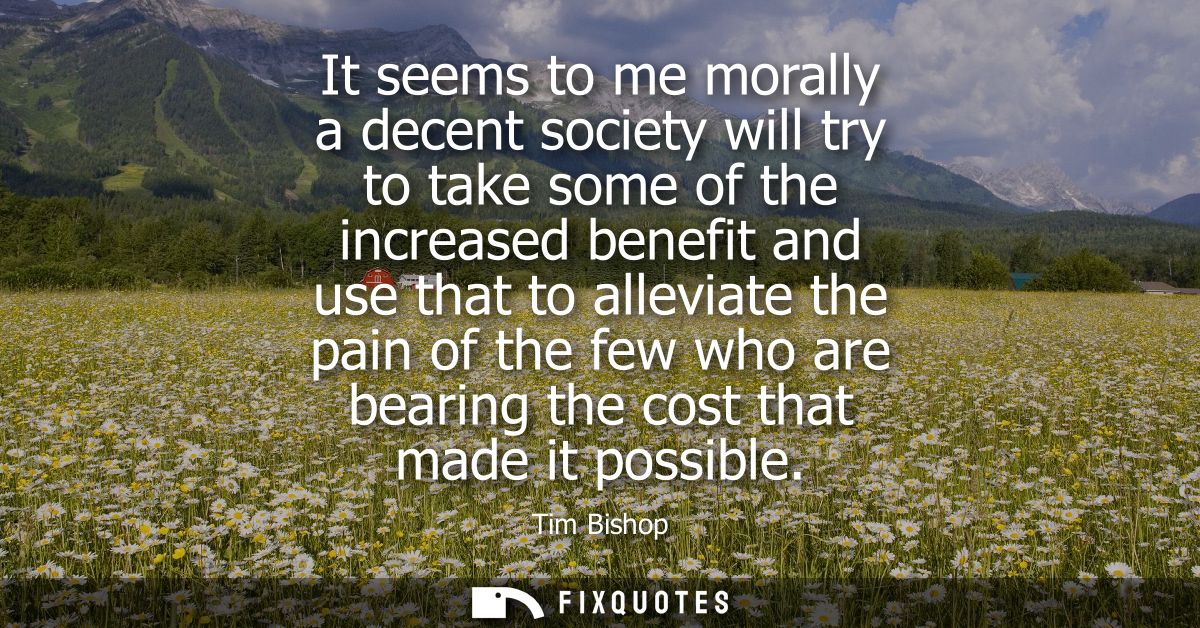
"It seems to me, morally, a decent society will try to take some of the increased benefit and use that to alleviate the pain of the few who are bearing the cost that made it possible"
About this Quote
That framing does two things at once. It reassures beneficiaries that they can keep "some of the increased benefit" (not all, not even most) while insisting that decency requires a rebate to those who got cut out of the deal. It's a moderation tactic: justice, but calibrated. He doesn't invoke rights or entitlement; he invokes "morally... decent", a softer civic standard that aims to recruit even people allergic to big-government language.
The subtext is an argument against the shrug that often accompanies modern policymaking: the idea that disruption is regrettable but necessary and the displaced should simply "adapt". Bishop rejects that as insufficiently adult. If society knowingly cashes a check written on someone else's stability, it inherits an obligation. In context, it's the classic social-contract pitch for unemployment insurance, retraining, regional investment, or targeted safety nets - not as charity, but as the maintenance fee for an economy that prides itself on dynamism.
Quote Details
| Topic | Justice |
|---|---|
| Source | Help us find the source |
| Cite |
Citation Formats
APA Style (7th ed.)
Bishop, Tim. (2026, February 17). It seems to me, morally, a decent society will try to take some of the increased benefit and use that to alleviate the pain of the few who are bearing the cost that made it possible. FixQuotes. https://fixquotes.com/quotes/it-seems-to-me-morally-a-decent-society-will-try-105422/
Chicago Style
Bishop, Tim. "It seems to me, morally, a decent society will try to take some of the increased benefit and use that to alleviate the pain of the few who are bearing the cost that made it possible." FixQuotes. February 17, 2026. https://fixquotes.com/quotes/it-seems-to-me-morally-a-decent-society-will-try-105422/.
MLA Style (9th ed.)
"It seems to me, morally, a decent society will try to take some of the increased benefit and use that to alleviate the pain of the few who are bearing the cost that made it possible." FixQuotes, 17 Feb. 2026, https://fixquotes.com/quotes/it-seems-to-me-morally-a-decent-society-will-try-105422/. Accessed 30 Mar. 2026.