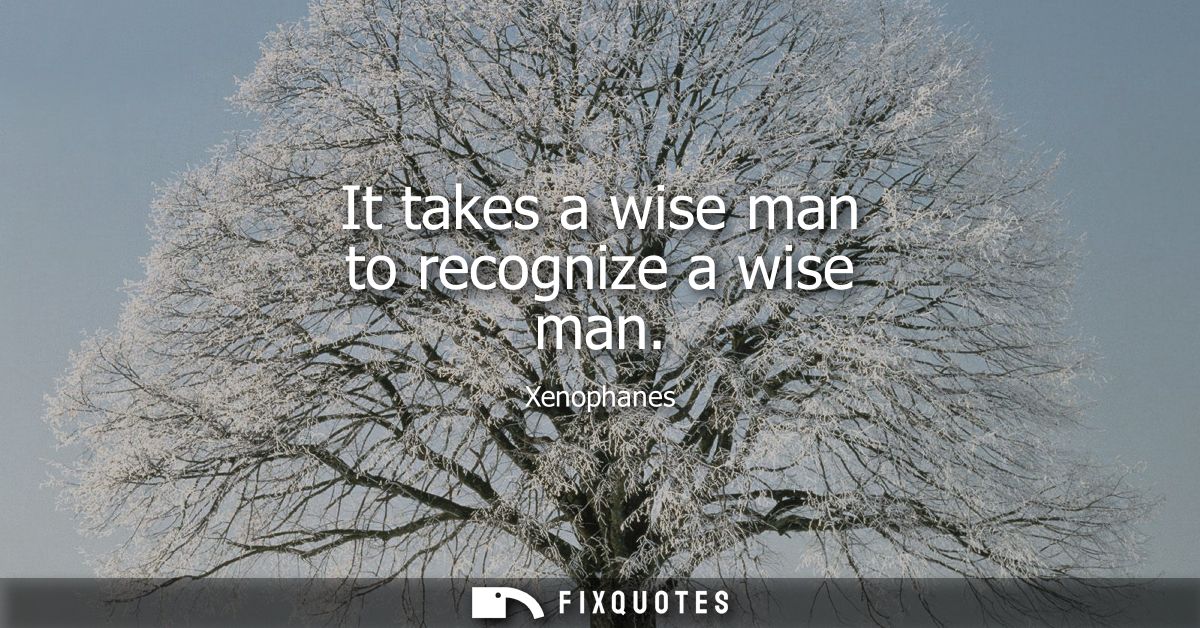
"It takes a wise man to recognize a wise man"
About this Quote
A neat little paradox sits inside Xenophanes line: wisdom is not self-certifying, and it is not democratically legible. "It takes a wise man to recognize a wise man" doesn’t flatter an elite so much as it exposes a problem in how communities decide who deserves authority. If only the wise can spot wisdom, then public judgment is structurally unreliable; the crowd is left mistaking confidence for insight, tradition for truth, charisma for competence. Xenophanes, famous for skewering anthropomorphic gods and the complacency of received belief, is needling the same human weakness here: we want shortcuts to the real thing.
The subtext is epistemological and political at once. Epistemological, because it implies that recognition is a skill, not a reflex. You can’t evaluate arguments you don’t have the tools to understand; ignorance doesn’t just lack knowledge, it lacks the ability to identify knowledge. Political, because it suggests why bad leaders and bad ideas thrive: they are easy to "get". Wisdom, by contrast, often arrives as difficulty, restraint, or unpopular nuance.
Context matters: Xenophanes is writing in a Greek world where poets, priests, and city fathers claim cultural supremacy, and where the new figure of the philosopher is trying to carve out legitimacy. The line doubles as a warning and a self-defense. It warns audiences against trusting consensus as a truth test. It also quietly asserts that philosophy may look like heresy or pedantry to the untrained - and that dismissal proves less about the thinker than about the dismissers.
The subtext is epistemological and political at once. Epistemological, because it implies that recognition is a skill, not a reflex. You can’t evaluate arguments you don’t have the tools to understand; ignorance doesn’t just lack knowledge, it lacks the ability to identify knowledge. Political, because it suggests why bad leaders and bad ideas thrive: they are easy to "get". Wisdom, by contrast, often arrives as difficulty, restraint, or unpopular nuance.
Context matters: Xenophanes is writing in a Greek world where poets, priests, and city fathers claim cultural supremacy, and where the new figure of the philosopher is trying to carve out legitimacy. The line doubles as a warning and a self-defense. It warns audiences against trusting consensus as a truth test. It also quietly asserts that philosophy may look like heresy or pedantry to the untrained - and that dismissal proves less about the thinker than about the dismissers.
Quote Details
| Topic | Wisdom |
|---|---|
| Source | Later attribution: Help for Helpers (Hazelden Publishing, Anonymous, Krist..., 1994) modern compilationISBN: 9781568380612 · ID: 3I8J4wsnLCYC
Evidence: ... It takes a wise man to recognize a wise man . Xenophanes Do I recognize wisdom ? We're all learning constantly , from everything and everyone that touches us . But what are we learning ? Who are our teachers ? Are we learning laziness ... Other candidates (1) Lives of Eminent Philosophers (Xenophanes, 3)50.0% Naturally, for it takes a wise man to recognize a wise man. (Book IX, section 20). The earliest primary-source witnes... |
| Cite |
Citation Formats
APA Style (7th ed.)
Xenophanes. (2026, March 14). It takes a wise man to recognize a wise man. FixQuotes. https://fixquotes.com/quotes/it-takes-a-wise-man-to-recognize-a-wise-man-128451/
Chicago Style
Xenophanes. "It takes a wise man to recognize a wise man." FixQuotes. March 14, 2026. https://fixquotes.com/quotes/it-takes-a-wise-man-to-recognize-a-wise-man-128451/.
MLA Style (9th ed.)
"It takes a wise man to recognize a wise man." FixQuotes, 14 Mar. 2026, https://fixquotes.com/quotes/it-takes-a-wise-man-to-recognize-a-wise-man-128451/. Accessed 30 Mar. 2026.
More Quotes by Xenophanes
Add to List