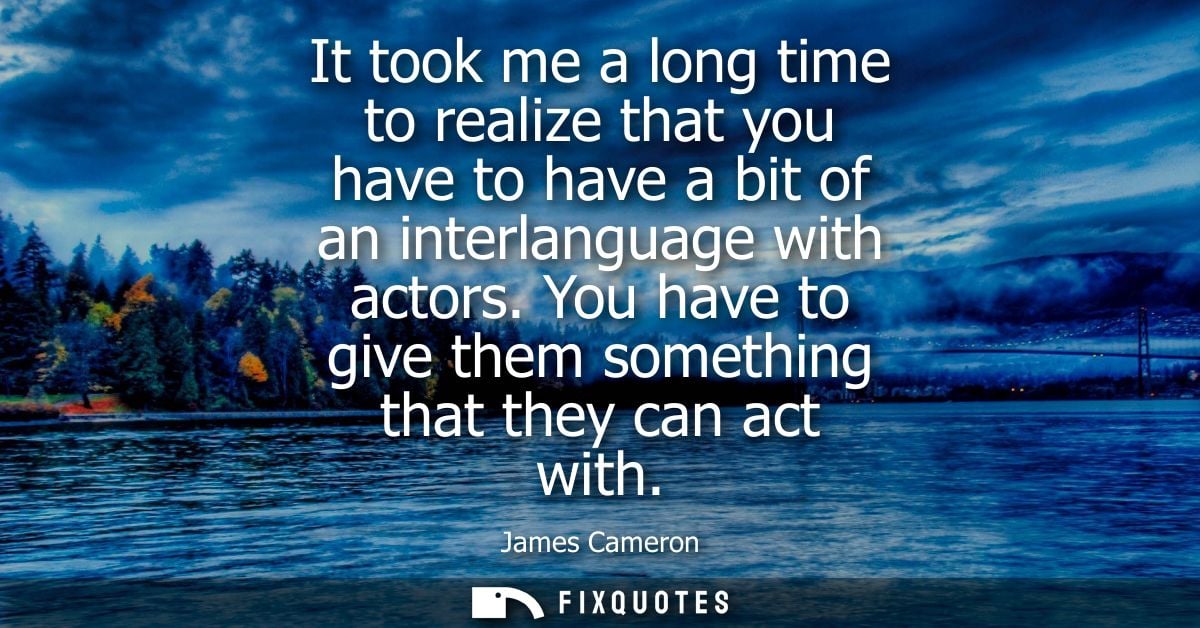
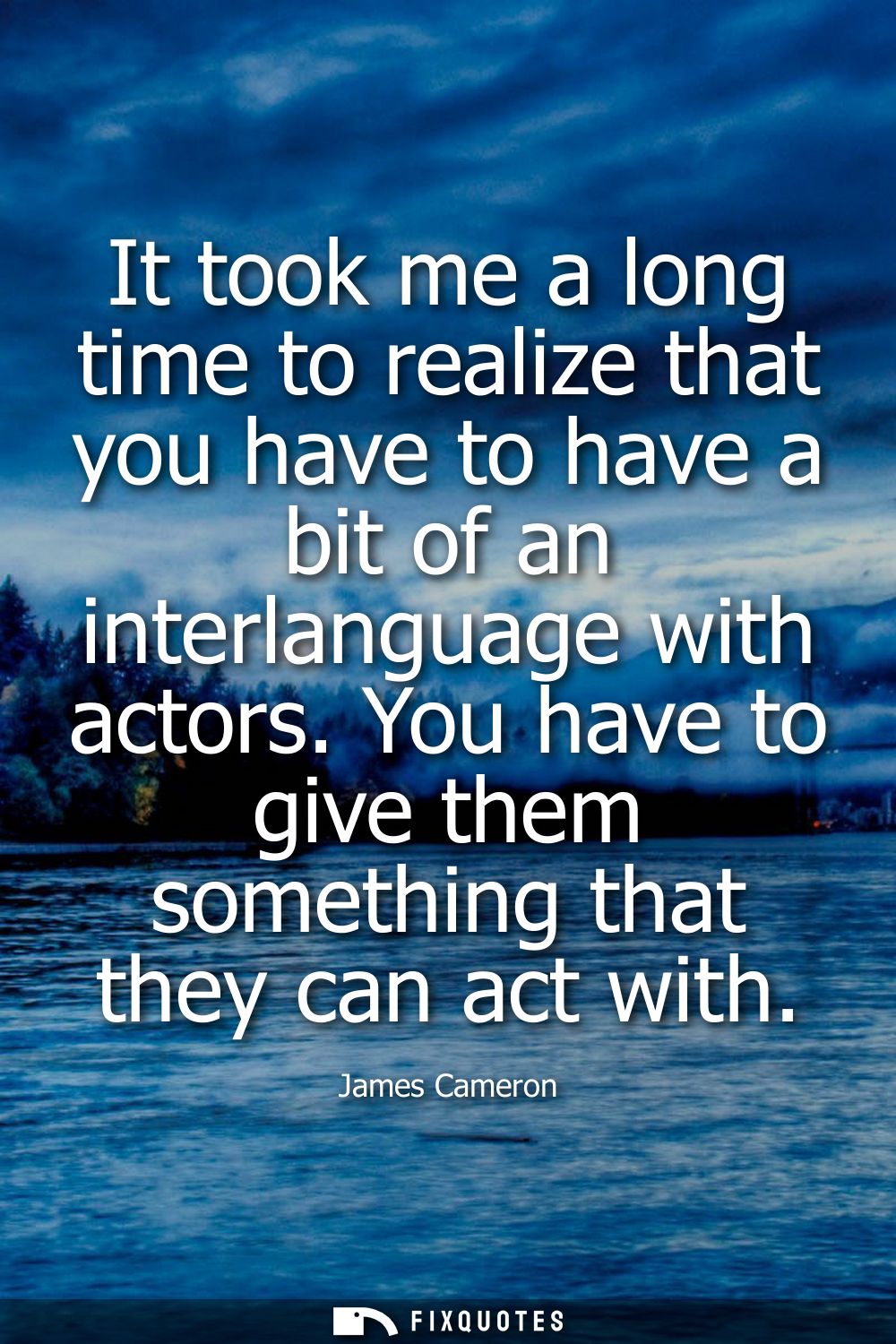
"It took me a long time to realize that you have to have a bit of an interlanguage with actors. You have to give them something that they can act with"
About this Quote
Cameron’s line admits a hard truth about directing that auteur mythology likes to skip: your brilliant mental movie is useless until it becomes playable. “Interlanguage” is a quietly revealing word. He’s not talking about dumbing things down for actors; he’s describing translation work between two operating systems. Directors tend to think in images, rhythms, and engineering-grade logistics. Actors think in impulses, objectives, and contradictions. The “bit” is humility: even a famously exacting technician has to meet performers halfway, building a shared vocabulary that turns intention into behavior.
The subtext is pragmatic, almost industrial. Actors don’t “execute” an idea like a camera rig does; they metabolize it. Cameron’s phrase “something they can act with” signals a shift from giving notes as commands (“Be sadder,” “Faster”) to giving notes as tools: a playable action, a relationship dynamic, a concrete obstacle, a secret the character is protecting. It’s direction as affordance, not instruction.
Context matters: Cameron’s filmography is packed with effects-heavy worlds that could easily swallow human feeling. His best work (Aliens, Titanic, even the clean emotional spines inside Avatar) depends on performances that feel lived-in amid spectacle. The quote reads like a lesson learned in the trenches of big-budget filmmaking: if you want the impossible shot, you also need the possible moment - an actor’s handle on the scene. Without that interlanguage, the movie becomes immaculate and dead.
The subtext is pragmatic, almost industrial. Actors don’t “execute” an idea like a camera rig does; they metabolize it. Cameron’s phrase “something they can act with” signals a shift from giving notes as commands (“Be sadder,” “Faster”) to giving notes as tools: a playable action, a relationship dynamic, a concrete obstacle, a secret the character is protecting. It’s direction as affordance, not instruction.
Context matters: Cameron’s filmography is packed with effects-heavy worlds that could easily swallow human feeling. His best work (Aliens, Titanic, even the clean emotional spines inside Avatar) depends on performances that feel lived-in amid spectacle. The quote reads like a lesson learned in the trenches of big-budget filmmaking: if you want the impossible shot, you also need the possible moment - an actor’s handle on the scene. Without that interlanguage, the movie becomes immaculate and dead.
Quote Details
| Topic | Movie |
|---|
More Quotes by James
Add to List