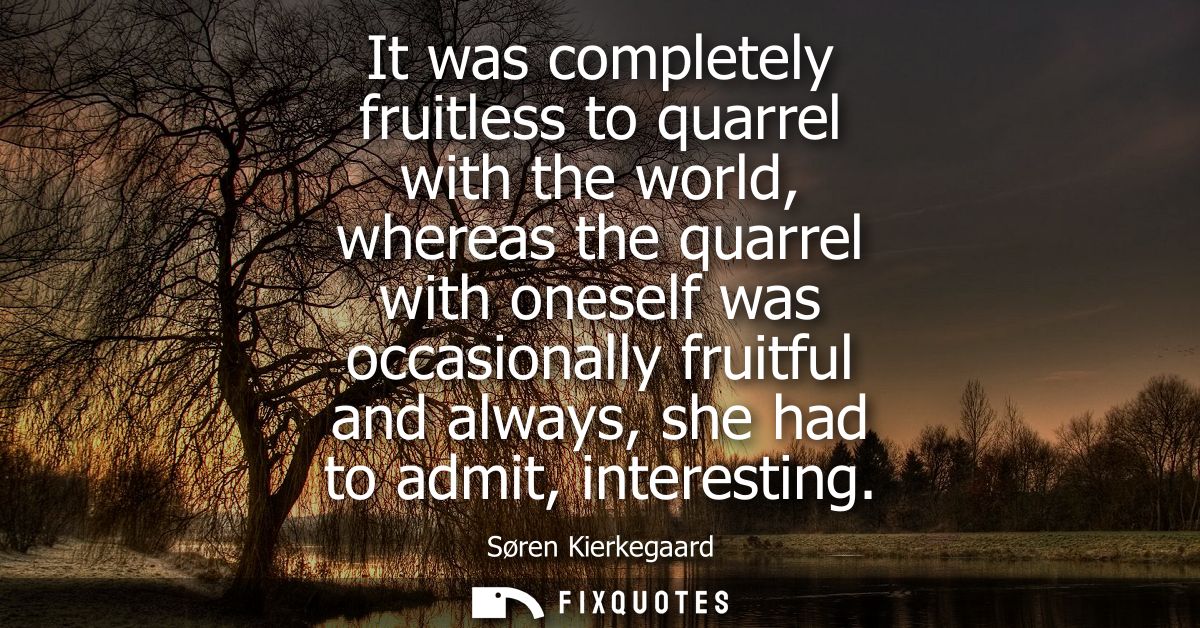
"It was completely fruitless to quarrel with the world, whereas the quarrel with oneself was occasionally fruitful and always, she had to admit, interesting"
About this Quote
The subtext is pure Kierkegaard: the modern person wants to outsource meaning-making to public verdicts, systems, and historical forces, then wonders why they feel hollow. “Quarrel with oneself” sounds like pathology until you hear the promise embedded in the adverbs. “Occasionally fruitful” is a deliberately modest claim; self-scrutiny isn’t a productivity hack, it’s a risky practice that sometimes yields clarity, sometimes yields only discomfort. Yet it is “always...interesting” because the self is not a static object but a live contradiction - desire versus duty, finitude versus infinity, faith versus despair. That friction generates insight in a way the world’s mute resistance cannot.
Even the grammar does work: “she had to admit” suggests reluctant honesty, like someone catching themselves preferring the simpler melodrama of blaming circumstances. Contextually, this sits in Kierkegaard’s broader project of making inwardness an ethical demand, not a cozy retreat. The self-argument is where responsibility begins, where you stop performing grievance and start confronting the choices you keep disguising as fate.
Quote Details
| Topic | Deep |
|---|---|
| Source | Help us find the source |
| Cite |
Citation Formats
APA Style (7th ed.)
Kierkegaard, Søren. (2026, January 14). It was completely fruitless to quarrel with the world, whereas the quarrel with oneself was occasionally fruitful and always, she had to admit, interesting. FixQuotes. https://fixquotes.com/quotes/it-was-completely-fruitless-to-quarrel-with-the-10003/
Chicago Style
Kierkegaard, Søren. "It was completely fruitless to quarrel with the world, whereas the quarrel with oneself was occasionally fruitful and always, she had to admit, interesting." FixQuotes. January 14, 2026. https://fixquotes.com/quotes/it-was-completely-fruitless-to-quarrel-with-the-10003/.
MLA Style (9th ed.)
"It was completely fruitless to quarrel with the world, whereas the quarrel with oneself was occasionally fruitful and always, she had to admit, interesting." FixQuotes, 14 Jan. 2026, https://fixquotes.com/quotes/it-was-completely-fruitless-to-quarrel-with-the-10003/. Accessed 20 Mar. 2026.