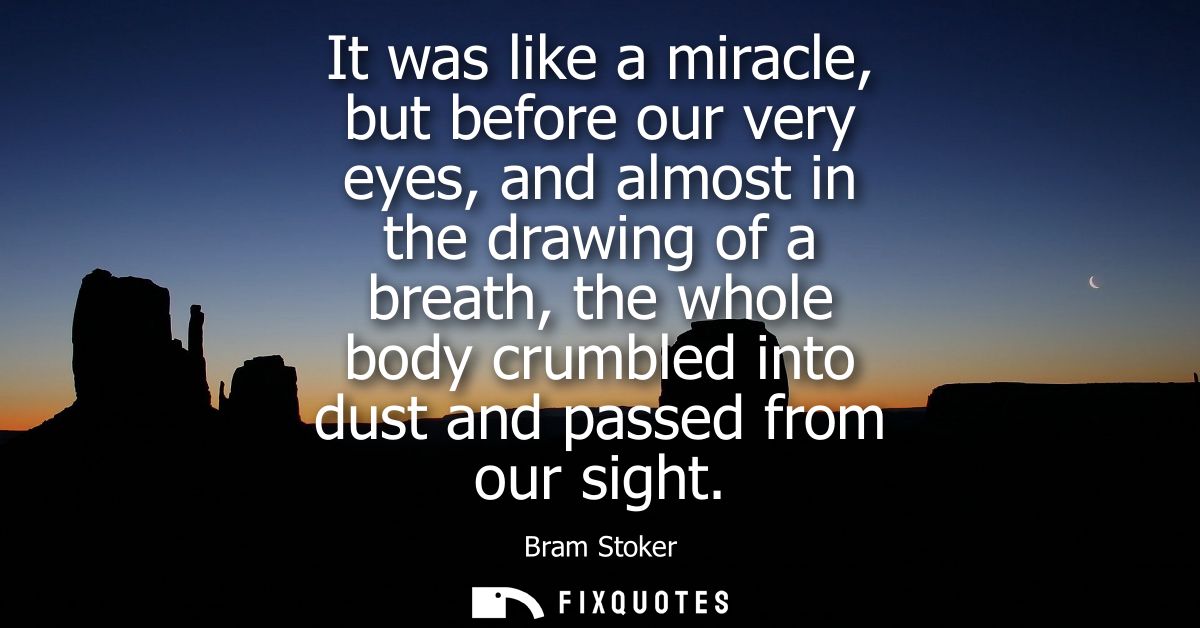
"It was like a miracle, but before our very eyes, and almost in the drawing of a breath, the whole body crumbled into dust and passed from our sight"
About this Quote
The speed of it, "almost in the drawing of a breath", is the real horror. Stoker compresses the event into the smallest unit of human time, a bodily reflex, which makes the supernatural feel less like a distant myth and more like an ambush inside ordinary life. Victorian fiction often luxuriates in deathbed scenes and moral reckonings; this is the opposite. No dignity, no narrative preparation, just a body unmade.
"Whole body crumbled into dust" also lands as a cultural anxiety: the era's fascination with science, decomposition, and the material facts of mortality collides with spiritual panic. Dust isn't just an image of decay; it's biblical finality ("dust to dust") stripped of consolation. The subtext is that modern people, armed with observation and reason, can still be rendered powerless in an instant. Stoker wants the reader to feel the thinness of the boundary between the solid, knowable world and a nightmarish physics where the self can be erased mid-breath.
Quote Details
| Topic | Mortality |
|---|---|
| Source | Help us find the source |
| Cite |
Citation Formats
APA Style (7th ed.)
Stoker, Bram. (2026, January 15). It was like a miracle, but before our very eyes, and almost in the drawing of a breath, the whole body crumbled into dust and passed from our sight. FixQuotes. https://fixquotes.com/quotes/it-was-like-a-miracle-but-before-our-very-eyes-140731/
Chicago Style
Stoker, Bram. "It was like a miracle, but before our very eyes, and almost in the drawing of a breath, the whole body crumbled into dust and passed from our sight." FixQuotes. January 15, 2026. https://fixquotes.com/quotes/it-was-like-a-miracle-but-before-our-very-eyes-140731/.
MLA Style (9th ed.)
"It was like a miracle, but before our very eyes, and almost in the drawing of a breath, the whole body crumbled into dust and passed from our sight." FixQuotes, 15 Jan. 2026, https://fixquotes.com/quotes/it-was-like-a-miracle-but-before-our-very-eyes-140731/. Accessed 8 Mar. 2026.