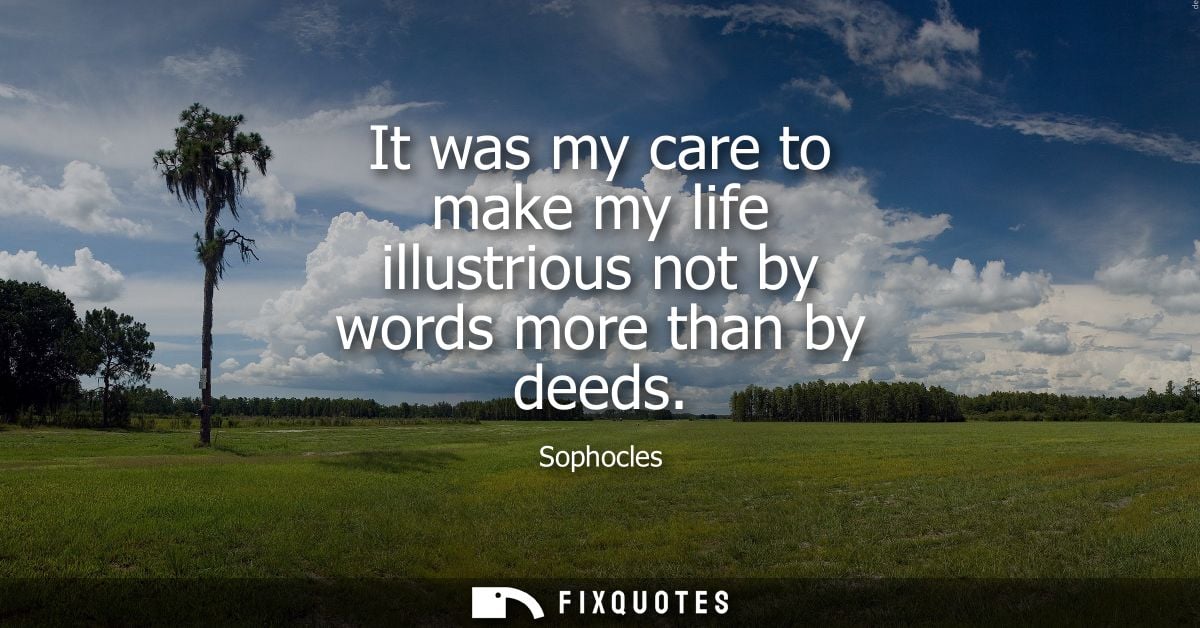
"It was my care to make my life illustrious, not by words more than by deeds"
About this Quote
The subtext is quietly competitive. In Sophocles’ Athens, rhetoric was currency and celebrity; politicians and litigants could talk themselves into power. By insisting on deeds “more than” words, he’s not rejecting language (a playwright can’t), he’s placing it on probation. It’s a self-aware paradox: the master of tragic speech uses a sentence to warn against trusting sentences. That tension is the point. Tragedy itself is built on eloquence failing to control consequences; characters argue brilliantly and still walk into fate. Sophocles is signaling that he’s learned the lesson his plays teach: moral weight isn’t delivered in monologues; it shows up in choices, costs, and the collateral damage we accept.
Context sharpens it further. Sophocles wasn’t only a dramatist; he moved inside civic life, where honor depended on visible service. The line reads like a personal ethic tailored to a city that rewarded performative persuasion, and a dramatist’s bid to be judged by the harder proof: how a life lands, not how it sounds.
Quote Details
| Topic | Legacy & Remembrance |
|---|---|
| Source | Later attribution: Between the Stops (Sandi Toksvig, 2019) modern compilationISBN: 9780349006390 · ID: cSw9CgAAQBAJ
Evidence:
... Sophocles Bakery and stop to get a Greek sweet treat . It was Sophocles who said , ' It was my care to make my life illustrious not by words more than by deeds . ' He could not have imagined that ' Deeds not words ' would become the ... |
| Cite |
Citation Formats
APA Style (7th ed.)
Sophocles. (2026, March 7). It was my care to make my life illustrious, not by words more than by deeds. FixQuotes. https://fixquotes.com/quotes/it-was-my-care-to-make-my-life-illustrious-not-by-34382/
Chicago Style
Sophocles. "It was my care to make my life illustrious, not by words more than by deeds." FixQuotes. March 7, 2026. https://fixquotes.com/quotes/it-was-my-care-to-make-my-life-illustrious-not-by-34382/.
MLA Style (9th ed.)
"It was my care to make my life illustrious, not by words more than by deeds." FixQuotes, 7 Mar. 2026, https://fixquotes.com/quotes/it-was-my-care-to-make-my-life-illustrious-not-by-34382/. Accessed 20 Mar. 2026.