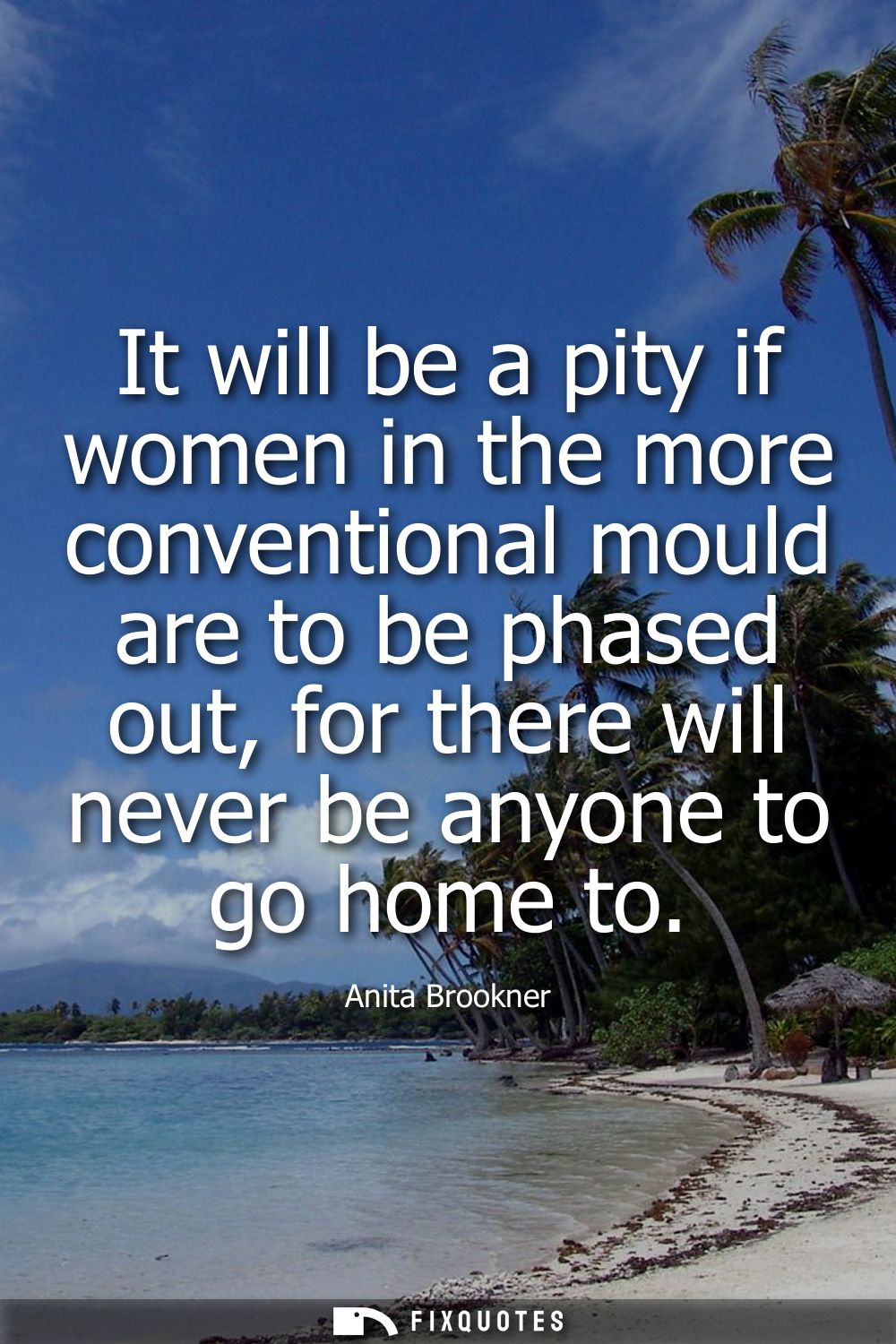
"It will be a pity if women in the more conventional mould are to be phased out, for there will never be anyone to go home to"
About this Quote
The “more conventional mould” isn’t really about hemlines or manners; it’s shorthand for a whole gendered job description: emotional steadiness, domestic continuity, the patient maintenance of a private refuge. “Phased out” borrows the language of corporate restructuring, as if cultural change were a rational modernization plan that accidentally makes a whole kind of person redundant. That’s where Brookner’s historian’s eye shows: she’s reading social shifts not as liberation narratives but as demographic and economic reassignments, with unforeseen casualties.
The most revealing clause is the last: “there will never be anyone to go home to.” It frames “home” as something delivered by women, and it exposes the dependency hidden inside certain versions of male autonomy. If women stop specializing in being the destination, the traveler discovers he has nowhere to arrive. Brookner isn’t simply nostalgic; she’s acidly attentive to the bargain modernity breaks. The subtext is less “women should stay put” than “society wants progress without paying for what progress displaces.” The line’s power is its quiet indictment: we celebrate independence while still craving the old comforts - and then act shocked when comfort stops showing up.
Quote Details
| Topic | Husband & Wife |
|---|---|
| Source | Help us find the source |
| Cite |
Citation Formats
APA Style (7th ed.)
Brookner, Anita. (2026, January 17). It will be a pity if women in the more conventional mould are to be phased out, for there will never be anyone to go home to. FixQuotes. https://fixquotes.com/quotes/it-will-be-a-pity-if-women-in-the-more-42416/
Chicago Style
Brookner, Anita. "It will be a pity if women in the more conventional mould are to be phased out, for there will never be anyone to go home to." FixQuotes. January 17, 2026. https://fixquotes.com/quotes/it-will-be-a-pity-if-women-in-the-more-42416/.
MLA Style (9th ed.)
"It will be a pity if women in the more conventional mould are to be phased out, for there will never be anyone to go home to." FixQuotes, 17 Jan. 2026, https://fixquotes.com/quotes/it-will-be-a-pity-if-women-in-the-more-42416/. Accessed 9 Mar. 2026.