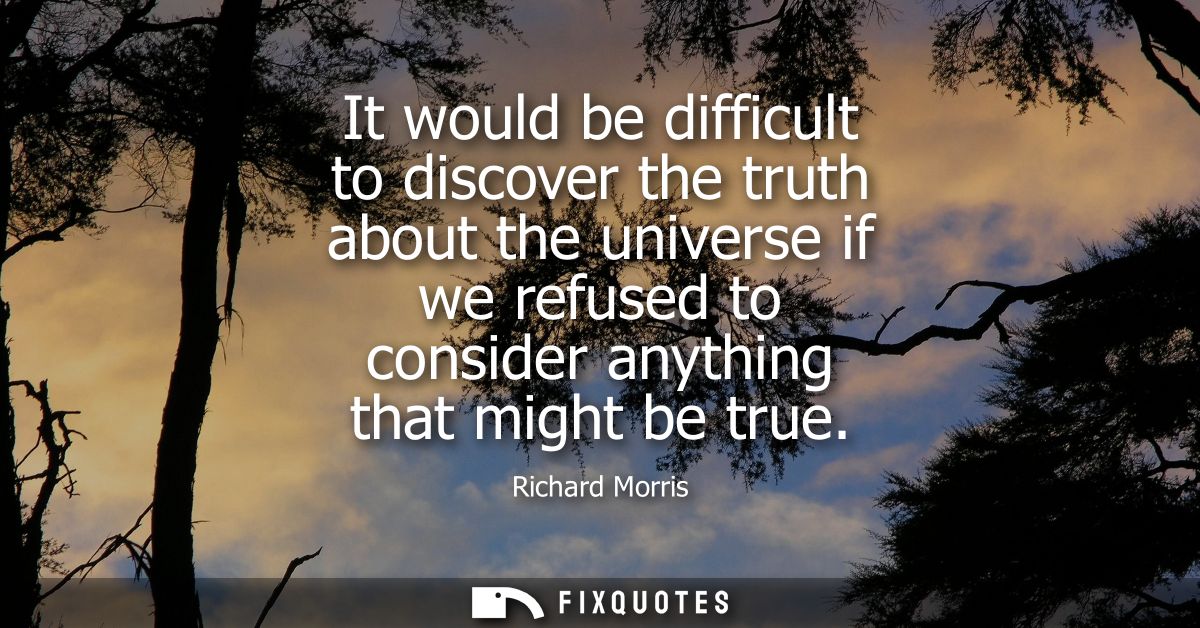
"It would be difficult to discover the truth about the universe if we refused to consider anything that might be true"
About this Quote
As a religious thinker writing in an era rattled by geology, higher biblical criticism, and Darwin’s aftershocks, Morris is doing rhetorical judo. He grants the authority of “truth about the universe” to investigation rather than decree, then smuggles in a theological tolerance for uncertainty. The phrase “refused to consider” is the pressure point: he’s targeting the willful closing of the mind, not the normal process of doubt. Consideration is framed as low-cost and morally responsible, a prerequisite for truth rather than a threat to it.
The subtext is both defensive and aspirational. Defensive, because clergy in that period were often caricatured as gatekeepers of dogma; Morris positions the clerical voice as compatible with open-ended reasoning. Aspirational, because he implies that reality is larger than our current categories - scientific, religious, or ideological - and that any method that preemptively bans possibilities is self-sabotaging.
It works because it shifts the debate from which answers are acceptable to which habits of mind are honest. The universe, Morris suggests, doesn’t reward purity tests; it rewards intellectual hospitality.
Quote Details
| Topic | Truth |
|---|---|
| Source | Help us find the source |
| Cite |
Citation Formats
APA Style (7th ed.)
Morris, Richard. (2026, January 18). It would be difficult to discover the truth about the universe if we refused to consider anything that might be true. FixQuotes. https://fixquotes.com/quotes/it-would-be-difficult-to-discover-the-truth-about-23951/
Chicago Style
Morris, Richard. "It would be difficult to discover the truth about the universe if we refused to consider anything that might be true." FixQuotes. January 18, 2026. https://fixquotes.com/quotes/it-would-be-difficult-to-discover-the-truth-about-23951/.
MLA Style (9th ed.)
"It would be difficult to discover the truth about the universe if we refused to consider anything that might be true." FixQuotes, 18 Jan. 2026, https://fixquotes.com/quotes/it-would-be-difficult-to-discover-the-truth-about-23951/. Accessed 12 Feb. 2026.