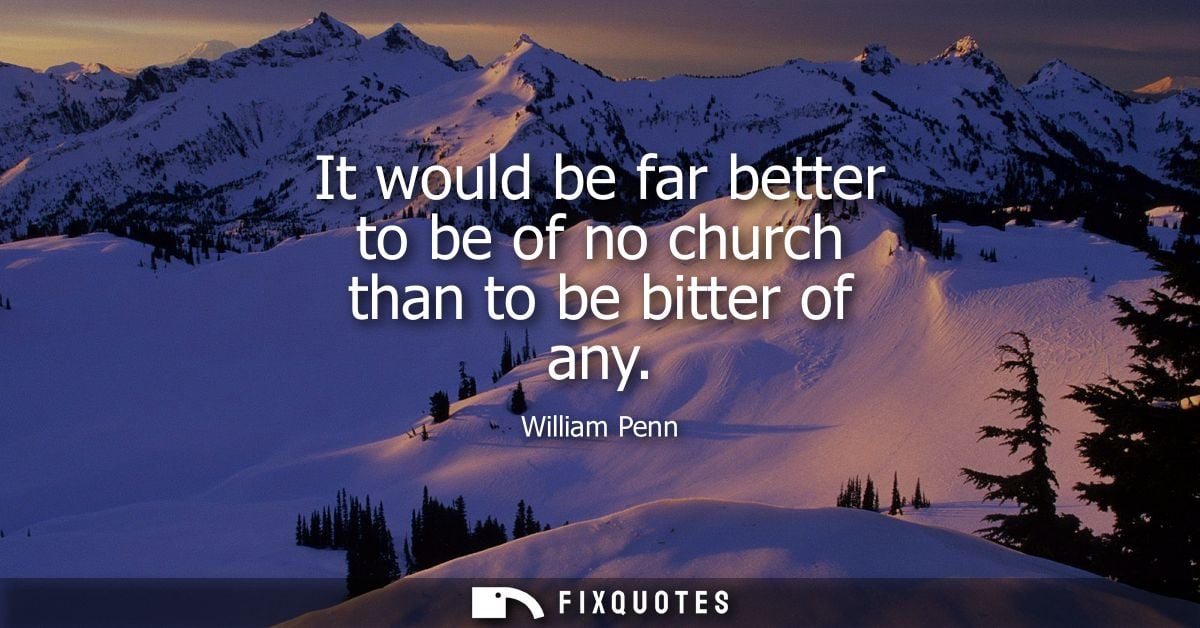
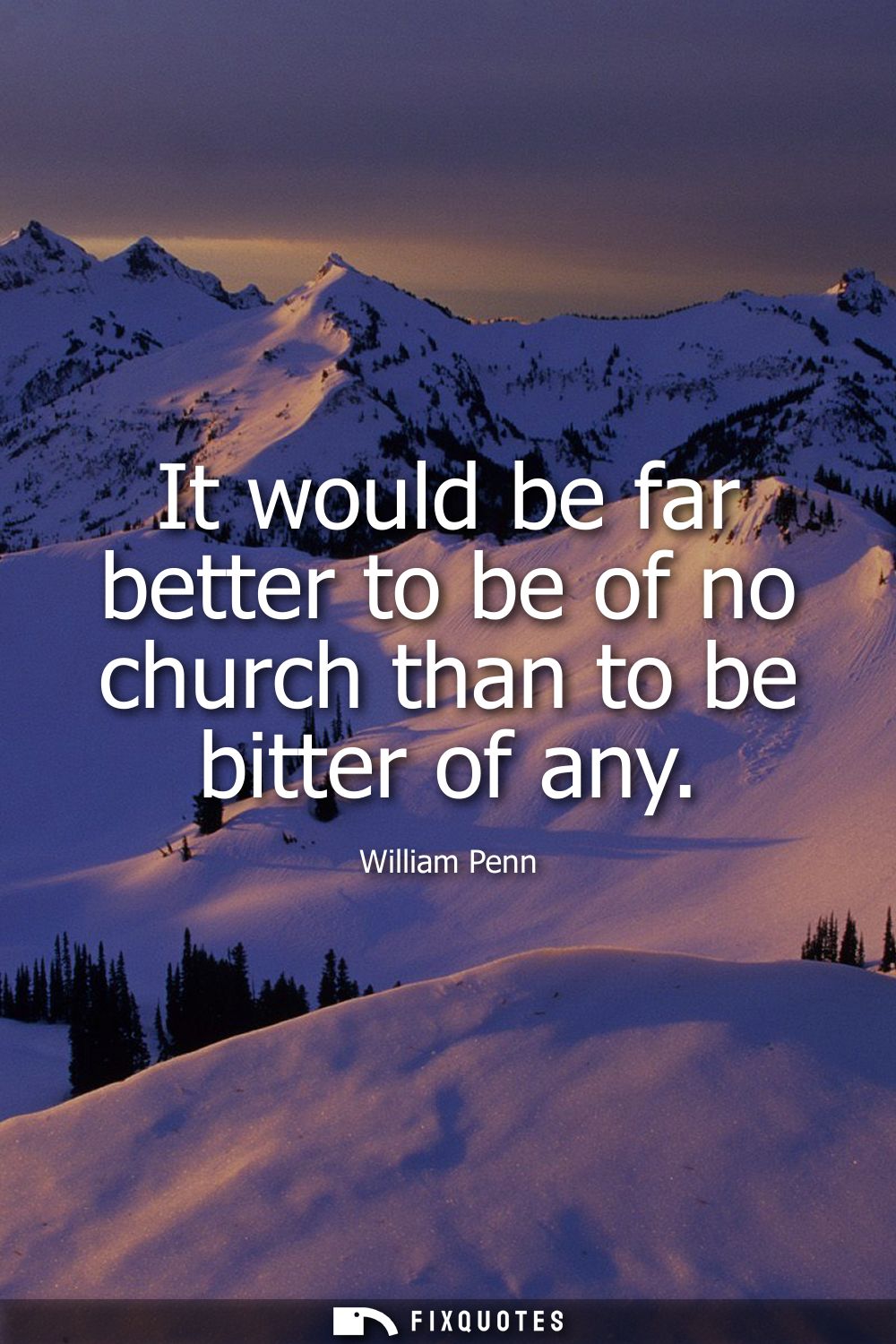
"It would be far better to be of no church than to be bitter of any"
About this Quote
Penn is not issuing a soft plea for niceness; he is drawing a political and spiritual boundary line. In an age when church affiliation could decide your civil rights, your credibility, even your safety, “bitter” wasn’t a mood. It was a social toxin with bodies attached to it: persecution, oaths, fines, prisons, the righteous pleasure of watching the wrong sort of believer suffer. Penn, a Quaker and a repeat target of state power, knew how quickly theology turns into paperwork and punishment.
The line works because it flips the era’s hierarchy. Seventeenth-century Europe treated belonging as a moral prerequisite: pick a church, then pick your enemies. Penn elevates temperament over membership. “No church” reads like heresy to the gatekeepers, but it’s a calculated provocation: better to stand outside the institution than to let the institution license cruelty inside you. The subtext is Quaker to the core: the proof of faith is not correct doctrine but the lived refusal to dehumanize.
There’s also a pragmatic colonial intelligence here. Penn’s Pennsylvania project depended on pluralism not as an abstract virtue but as a civic technology. A society of rival sects can function if it prizes restraint over triumph. By condemning bitterness, he’s warning that sectarian identity, unmoored from humility, becomes a machine for domination. He’s offering a radical standard: the moral failure isn’t unbelief; it’s the sanctified appetite to harm.
The line works because it flips the era’s hierarchy. Seventeenth-century Europe treated belonging as a moral prerequisite: pick a church, then pick your enemies. Penn elevates temperament over membership. “No church” reads like heresy to the gatekeepers, but it’s a calculated provocation: better to stand outside the institution than to let the institution license cruelty inside you. The subtext is Quaker to the core: the proof of faith is not correct doctrine but the lived refusal to dehumanize.
There’s also a pragmatic colonial intelligence here. Penn’s Pennsylvania project depended on pluralism not as an abstract virtue but as a civic technology. A society of rival sects can function if it prizes restraint over triumph. By condemning bitterness, he’s warning that sectarian identity, unmoored from humility, becomes a machine for domination. He’s offering a radical standard: the moral failure isn’t unbelief; it’s the sanctified appetite to harm.
Quote Details
| Topic | Faith |
|---|---|
| Source | Help us find the source |
| Cite |
Citation Formats
APA Style (7th ed.)
Penn, William. (2026, January 15). It would be far better to be of no church than to be bitter of any. FixQuotes. https://fixquotes.com/quotes/it-would-be-far-better-to-be-of-no-church-than-to-156284/
Chicago Style
Penn, William. "It would be far better to be of no church than to be bitter of any." FixQuotes. January 15, 2026. https://fixquotes.com/quotes/it-would-be-far-better-to-be-of-no-church-than-to-156284/.
MLA Style (9th ed.)
"It would be far better to be of no church than to be bitter of any." FixQuotes, 15 Jan. 2026, https://fixquotes.com/quotes/it-would-be-far-better-to-be-of-no-church-than-to-156284/. Accessed 7 Apr. 2026.
More Quotes by William
Add to List