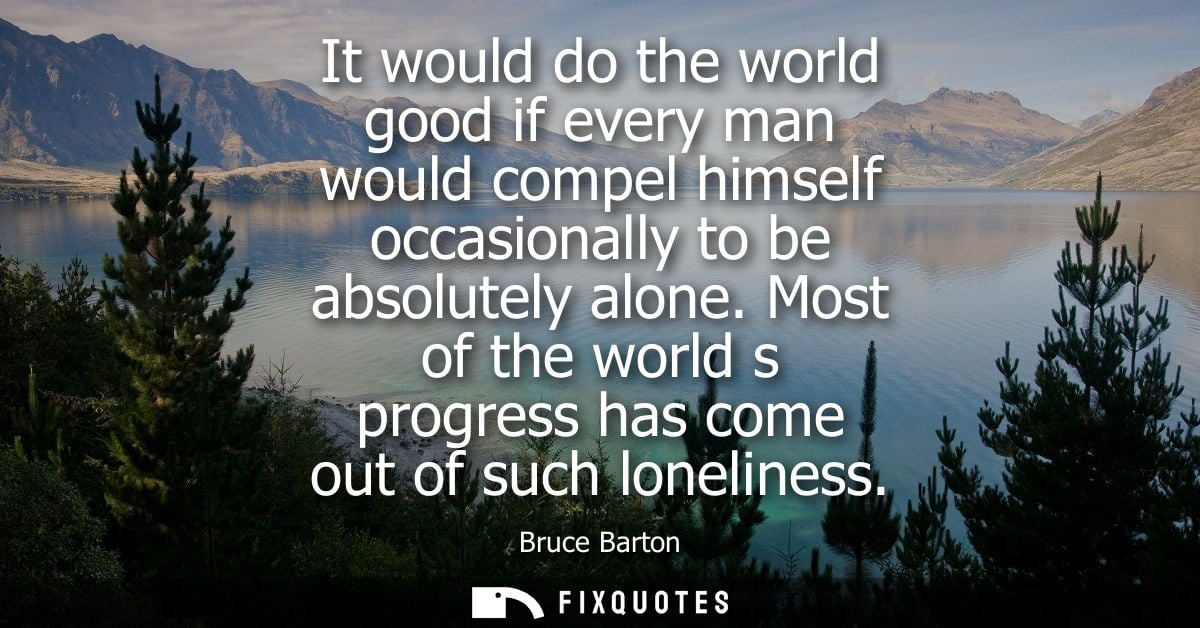
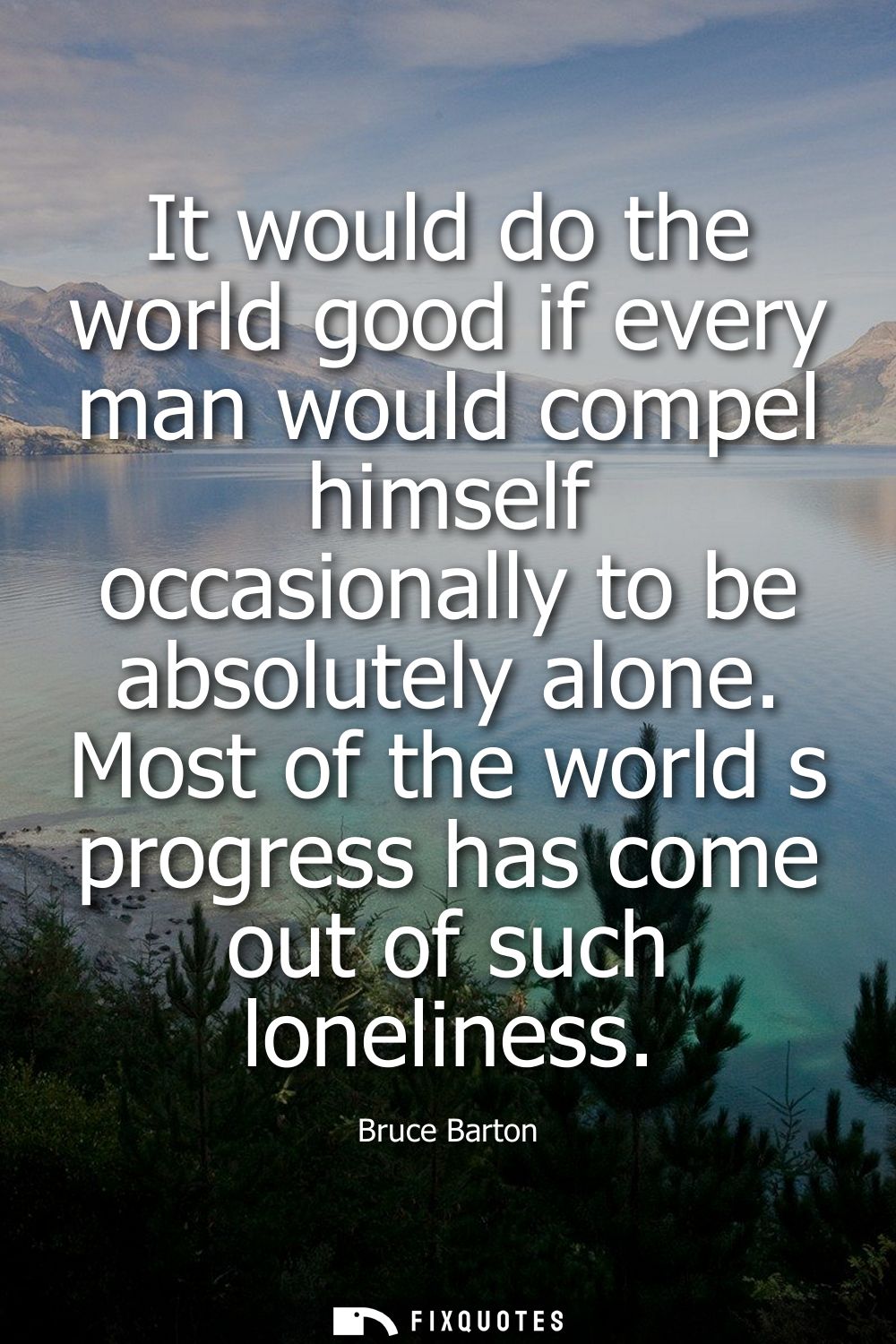
"It would do the world good if every man would compel himself occasionally to be absolutely alone. Most of the world s progress has come out of such loneliness"
About this Quote
Barton pitches solitude not as a retreat from the world but as a civic duty to it. The line opens with a moral nudge - "compel himself" - suggesting alone time isn’t a luxury for the pampered or the artistic; it’s discipline, almost hygiene. In an era when modern life was getting louder (mass advertising, mass politics, mass everything), he recasts loneliness as a counter-technology: the one tool that can’t be outsourced, purchased, or performed for an audience.
The subtext is quietly gendered and managerial. "Every man" reads like the default citizen of Barton's world: the striver, the decision-maker, the one whose inner clarity allegedly translates into outer progress. Solitude becomes a kind of executive workshop where ideas are purified of social noise. That’s also why the claim about progress lands: he’s not praising suffering or alienation; he’s praising incubation. Loneliness here is the furnace that turns private doubt into public invention.
Context matters: Barton made his name writing in a culture enthralled by productivity and self-making, and he helped shape the language of modern persuasion. There’s an irony in an advertising pioneer extolling silence, but it’s a useful one. He recognizes that constant social immersion can flatten thought into consensus. The quote works because it flatters ambition while prescribing restraint: step away, not to disappear, but to return with something only you could have made.
The subtext is quietly gendered and managerial. "Every man" reads like the default citizen of Barton's world: the striver, the decision-maker, the one whose inner clarity allegedly translates into outer progress. Solitude becomes a kind of executive workshop where ideas are purified of social noise. That’s also why the claim about progress lands: he’s not praising suffering or alienation; he’s praising incubation. Loneliness here is the furnace that turns private doubt into public invention.
Context matters: Barton made his name writing in a culture enthralled by productivity and self-making, and he helped shape the language of modern persuasion. There’s an irony in an advertising pioneer extolling silence, but it’s a useful one. He recognizes that constant social immersion can flatten thought into consensus. The quote works because it flatters ambition while prescribing restraint: step away, not to disappear, but to return with something only you could have made.
Quote Details
| Topic | Loneliness |
|---|
More Quotes by Bruce
Add to List