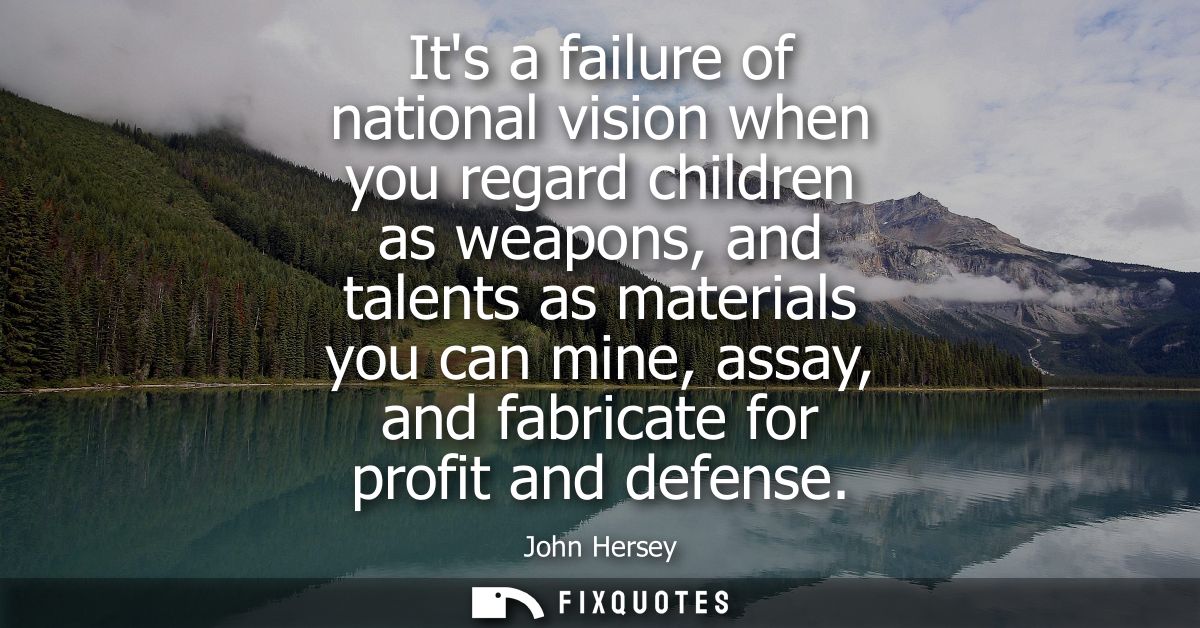
"It's a failure of national vision when you regard children as weapons, and talents as materials you can mine, assay, and fabricate for profit and defense"
About this Quote
The phrasing is deliberately industrial. Children become “weapons,” talents become “materials,” and the state (or its adjacent institutions) becomes a kind of refinery: you “mine, assay, and fabricate.” Each verb evokes extraction and quality control, turning education, childhood, and vocation into a supply chain. That’s the subtext: the moment you talk about people in the language of production, you’ve already made the ethical decision. The sentence implicates not only militarism but also the softer, more socially acceptable cousin of militarism: a market logic that treats giftedness as raw ore to be converted into returns.
Context matters. Hersey wrote with the long shadow of World War II and the atomic age, when national security and scientific talent were fused into a single civic religion. He reported on catastrophe (“Hiroshima”) with an almost clinical restraint that made the horror harder to evade. Here, that same restraint sharpens into warning: when defense and profit become the default justification for shaping young lives, a nation doesn’t just miseducate its children. It misrecognizes them.
Quote Details
| Topic | Human Rights |
|---|---|
| Source | Help us find the source |
| Cite |
Citation Formats
APA Style (7th ed.)
Hersey, John. (2026, January 17). It's a failure of national vision when you regard children as weapons, and talents as materials you can mine, assay, and fabricate for profit and defense. FixQuotes. https://fixquotes.com/quotes/its-a-failure-of-national-vision-when-you-regard-80326/
Chicago Style
Hersey, John. "It's a failure of national vision when you regard children as weapons, and talents as materials you can mine, assay, and fabricate for profit and defense." FixQuotes. January 17, 2026. https://fixquotes.com/quotes/its-a-failure-of-national-vision-when-you-regard-80326/.
MLA Style (9th ed.)
"It's a failure of national vision when you regard children as weapons, and talents as materials you can mine, assay, and fabricate for profit and defense." FixQuotes, 17 Jan. 2026, https://fixquotes.com/quotes/its-a-failure-of-national-vision-when-you-regard-80326/. Accessed 10 Mar. 2026.